
Speaking to an audience can be fun and exciting. However, a lack of preparation or not clearly defining the purpose of a presentation and its audience can turn a best-intentioned presentation into a total disaster.
To ensure your presentation is effective, first determine your goal. Ask yourself:
- Why am I giving a presentation?
- What do I want the audience to take away from the presentation?
Second, define your audience. Their familiarity with the presentation topic will determine the presentation level of your speech.
Once you've defined your overall presentation goals and objectives, as well as your audience, it's time to craft your presentation. You should start this process by determining the length of the presentation.
Take the allotted time and break it down into smaller segments, with each segment tackling a specific task (all of which reflect the overall purpose of the presentation). For example, the first segment should be an introduction to the presentation. In this segment, you should provide an overview of your presentation, or a short summary of your speech, explaining the topic, why you are addressing this topic, and what you hope to achieve.
The next segment should handle the first item on your agenda, with the next segment handling the next item on your agenda, and so on. After you've developed your introduction and outlined the following segments, take some time to think about the conclusion of your presentation. The presentation introduction and presentation closing are the most important parts and should have the strongest impact.
Keep your presentation short and simple. Your audience won't remember every point of your presentation, so highlight the most important parts. The longer the presentation, the higher the risk of boredom. When in doubt, use the "tell them" structure:
- Tell them what you are going to tell them (For example, "In this presentation I will show you.").
- Tell them the key points, developing and illustrating each one, clearly and concisely.
- Tell them what you have told them (For example, "In closing." or "In summary.") and conclude.
Next, consider using visual aids. Slide projectors, data projectors, video engines, and computers should be tested to make sure they are operating properly and that you know how to use them.
Make sure you don't cram too much information into just one visual. A good rule of thumb to follow is to keep each visual to six lines or less. Also, make sure any type or graphics are large enough for the audience to see them clearly (from all seats) and make sure the colors used are easy on the eyes, taking into account the lighting.
The sad fact is that a large part of your authority will be judged by the quality of your slides – you need to make sure that the design matches the style of your message. Overhead must be clearly marked and prearranged. Flip charts should be prepared in advance if possible. When used during presentations for taking notes, make prints large enough for all attendees to see. When using these visuals, don't turn your back to the audience. Position yourself so you can use the visuals while facing your audience.
If possible, visit the room where you will be presenting well in advance. Decide on seating (circular seating encourages interaction, rows of seats discourage interaction, etc.) and determine how your chosen visual aid will work. Consider lighting, space, even room temperature. Consider placing a notebook and pencil in each chair if participants need to take notes. Or, you may want to have a glass at each seat with a few pitchers of water if the presentation will last more than half an hour. If you do this, make sure you allow time for bathroom breaks.
The material above was delivered by a presenter from Mexico in an international webinar held by STEKOM University in collaboration with the University of Mexico. The title of the presentation is "The Importance of public speaking in intercultural contexts". The name of the presenter is Estela Salome Solis Gutierres, PhD. He works at the Faculty of Human Science, Universidad Autonoma de Baja California.
This international webinar activity is part of the implementation of STEKOM University's commitment to increase various international activities. This was done in order to realize the vision to become an international-class university. Various international activities carried out by STEKOM University continue from year to year. There are international activities that are sustainable and there are also some international activities that are not sustainable. All types of international activities are accommodated and regulated by the International department of STEKOM University.
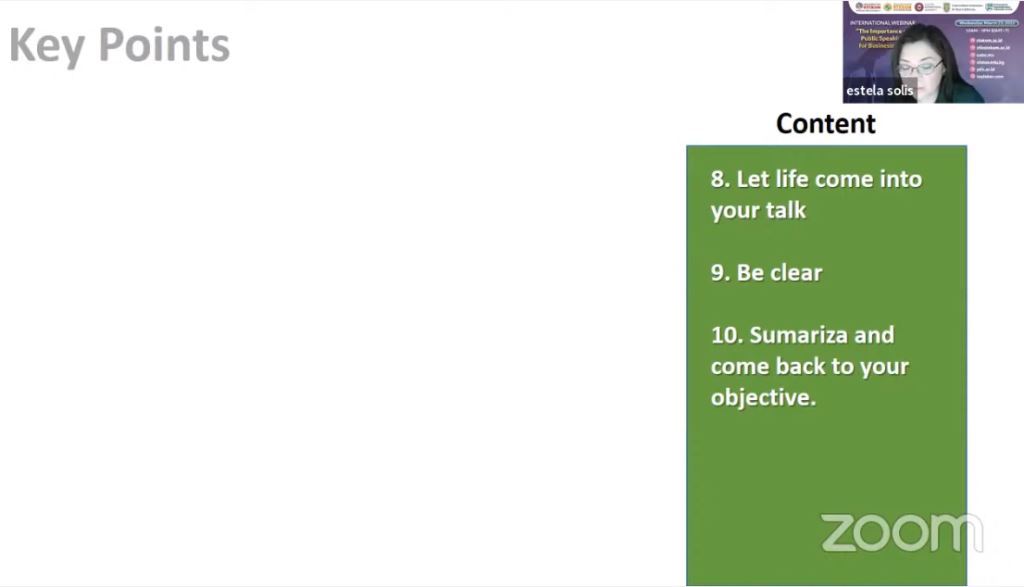
2023 - International Webinar - The important of public speaking for businessman - Part 8
International Webinar
Back to News
International Webinar
Sunday, March 5, 2023
Priyadi, S.Kom, M.Kom
0 Views