
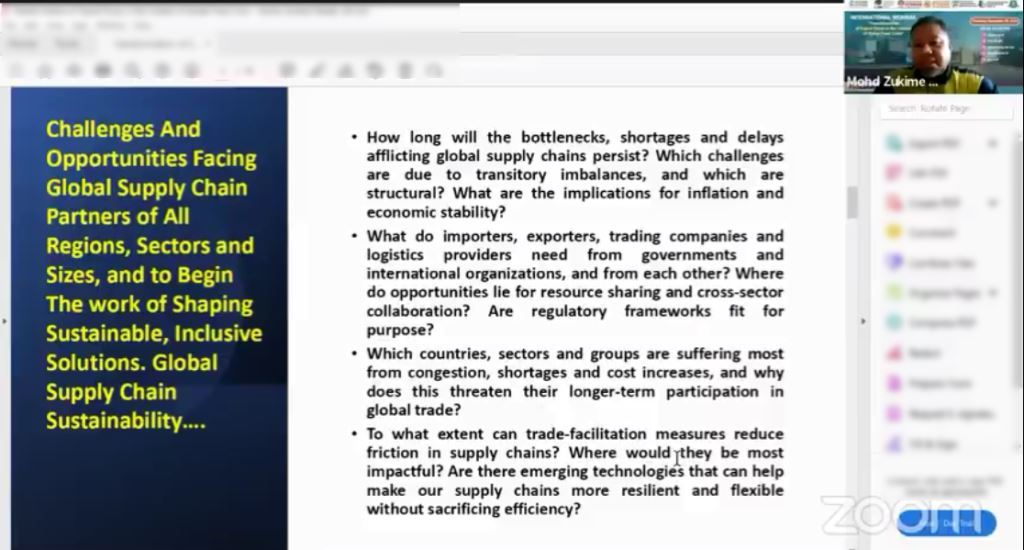
Global Supply Chain Challenges and Export Transformation continue to occur in today's global economy. The COVID-19 pandemic, worsening climate impacts and echoes of economic shocks have demonstrated how deeply connected countries are, and how global crises hit the world's most vulnerable communities the hardest. Globally, more than 828 million people go to bed hungry every night and the number of people facing acute food insecurity — meaning they get so little food they face severe health complications — has nearly tripled since 2019, jumping from 135 million people to 345 million people by 2022. In the face of the global crisis, global solutions are needed more than ever, we can change the agri-food system and build a better future by implementing sustainable and holistic solutions that consider long-term development, inclusive economic growth, and greater resistance. The transformation of world trade will present new challenges and opportunities. To seize new opportunities, the poorest and most commodity-dependent countries need to make ongoing efforts to improve their business climate. Developed countries must also maintain their lead in innovation and product differentiation. While domestic reforms are key, international regulations must be strengthened to make trade more open and predictable. Countries that fail to adapt to the transformations of world trade will not only miss opportunities but will also find firms in tradable sectors under attack by both low-cost, cost-based competitors and fast innovators.
New priorities for global companies are currently undergoing a number of changes. They are now more inclined to follow shifts in value creation in the industry. They also put more weight on the service offering. They also assess the full costs and risks of the location decision. They also build flexibility and resilience in operations. They also prioritize speed to market and proximity to customers. They are also building closer and more digital supplier relationships.
The challenges for the country are the following: Building a strong service sector; Set up automation—particularly in labor-intensive value chains; Deepening regional trade relations; Invest in R&D and skills; Modernizing customs operations and trade agreements; Look for new opportunities as the value chain grows. If a country manages to handle these challenges well, it is not impossible that the country will be free from the threat of a global supply crisis in the future.
The presenter who delivered the material was DR Mohd Zukime Mat Junoh from University Malaysia Perlis, Malaysia. This material was presented at an international webinar organized by the University of Science & Computer Technology (STEKOM University) in collaboration with the Karachi Institute of Economics & Technology (Pakistan), Universiti Malaysia Perlis (Malaysia), STIE STEKOM, Association of Industrial and Vocational Communities (PERKIVI), Indonesian Smart Teacherpreneur Association (PTIC) and TopLoker.com. The webinar will be held on December 8, 2022 online using zoom media. All scheduled international presenters managed to attend and fill in the material well.
The webinar activity is part of the implementation of STEKOM University's commitment to increase various international activities in order to realize the vision to become an international-class university. Various international activities carried out by STEKOM University continue from year to year. There are international activities that are sustainable and there are also some international activities that are not sustainable. All types of international activities are accommodated and regulated by the International department of STEKOM University.
International Webinar 2022 - Transformation of Export Flows in the Context of Global Food Crisis - Part 2
International Webinar
Back to News
International Webinar
Wednesday, December 14, 2022
Priyadi, S.Kom, M.Kom
0 Views