
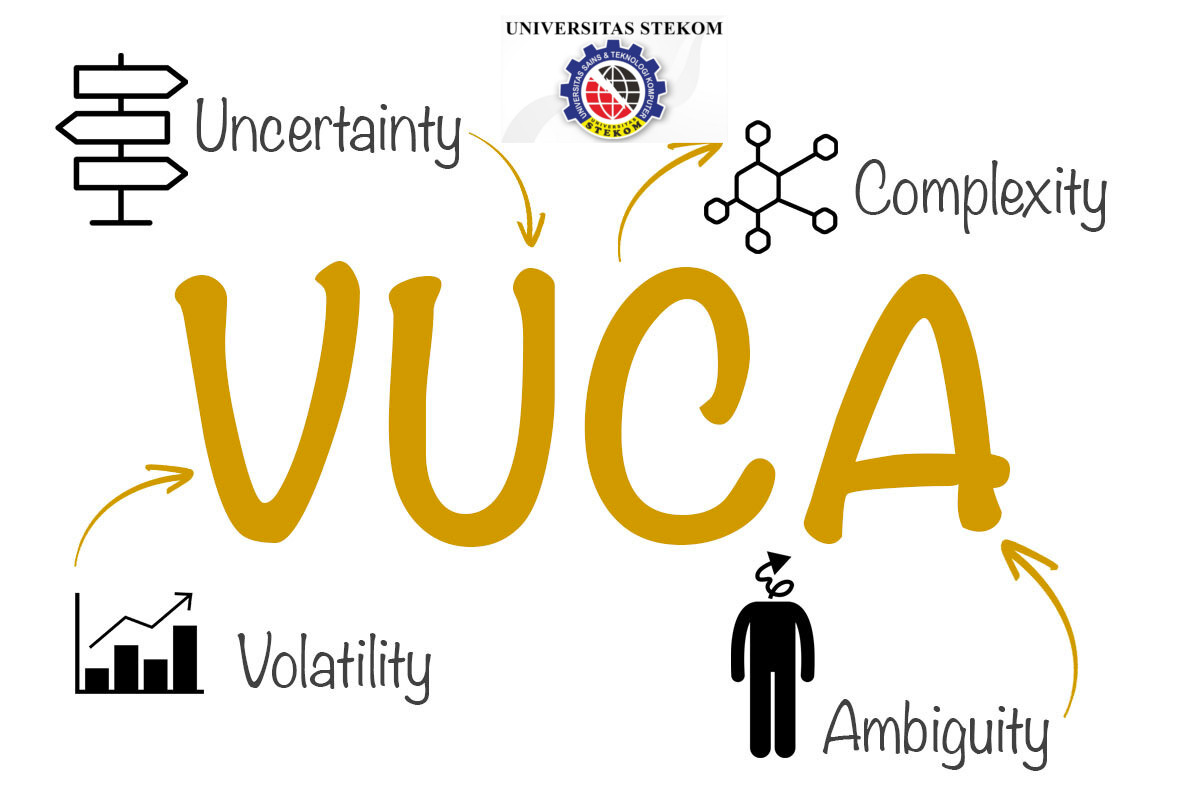
Getting to know VUCA: Volatility, Uncertainty, Complexity, Ambiguity
– VUCA is not a new situation for the business world.
Organizational leaders are faced with a changing and unpredictable
environment. After the crisis in COVID19, this makes VUCA even more
intense and very influential in the business world.
Business
leaders are not only facing an era of digital collapse that is
shaking up market structures and weakening old industries, but also
facing an epidemic that has killed more than 3 million people and
plunged the country into recession. Today, the future of business is
becoming increasingly uncertain.
The following are
important points to understand about the VUCA era.
1.
Volatility
Volatility is characterized by the emergence of
new challenges whose causes are difficult to determine. There is no
consistent pattern for this new challenge. They change very fast. One
threat two years ago can now be replaced by another. At this event do
not know what should be the cause of the problem. What was meant to
be a solution initiative turned out to be quite the opposite.
The
process of forming an unstable environment is inseparable from the
impact of technology, the emergence of a new economic order, changes
in values and lifestyles, as well as the flow of information,
the availability of exchange of goods and services and price trends
combined with the flow of services and dissemination of information.
The emergence of an economic model that shares transportation and
accommodation has disrupted the establishment of the taxi and hotel
industries.
Applications such as Grab, Uber and Gojek
inspire businesses in the transportation industry. Their business
model almost rolls out all the taxi operators or companies in every
country in the world. Airbnb has suddenly become the solution that
meets the needs of travelers and business people who need affordable
accommodation. The quality is as comfortable as at home.
Forecasts
and business plans must be flexible and adaptive to take into account
emerging disruptions, new regulations, technological changes,
competition, social patterns and lifestyles of potential consumers.
Structural models are often difficult to operate in thick and rigid
networks. Their pace seems slow and market share gains are
declining.
Quick response is the key to success, as well
as the accuracy of reading the map of changes that are happening. The
use of seniority and power as models of success in facilitating
action in an organization is the biggest barrier to breakthrough and
creativity today.
2.
Uncertainty
Uncertainty or uncertainty is a tragic tragedy
for business people. Environmental anxiety is a common condition in
the business world that likes or dislikes being a part of everyday
life. The global environmental impact will sooner or later be felt.
For example, with the advent of online banking, 46,000 bank branches
have been closed across Europe since 2007.
The impact of
Brexit affects most of the world's banking operations that depend on
forex trading on the London market, the world's second largest
market. The election of Trump as the 45th President of the United
States at the end of 2016 exceeded the expectations of political
observers. Diplomatic relations with China and trade war tensions led
to currency weakening and stock market fluctuations in various Third
World countries.
China, which was once the engine of
global economic growth, is now starting to question its
sustainability. The US policy of non-intervention, intensification of
Middle East conflicts, and declining demand from China contributed to
the destabilization of the world economy. Not to mention addressing
the above situation, drought, extreme weather and natural disasters
over the past decade have threatened the stability of the world's
food supply.
Food prices have increased over the last
decade. The price of crude oil, which has been in short supply in
recent years, has plummeted. The supply of oil from silt
fractionation in North America has changed the world oil price map.
The impact was felt with the collapse of the oil giant and its
logistics companies. The multifaceted effect of this condition has
created a higher level of uncertainty.
3.
Complexity
Complexity or complexity in the VUCA
environment is difficult to directly understand the cause of the
problem. The interdependence and interconnection of various events
can influence each other and cause problems. That is why complexity
can be caused by several factors, including the emergence of new
competitors, technological disruptions, changes in consumption
patterns, complex regulations, changes in supply chain patterns, and
many other factors.
Solutions considered as answers become
absurd during implementation, and the result does not solve the
problem at hand. Attempts to investigate the cause of the problem
appear to have uncovered something new that has yet to be explained.
The complexity of the problem can be frustrating for policymakers.
Issues that occur in the context of VUCA are the result of duplicate
events and causes.
The term Ronald Heifetz uses to
describe this condition is adaptive challenge. When an organization
or company tries to use a linear approach, such as trying to solve a
problem using a “herringbone” approach to analysis, a complete
solution is rarely achieved and the same problem tends to repeat
itself.
An approach to tackling complexity requires wisdom
to identify all of the system's actor components, and also includes
consideration of yourself or your organization as contributing to the
problems that arise. This process is often unknowingly avoided by
policy makers. The fact that they are part of the existing
troublemaker creates a sense of anxiety and fear of failure as a
leader.
An organizational or corporate situation
characterized by a system of seniority and a more disciplined
management style, weakens the response to the complexity of
challenges. The reaction pattern that always considers outsiders as
the cause of the problem worsens the situation and creates new
tensions within the organization. It is not uncommon for members who
provide feedback on field events to be disappointed with their boss's
reaction, which tends to lead to execution errors on the field
team.
The situation can be exacerbated if the leadership
style is ABS (As long as the Boss is Happy) and reactive (control,
perfectionism, following the wind from above). The complexity of the
environment requires the activation of leadership patterns. Not
infrequently the things above are the main causes of problems caused
by the complexity of VUCA.
4. Ambiguity or
Uniqueness
Ambiguity is the fourth factor in the VUCA
environment. Ambiguity is the same as “to confuse or mislead”.
This can be compared to looking through frosted glass. It makes it
hard for decision makers to see what's in there. When a seemingly
correct solution is applied, the certainty of achieving a result is
considered to be unpredictable.
Ambiguity is characterized
by the fact that it is difficult to conceptualize existing challenges
and develop solution models. Ambiguity is a situation where it is
difficult for the company to make decisions. In addition, an
uncertain situation can be misleading if the company does not have
the courage to make a decision.
However, companies need to
be researched and analyzed carefully before making a decision. The
goal is to avoid decision-making errors. When ambiguity arises,
managers face questions about the decision-making process because the
outcome is highly uncertain. For example, what if Grameds is faced
with questions such as what organizational structure does the
organization need to change? Managers feel a paradox in decision
making. That is, they face a dilemma and do not know a definite
answer.
It is not uncommon for managers who understand
themselves well and feel they have found a solution to become
discouraged when they enter the implementation phase. The field
results obtained did not match the assumptions made when creating the
new solution. It's certainly not easy for business owners who have
their own opinions and rely on past success stories to accept this
reality.
Tension in an organization or company occurs when
those at the top feel like controlling the “brains” and view
those at the bottom as hands and feet. The attitude of top management
who seems to know best, is arrogant, doesn't want to know, and
doesn't want to hear what seems to be the "reason" of field
workers, actually reduces the organization's response to the
situation.