
Activity diagram is a diagram that can model the processes that occur in a system. The process sequence of a system is described vertically. Activity diagram is a development of a Use Case which has an activity flow.
The flow or activity can be in the form of a sequence of menus or business processes contained in the system. In the book Software Engineering by Rosa AS says, “Activity diagrams do not explain the behavior of actors. It can be interpreted that in making activity diagrams it can only be used to describe workflow or system activities.
Activity diagrams must be used parallel (horizontally) with other modeling techniques, such as Use Case diagrams and State diagrams. You can use activity diagrams to model the workflow of the system properly. Activity diagrams also function to analyze use case diagrams by describing actors, actions that need to be taken, and when they should occur. This diagram depicts a complex sequential algorithm and modeling with parallel processes.
Here are some goals of activity diagrams:
- Describe the sequence of activities in a process.
- In the business world it is usually used for modeling (showing the sequence of business processes).
- Easy to understand the processes that exist in the system as a whole.
- Is a structured design method, similar to Flowcharts and Data Flow Diagrams (DFD).
- Know the activities of actors/users based on use cases/diagrams made previously.
The following is an explanation of the components in the activity diagram in general:
- Start Point or Initial State
The Start Point is a small black circle. Usually used to indicate the initial state, initial action, or activity starting point for any activity diagram.
- Activity
Activity is an activity that is being done or is happening in the system. Usually begins with the "verb" of the activity performed.
- Decision or branching
Branching or decision is a point or points that indicate a condition where there is a possibility in the transition difference. This is necessary when the system has several possibilities or alternative paths.
- Synchronization
Synchronization is divided into 2 parts, namely fork and join.
- Fork (branching) is used to break behavior (behavior) into activities or actions (action) in parallel.
- Join (merging) is used to reconnect activities with actions in parallel.
-Merges
Merge flows that have been split into several parts by a flow.
- Swimlane
Breaking down the activity diagram into columns and rows to divide the responsibilities of the objects that perform an activity.
-Transitions
Used to indicate next and previous activities.
- Notation end (end state)
The end notation is used to indicate the end of the process. In UML, the final notation can be represented by the symbol of a bull's eye.
Sometimes it's wrong to use a fork (decision) with a fork. Because Decision is used to break down conditional activities. For example, if the option is Yes or No, if the option is Yes, then a new action occurs and if No, then the new action is rejected. Meanwhile, forks are used to break behavior into parallel activities, for example, as users can select, add, change, and can also delete.
The above material was delivered by a presenter from Indonesia in an international visiting lecturer held by STEKOM University in collaboration with Universities from Ukraine. The title of the presentation is "Engineering in the Software Development Model". The name of the presenter is Migunani Hudayatullah, S.Kom., M.Kom. Mr. Migunanani is an active lecturer and head of the Information Systems study program at STEKOM University.
This international webinar activity is part of the implementation of STEKOM University's commitment to increase various international activities. This was done in order to realize the vision to become an international-class university. Various international activities carried out by STEKOM University continue from year to year. There are international activities that are sustainable and there are also some international activities that are not sustainable. All types of international activities are accommodated and regulated by the International department of STEKOM University.
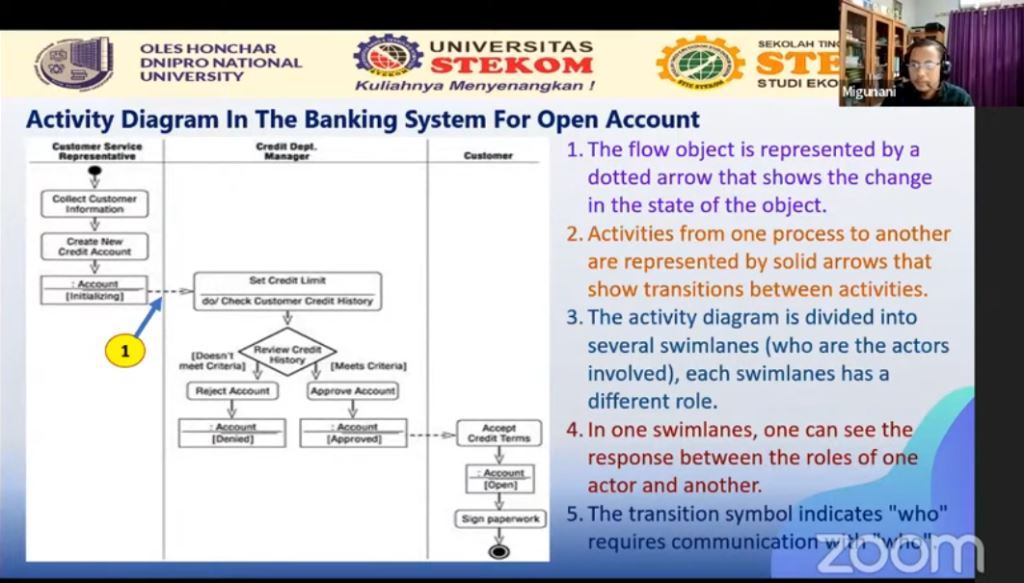
Visiting Lecturer from STEKOM University with Oles Honchar Dnipro National University (Ukraine) part 6
International Webinar
Back to News
International Webinar
Wednesday, April 5, 2023
Priyadi, S.Kom, M.Kom
0 Views