
Public speaking, also called a speech or oration, has traditionally meant the act of speaking face to face with a live audience. Today it includes any form of speaking (formal and informal) to an audience, including pre-recorded speeches delivered remotely via technology.
Confucius, one of the many scholars associated with public speaking, once taught that if a speech is considered a good speech, it will have an impact on the lives of individuals whether they listen to it in person or not. The idea is that the words and actions of someone in power can affect the world.
Public speaking is used for many purposes, but usually as a mixture of teaching, persuasion, or entertainment. Each requires a slightly different approach and technique.
Public speaking developed as a major field of learning in Greece and Rome, where prominent thinkers codified it as a central part of rhetoric. Today, the art of public speaking has been transformed by the new technologies available such as video conferencing, multimedia presentations and other non-traditional forms.
The function of public speaking depends entirely on what effect the speaker intends to have when addressing a particular audience. The same speaker, with the same strategic intent, may deliver very different speeches to two different audiences. The point is to change something, in the hearts, minds or actions of the audience.
Despite its name, public speaking is often delivered to a closed and limited audience with a broad public view. The audience may be loyal fans of the speaker; they may be hostile (attend an event reluctantly, or out of spite); or they might be random strangers (don't care about the talker on the soap box down the street). All the same, effective speakers remember that even a small audience is not a single mass with a single point of view but a variety of individuals.
As a broad generalization, public speaking seeks to convince a troubled audience, or to awaken a complacent audience to something important. After deciding which approach is needed, a speaker will then combine the information and tell the story in the way that is most likely to achieve it.
The word persuasion comes from the Latin term "persuādēre." The main goal behind a persuasive speech is to change the confidence of the speaker's audience. Examples of persuasive speaking can be found in any political debate where leaders try to persuade their audience, whether it's the general public, or members of the government.
Persuasive speaking can be defined as a style of speaking in which there are four parts to the process: the persuader, the audience, the method the speaker uses to speak, and the message the speaker is trying to uphold. When trying to persuade an audience, a speaker targets the audience's feelings and beliefs, to help change the audience's opinion.
There are several different techniques speakers can use to gain support from the audience. Some of the main techniques include demanding the audience to take action, using inclusive language ('we' & 'us') to make the audience and speaker appear as if they are one group, and choosing certain words that have strong connotative meanings. increase the impact of the message. Asking rhetorical questions, generalizing information (including anecdotes), exaggerating meaning, using metaphors, and applying irony to situations are other methods in which a speaker can increase the chances of convincing an audience.
The material above was delivered by a presenter from Indonesia in an international webinar held by STEKOM University in collaboration with the University of Mexico. The title of the presentation was "The Role of Public Speaking in Marketing Communication". The name of the presenter is Wibi Ardi Alvianto, S.Pd, M.Pd. Mr. Wibi is an active lecturer at STEKOM University.
This international webinar activity is part of the implementation of STEKOM University's commitment to increase various international activities. This was done in order to realize the vision to become an international-class university. Various international activities carried out by STEKOM University continue from year to year. There are international activities that are sustainable and there are also some international activities that are not sustainable. All types of international activities are accommodated and regulated by the International department of STEKOM University.
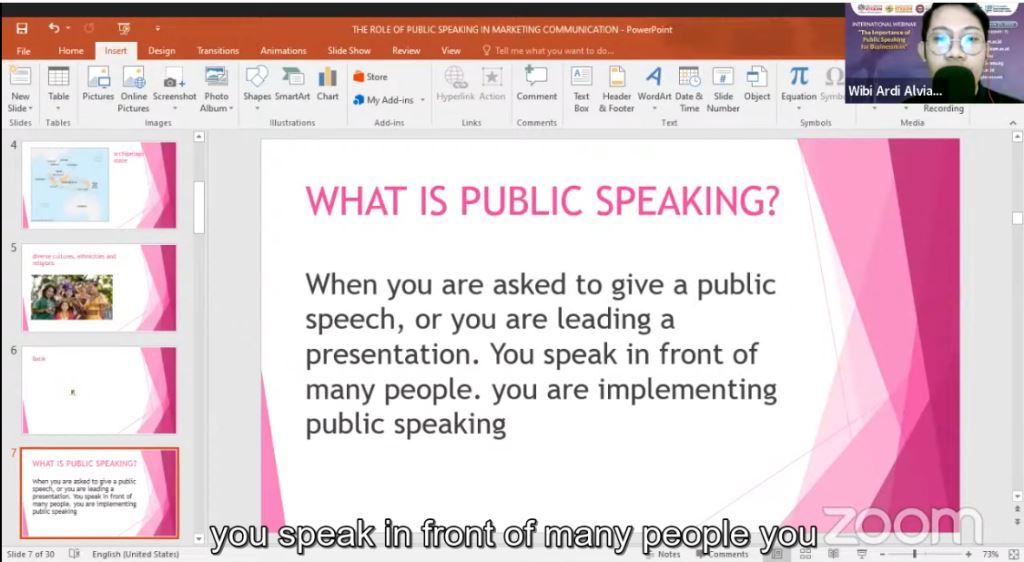
2023 - International Webinar - The important of public speaking for businessman - Part 11
International Webinar
Kembali ke Berita
International Webinar
Senin, 6 Maret 2023
Priyadi, S.Kom, M.Kom
0 Dilihat