
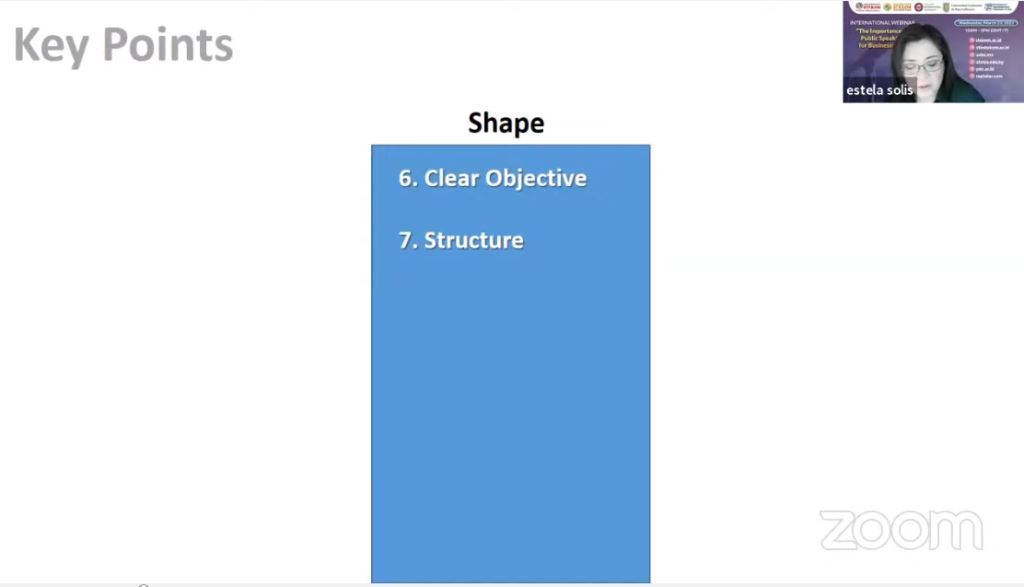
Organizing the speech serves two important functions. First, organization helps improve clarity of thought in a systematic way. Second, organization increases the likelihood that the speech will be effective. Audiences are less likely to understand disorganized speech and even less likely to think a disorganized speaker is reliable or credible. Speeches are organized into three main parts: introduction, body, and conclusion.
Speech recognition establishes the important first contact between speaker and audience. For most class speeches, the introduction should last less than a minute. The introduction needs to accomplish three things:
Focus your audience's attention. The speaker must have an "attention grabber" to hold the audience's attention—a joke, mind-blowing fact, or anecdote. (Rhetorical questions like “Have you ever wondered how…” is notoriously ineffective.) The introduction is the place where the main claim or idea must be stated very clearly to give the audience an idea of the purpose of the speech. Speakers need to direct the audience and make connections between what they know or are already interested in and the topic of the speech.
Build goodwill and credibility. Many people believe that the most important part of persuasion is the ethos, or character that the speaker conveys to the audience. The audience needs to see the speaker as someone who is listening attentively and sympathetically. The ethos is generated by the style of delivery and the content of the speech. Making eye contact with the audience and showing confidence in your voice and body are two important ways to establish an ethos. Also, if you come up with original and clever ideas, you will display an extraordinary "intellectual character." Viewers notice interesting habits of mind and are worth listening to.
Give a preview. Mentioning the main points to be discussed in the body prepares the audience to listen. Repetition is an important aspect of public speaking, because listening is an imperfect art, and audiences almost always ignore parts of it — sometimes to think of earlier parts of the speech, sometimes for other reasons. The preview should end with a transition, short phrase, or pause to signal to the audience that the speech is leaving the introduction and entering the body.
The body follows and is structured itself by organizational modes, logical or culture-specific patterns of thought about ideas, events, objects, and processes. Having an organizational mode means grouping similar material together and linking component parts together by transitions. Good transitions show the relationship between parts of speech. They display the logic of speech. Common transitional phrases include: beside, next, even more, next, after that, then, as a result, beyond that, otherwise, and on the other side. One special type of transition is called an internal summary, a brief restatement of the main points being resolved.
Within the body, the fewer major points the better. For short class speeches, under 10 minutes, the speech should have no more than three main points. For longer speeches, more than five main points ensures that the audience will have a hard time following and remembering the speech. In a speech, the main points should be clearly stated and "marked", marked as distinct and important to the audience. Transitions often serve to mark new points, as do pauses before important ideas. In addition, the speaker may mention the main points—first, second, third or first, next, last. Always make it easy for your audience to recognize and follow key ideas.
There are several general modes for organizing information in the body of your speech:
The temporal organization groups information according to when it happened or will happen. Types of temporal patterns include chronological (in the order in which events occur) and reverse chronological (from end to beginning). Sequences of inquiry are one particular mode of temporal organization that is useful in presenting certain types of research: here you organize the body according to the thought processes and data collection that are taking place, taking the audience from initial curiosity and questioning to the final result.
Causation is a related mode of organization, showing how one event produces another. Causation, like other temporal modes, can be used for past, present, or future events and processes. Causation can also be reversed, from the effect back to the cause.
Group spatial patterns and organize your speech based on the physical arrangement of the parts. If the speech describes a place, a physical object, or the process of movement—the downtown Mercer, a plant cell, or the Battle of Shiloh—spatial patterns can be useful.
Topical designs are appropriate when the subject matter has clear divisional categories. Governments in the United States, for example, fall into the federal, state, and local categories; or to the executive, legislative, and judicial branches; become elected and appointed officials. Categories like these can help divide course material to organize the main points.
Compare/contrast takes two or more entities and draws attention to their differences and/or similarities. Sometimes speakers explain difficult subjects by contrasting them with easier and more accessible subjects—to explain nuclear fusion to the stages of a high school romance, for example. The use of analogies often helps audience understanding.
After the transition from the body of speech, the conclusion follows. The conclusion should be somewhat shorter than the introduction and serve two purposes: summarizing the main ideas and providing a closing and concluding speech. A good conclusion might refer back to the introduction, offer an analogy or metaphor that captures the main idea, or leave the audience with a question or challenge of some kind. Short quotes can also make for effective conclusions (just as they can make for effective openings for introductions).
The material above was delivered by a presenter from Mexico in an international webinar held by STEKOM University in collaboration with the University of Mexico. The title of the presentation is "The Importance of public speaking in intercultural contexts". The name of the presenter is Estela Salome Solis Gutierres, PhD. He works at the Faculty of Human Science, Universidad Autonoma de Baja California.
This international webinar activity is part of the implementation of STEKOM University's commitment to increase various international activities. This was done in order to realize the vision to become an international-class university. Various international activities carried out by STEKOM University continue from year to year. There are international activities that are sustainable and there are also some international activities that are not sustainable. All types of international activities are accommodated and regulated by the International department of STEKOM University.
2023 - International Webinar - The important of public speaking for businessman - Part 7
International Webinar
Kembali ke Berita
International Webinar
Minggu, 5 Maret 2023
Priyadi, S.Kom, M.Kom
0 Dilihat