
On the one hand, nobody likes readers. If you're looking down at your notes, or worse, just reading through the slide show, you seem unengaged and unprepared. On the other hand, speech should feel natural. Good speakers sound as if the words just came out of nowhere in conversation, even though they've probably practiced them a thousand times.
For an interesting dissection of this, consider the analysis of how comedian Louis C.K. tell a joke. Her delivery is so casual that you feel like you're hearing her chatting with a friend at a bar. But the timing is so perfect that you know he's doing this dozens, if not hundreds of times to get it right. That's the paradox: You need to memorize a speech, without looking like you memorized it.
Over-reliance on memorizing word for word can result in speech that sounds artificial. Good speakers aren't completely rigid. There should be flexibility to your speech, especially if there's a chance you'll be interrupted or need to change direction based on the reaction from your audience. However, memorization, in some form or another, is very important. If the speech is not in memory, it should be on your cue card or slide show, and then you can go back to reading. So most of the criticism for memorizing speeches is just criticism for memorizing in an inflexible, verbatim way.
We don't need to memorize every presentation we have to give. If we know we have multiple takes (say we're shooting a video), very often what's recorded is the take we're making as we're trying to figure out what to say.
Similarly, if we are delivering a longer lecture then we may aim to improvise around the structure of the speech, without trying to master some elements of the delivery. Longer speeches, obviously, take longer to memorize, so there may be a place where the cost-benefits of memorization are no longer being achieved.
However, many times in your life you will have to deliver a speech where the stakes are high and there is no repetition. In this case, knowing how to memorize a speech properly, so that you can say it properly, without sounding like a robot, is a useful skill to develop.
The nice thing about this process is that it goes in order of priority. So the question usually isn't, "should we use this approach to memorizing speeches?" but, "how far do we have to go with this particular speech?". You can finish after the initial practice, or memorize the points, or even go further by timing the small nuances in your body language or tone of voice for certain words and phrases. The same process applies throughout.
The material above was delivered by a presenter from Indonesia in an international webinar held by STEKOM University in collaboration with the University of Mexico. The title of the presentation was "The Role of Public Speaking in Marketing Communication". The name of the presenter is Wibi Ardi Alvianto, S.Pd, M.Pd. Mr. Wibi is an active lecturer at STEKOM University.
This international webinar activity is part of the implementation of STEKOM University's commitment to increase various international activities. This was done in order to realize the vision to become an international-class university. Various international activities carried out by STEKOM University continue from year to year. There are international activities that are sustainable and there are also some international activities that are not sustainable. All types of international activities are accommodated and regulated by the International department of STEKOM University.
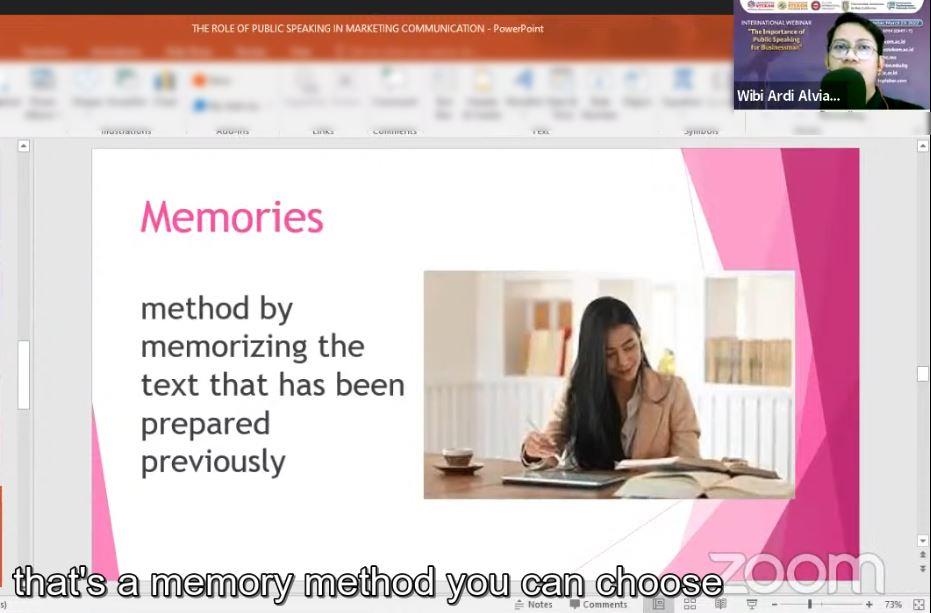
2023 - International Webinar - The important of public speaking for businessmen - Part 16
International Webinar
Kembali ke Berita
International Webinar
Selasa, 7 Maret 2023
Priyadi, S.Kom, M.Kom
0 Dilihat