
Sharing Responsibility for the Organization's Future Success among all people is the second principle of the Welfare and Performance Agenda which underpins the overall style and culture of the organization, and influences the way people behave towards one another. It is based on the combined intelligence of a workforce that is greater than that of its leaders and managers, and that all organizations need as much intelligence as possible to solve complex, adaptive, non-technical problems that affect future success.
This item influences the overall approach to leadership, management, and employee expectations. This is the basis for open Psychological Contracts and for achieving great success for the organization. It is a management style that places an expectation on every employee that they are responsible for the future success of the organization.
This means that the expectation is:
- Complete transparency about the organization and its management;
- The expectation that individuals will criticize all aspects of the organization and its management;
- Individuals focus on the success of the organization and not on its leaders and managers;
- The actions and behavior of leaders and managers will be judged by employees in the context of what is best for the future success of the organization;
- Employees are expected to form independent judgments about how the organization can improve and become more successful;
- Employees are expected to provide ideas on how to make the organization more successful in the future.
This approach is reinforced by Adaptive Leadership and acts directly on most of the elements that provoke psychological well-being and performance. People feel responsible; they, too, feel a sense of ownership of the organization and will therefore invest their energy into it to ensure its future success.
This approach encourages individuals to understand the whole organization and how it works, and to make unsolicited observations about how every aspect of the organization can be performed to increase prospects for future success. Sharing responsibility removes threats that hinder concentration and performance. It promotes kinship – a sense of sharing everything among the workforce – which helps create a shared vested interest in success.
The Board of Directors needs to approve this approach to lead and manage the organization. Once that happens, one way to facilitate change is to create a Freedom Manifesto, which will include:
- Freedom to raise 'Elephant in Room;
- Feedom to critically assess every aspect of the organization;
- The freedom to offer unsolicited ideas to enhance success, and expect those ideas to be seriously assessed for their validity and applicability;
- Freedom to identify anyone who is not helping the organization to be more successful in the future.
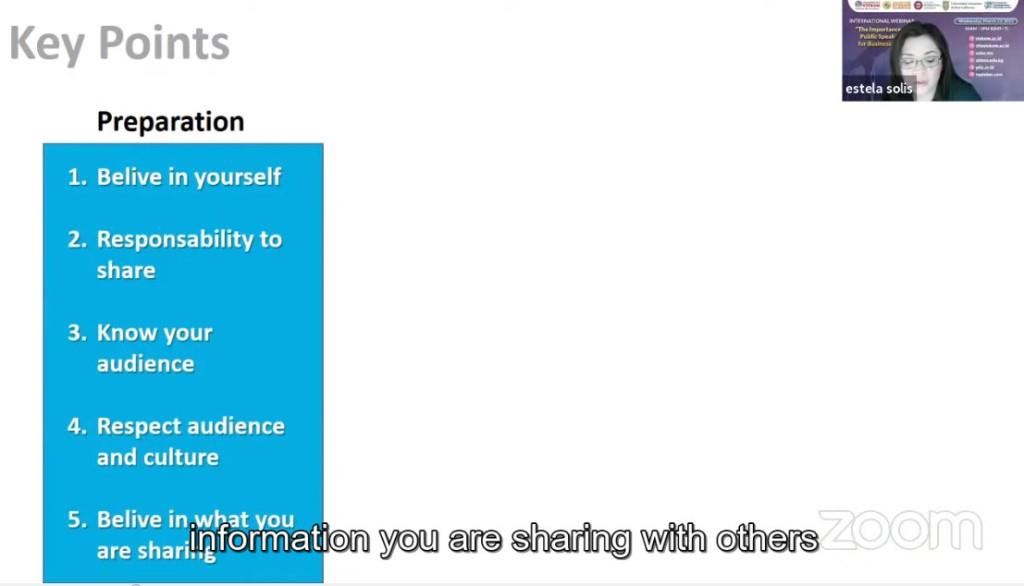
The material above was delivered by a presenter from Mexico in an international webinar held by STEKOM University in collaboration with the University of Mexico. The title of the presentation is "The Importance of public speaking in intercultural contexts". The name of the presenter is Estela Salome Solis Gutierres, PhD. He works at the Faculty of Human Science, Universidad Autonoma de Baja California.
This international webinar activity is part of the implementation of STEKOM University's commitment to increase various international activities. This was done in order to realize the vision to become an international-class university. Various international activities carried out by STEKOM University continue from year to year. There are international activities that are sustainable and there are also some international activities that are not sustainable. All types of international activities are accommodated and regulated by the International department of STEKOM University.
2023 - Visiting Lecture - The important of public speaking for businessmen - Part 2
International Webinar
Kembali ke Berita
International Webinar
Rabu, 1 Maret 2023
Priyadi, S.Kom, M.Kom
0 Dilihat