
The COVID-19 pandemic that we are currently experiencing has brought us all to enter a new world dominated by technology. Our work is done at home, learning at school through online, buying and selling has also shifted to the online market. This shift in phenomenon creates opportunities for those who have a high entrepreneurial spirit.
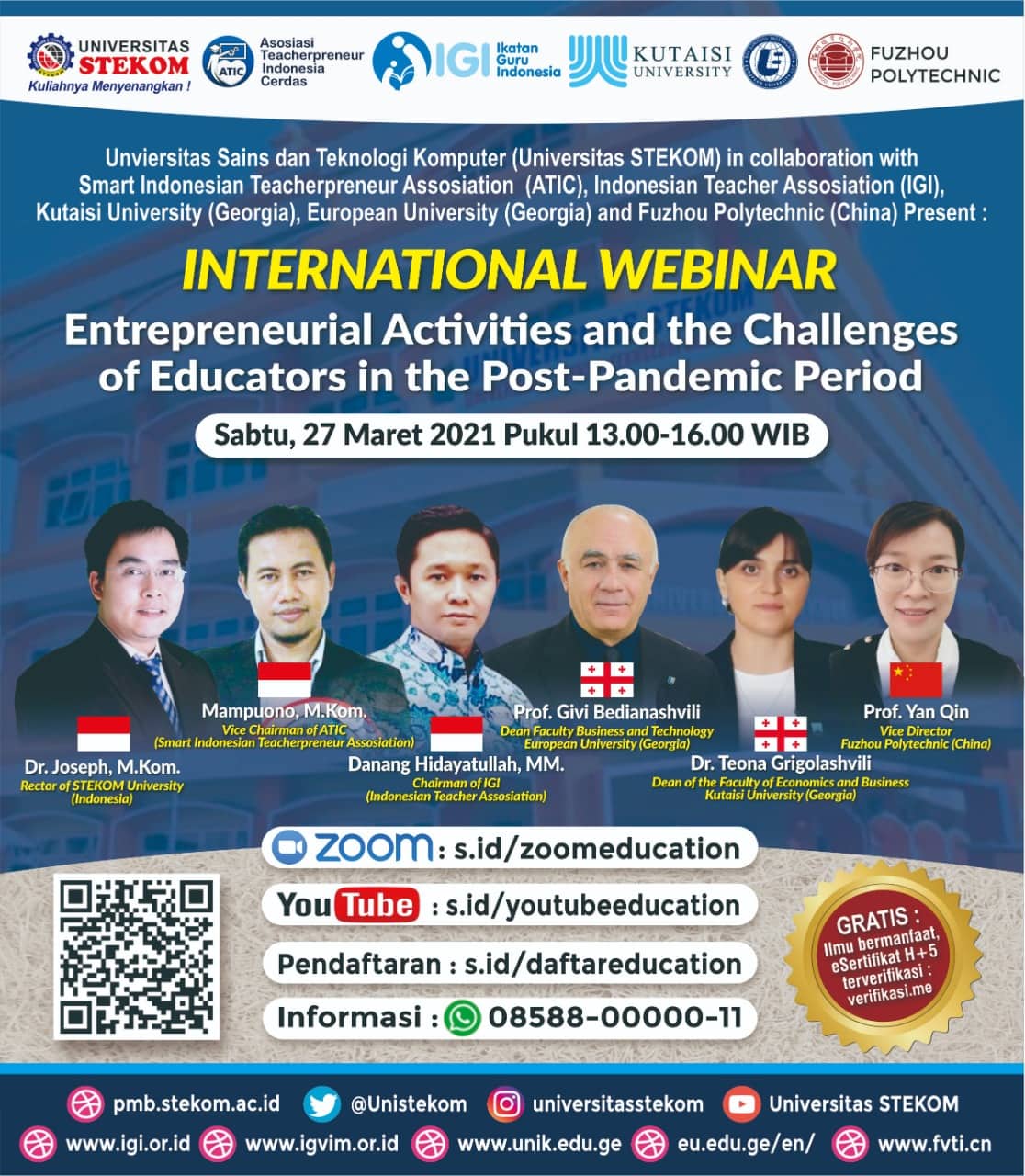
Not spared from the paradigm shift, educators must also be able to direct students to start having an entrepreneurial spirit through businesses that will be able to compete in the future. Through an international webinar, the University of Computer Science and Technology (STEKOM University) invited resource persons from 3 countries to provide material with the theme “Entrepreneurial Activities and the Challenges of Educators in the Post-Pandemic Period”. As a resource person is Dr. Teona Grigolashvili; Prof. Givi Bedianashvili; Prof. Yan Qin; Ableono, M. Kom and Danang Hidayatullah, MM.
Creativity in business does not only depend on the economic sector, but rather refers to all aspects of life, said Prof. Givi Bedianashvili from the European University. In the era of globalization and rapid technological change, it also began to encourage the emergence of new products, he added.
Tight business competition, daring to take risks is certainly not enough to be able to make a business able to compete successfully in the market. In making a business we also need to be creative. It is undeniable that this is also one of the important factors in the success of building a business.
We must have creative and unique thinking for the development of our business and immediately implement it, because if not, the ideas we have can be immediately taken and used by others. In the era of technology that has developed rapidly, people can easily find and seek inspiration for creative ideas that are widely available on the internet.
In building a business we are also required to think creatively because in this modern era, business competition is getting bigger, the problems we face are also increasingly diverse, so we will be faced with problems that make us have to think more creatively than our business competitors. But the problem is that most people think they're not creative, but that's just their perception. Actually everyone is creative, but it depends on ourselves. Creativity is just like any other skill, if we practice it often, of course we will become more creative.
The moment of national awakening in a broad sense is an invitation to unite to rise up nationally from the nation's problems. Under current conditions, the Covid-19 pandemic has had many negative impacts over the past two years, including the impact of social distancing due to the implementation of health protocols.
In the context of higher education, the inevitable implications of the social disruption of the Covid-19 pandemic include the problems of various forms of outreach, access, and acceptance of learning. However, pioneering efforts are still being made. Accelerate the implementation of digital transformation of universities and their supporting ecosystem by observing the two-year pandemic moment, the dynamics of diverse technological developments, and the need to fill gaps in access to higher education learning.
Digital transformation is a multifaceted transformation of a business or organization, from human resources, processes, strategies and structures, to the adoption of technology to improve performance. During the pandemic, we are mostly directed to transform from natural or manual media to digital approaches in various aspects.
Then how will educators behave when the pandemic will end. Digital habituation during a pandemic, will require adjustment again when the pandemic really ends. Educators must be able to adapt to face-to-face habits who are still accustomed to using digital media. Educators, during the pandemic, must also familiarize themselves with stricter health protocols than in the days before the pandemic.
This webinar will be held on March 27, 2021 and will be active for 3 hours which is closed by a presentation from ATIC representatives, and a Q&A session. The event went quite smoothly and was accompanied by very high enthusiasm of the participants. The question and answer session in the seminar was also very lively with each resource person who was given the opportunity for discussion.
Not spared from the paradigm shift, educators must also be able to direct students to start having an entrepreneurial spirit through businesses that will be able to compete in the future. Through an international webinar, the University of Computer Science and Technology (STEKOM University) invited resource persons from 3 countries to provide material with the theme “Entrepreneurial Activities and the Challenges of Educators in the Post-Pandemic Period”. As a resource person is Dr. Teona Grigolashvili; Prof. Givi Bedianashvili; Prof. Yan Qin; Ableono, M. Kom and Danang Hidayatullah, MM.
Creativity in business does not only depend on the economic sector, but rather refers to all aspects of life, said Prof. Givi Bedianashvili from the European University. In the era of globalization and rapid technological change, it also began to encourage the emergence of new products, he added.
Tight business competition, daring to take risks is certainly not enough to be able to make a business able to compete successfully in the market. In making a business we also need to be creative. It is undeniable that this is also one of the important factors in the success of building a business.
We must have creative and unique thinking for the development of our business and immediately implement it, because if not, the ideas we have can be immediately taken and used by others. In the era of technology that has developed rapidly, people can easily find and seek inspiration for creative ideas that are widely available on the internet.
In building a business we are also required to think creatively because in this modern era, business competition is getting bigger, the problems we face are also increasingly diverse, so we will be faced with problems that make us have to think more creatively than our business competitors. But the problem is that most people think they're not creative, but that's just their perception. Actually everyone is creative, but it depends on ourselves. Creativity is just like any other skill, if we practice it often, of course we will become more creative.
The moment of national awakening in a broad sense is an invitation to unite to rise up nationally from the nation's problems. Under current conditions, the Covid-19 pandemic has had many negative impacts over the past two years, including the impact of social distancing due to the implementation of health protocols.
In the context of higher education, the inevitable implications of the social disruption of the Covid-19 pandemic include the problems of various forms of outreach, access, and acceptance of learning. However, pioneering efforts are still being made. Accelerate the implementation of digital transformation of universities and their supporting ecosystem by observing the two-year pandemic moment, the dynamics of diverse technological developments, and the need to fill gaps in access to higher education learning.
Digital transformation is a multifaceted transformation of a business or organization, from human resources, processes, strategies and structures, to the adoption of technology to improve performance. During the pandemic, we are mostly directed to transform from natural or manual media to digital approaches in various aspects.
Then how will educators behave when the pandemic will end. Digital habituation during a pandemic, will require adjustment again when the pandemic really ends. Educators must be able to adapt to face-to-face habits who are still accustomed to using digital media. Educators, during the pandemic, must also familiarize themselves with stricter health protocols than in the days before the pandemic.
This webinar will be held on March 27, 2021 and will be active for 3 hours which is closed by a presentation from ATIC representatives, and a Q&A session. The event went quite smoothly and was accompanied by very high enthusiasm of the participants. The question and answer session in the seminar was also very lively with each resource person who was given the opportunity for discussion.