
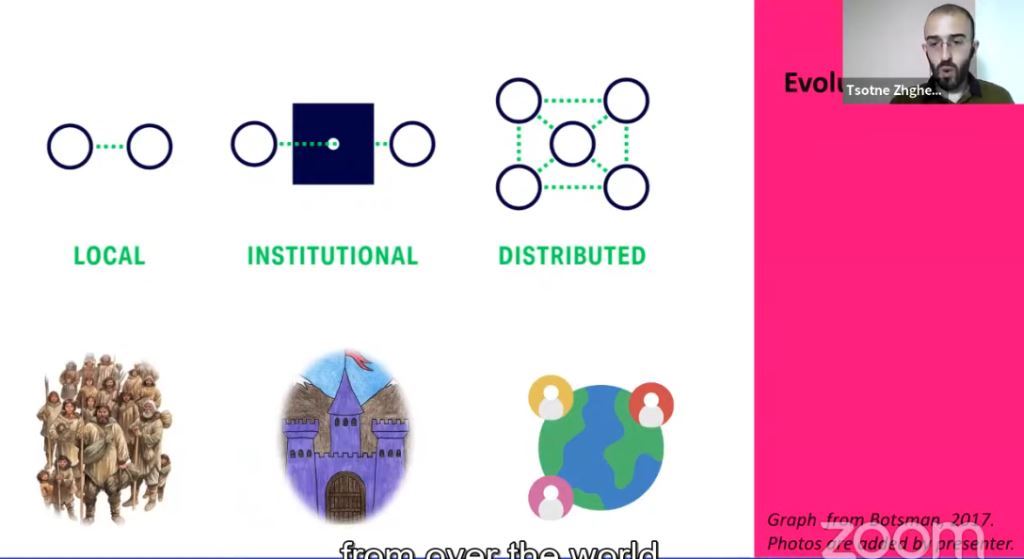
Mr. Tsotne's explanation about the evolution of human belief in a guest lecture on 07 June 2022 at STEKOM University is quite long. The explanation starts from the belief system of the past that is believed by traditional tribes or believed by individuals. Then the belief system continues to develop from local, institutional, to distributed belief systems.
This activity is part of the implementation of STEKOM University's commitment to increase various international activities in order to realize the vision to become an international class university. Various international activities carried out by STEKOM University continue from year to year. There are international activities that are sustainable and there are also some international activities that are not sustainable. All types of international activities are accommodated and regulated by the International department of STEKOM University.
In the guest lecture, Mr. Tsotne delivered lecture materials on how to build trust in digital platforms. At the beginning of his introduction, Mr. Tsotne said that his name was quite strange for people outside Georgia, because the spelling was quite difficult to pronounce. He also displays a visual estimate of the distance between the city of Semarang to Georgia, which is around 8,500 kilometers. As a hospitality, Mr. Tsotne also gave light questions to the participants. Is Georgia included in Europe or not? Tsotne asked. In his explanation, Georgia is sometimes mentioned in the European region, sometimes mentioned in the Asian region, or sometimes mentioned in the Caucasus region.
A locally trusted organization is the one selected by your Local Large partnership to manage and be responsible for the distribution of your funding, and/or provide activities or services on behalf of the Local Large partnership. Your Big Local Partnership guides the overall direction of Big Local in your area and makes decisions about how your Big Local funding will be used. You may be working with more than one locally trusted organization. This will depend on your Big Local plans and the skills and resources you need. This local belief is important to form the basis of an organization that grows from a small environment.
Institutional trust is a dynamic relationship between individuals and institutions. These are forms/sub-types of trust and are distinguished by the magnitude of their potential influence. The relationship can be analyzed through techniques developed for the analysis of interpersonal bonds. The form of this relationship can be explicit (or implicit) and internal (or external) for an institution in both perception and reality. Relationship dispositions can be qualified as positive, neutral or negative. The strength of the relationship is measured by the relative percentage from 0% (weak) to 100 percent (strong) and the degree of separation (eg, 1 degree of separation means the trust relationship is direct, see Six degrees of separation). Relationship characteristics can change over varying periods of time (from instant to slow). Institutional trust is often expressed through value judgments. This has major implications in all fields of study, especially power dynamics, including (but not limited to) forms of power (social and political).
The last evolution of belief systems is the distributed belief system. Where trust in an entity is not only assessed from one party, but involves other parties involved. An example of its application in information systems is Authorization and access control. Authorization and access control is the process by which security enforcement points determine whether an entity should be allowed to perform certain actions. Authorization occurs after the entity is authenticated. Furthermore, authorization occurs within the scope of the access control policy. In simpler terms, the first step in making an access control decision is to determine who is making the request; the second step is to determine, based on the authentication results as well as additional information (access control policies), whether the request should be allowed.
One of the security mechanisms that are often used in operating systems is the Access Control List (ACL). In short, an ACL is a list that describes which access rights the principal has over an object (resource). For example, the entry might read "User Foo can Read File Bar." Such a list (or table) need not physically exist in one location but can be distributed throughout the system. Unix file systems The "permissions" mechanism is basically an ACL.