
Massive open online courses or open online courses are online courses aimed at unrestricted partitioning and open access via the Web. In addition to traditional course materials, such as filmed lectures, readings, and problem sets, many MOOCs provide interactive courses with user forums or social media discussions to support community interaction between students, professors, and assistant developers (TAs), as well as direct feedback for quizzes. fast and on duty. MOOCs are a widely researched development in distance education, first introduced in 2008, which emerged as a popular learning model in 2012, the year called "The MOOC Year".
Early MOOCs (cMOOCs: Connectivis MOOCs) often emphasized open access features, such as open content licensing, structure and learning objectives, to promote the reuse and remixing of resources. Several later MOOCs (xMOOCs: extended MOOCs) use closed licenses for their course material while maintaining free access for students
Prior to the Digital Age, distance learning emerged in the form of correspondence courses in the 1890s-1920s and later radio and television broadcast programs and early forms of e-learning. Typically less than five percent of students will complete the course. For example the Stanford Honors Cooperative Program, founded in 1954, eventually offered video classes on company premises, at night, leading to a fully accredited Master's degree. This program is controversial because employers pay double the normal tuition fees paid by full-time students. The 2000s saw a shift to online, or e-learning and distance education, with increasing online presence, open learning opportunities, and the development of MOOCs. In 2010 the audience for the most popular college courses such as "Justice" with Michael J. Sandel and "Human Anatomy" with Marian Diamond have reached millions.
MOOCs first emerged from the open educational resources (OER) movement, sparked by MIT's OpenCourseWare project. The OER movement was motivated by the work of researchers showing that class size and learning outcomes do not have a well-established relationship. Here, the work of Daniel Barwick is the most frequently cited example.
Within the OER movement, Wikiversity was founded in 2006 and the first open course on the platform was organized in 2007. The ten week course with over 70 students was used to test the idea of making Wikiversity an open and free platform for education in the Scandinavian tradition of free adult education , People's Middle School and the free school movement. The term MOOC was coined in 2008 by Dave Cormier of Prince Edward Island University in response to a course called Connectivism and Connective Knowledge (also known as CCK08). CCK08, led by George Siemens of Athabasca University and Stephen Downes of the National Research Council, consists of 25 tuition-paying students in Extended Education at the University of Manitoba, as well as more than 2,200 students from the general public who pay nothing. All course content available via an RSS feed, and bold students can participate through collaborative tools, including blog posts, threaded discussions in Moodle, and Second Life meetings. Stephen Downes considers these so-called cMOOCs to be more "creative and dynamic" than current xMOOCs, which he says "resemble television shows or digital textbooks".
Another cMOOC was later developed; for example, Jim Groom of The University of Mary Washington and Michael Branson Smith of York College, City University of New York conducted MOOCs through several universities starting with 'Digital Storytelling' (ds106) MOOCs in 2011. MOOCs from private, not-for-profit institutions college members are primarily and the expansion of existing distance learning offerings (eg, podcasts) into free and open online courses.
Alongside the development of these open courses, other E-learning platforms have emerged – such as Khan Academy, Peer-to-Peer University (P2PU), Udemy, and Alison – which are considered to be similar to MOOCs and work outside of the university system or the individual pressures of self-study.
The above material was delivered by a presenter from Ukraine in an international visiting lecturer held by STEKOM University in collaboration with Universities from Ukraine. The presenter's name is Oleksii Panasenko. He is a Lecturer at the Vinnitsia State Pedagogical University
(Ukraine), Ph.D. in Mathematics. He is also a data scientist at NestLogic Inc. His interest in science is in mathematics: fractal analysis. Meanwhile, his interest in teaching is working with mathematically gifted pupils; mathematical olympiads. In addition he has an interest in all things related to machine learning, data science, AI. The time for the visiting lecture to be held is on May 12 2023 with initial remarks by Dr. Joseph Teguh Santoso who is the Chancellor of STEKOM University and guided by Mrs. Novita.
This international webinar activity is part of the implementation of STEKOM University's commitment to increase various international activities. This was done in order to realize the vision to become an international-class university. Various international activities carried out by STEKOM University continue from year to year. There are international activities that are sustainable and there are also some international activities that are not sustainable. All types of international activities are accommodated and regulated by the International department of STEKOM University.
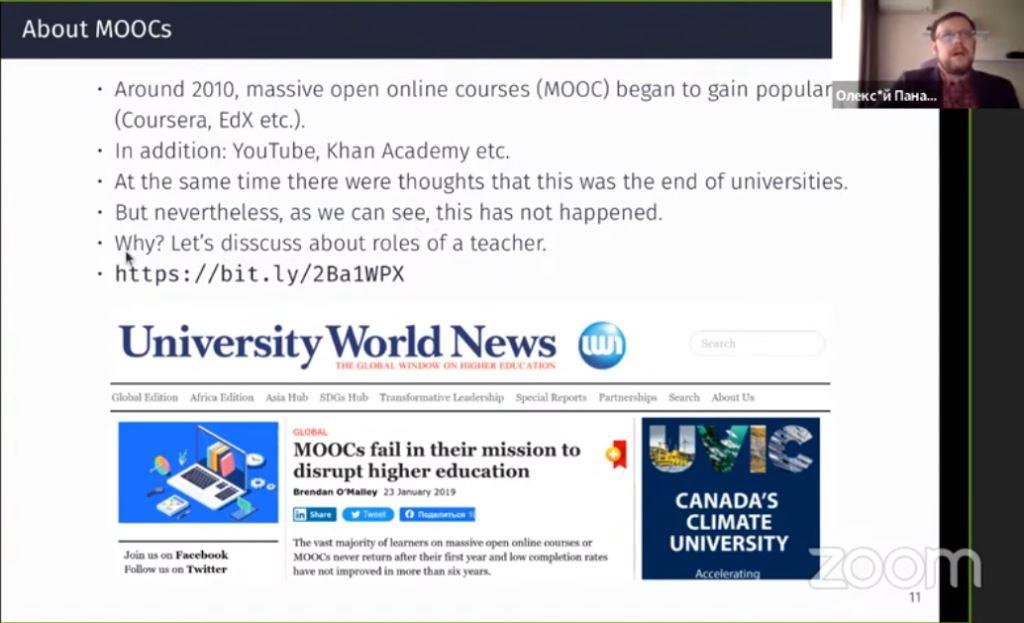
Guest lecture with Faculty from Vinnytsia Pedagogical University (Ukraine) Part 5
International Webinar
Kembali ke Berita
International Webinar
Kamis, 8 Juni 2023
Priyadi, S.Kom, M.Kom
0 Dilihat