
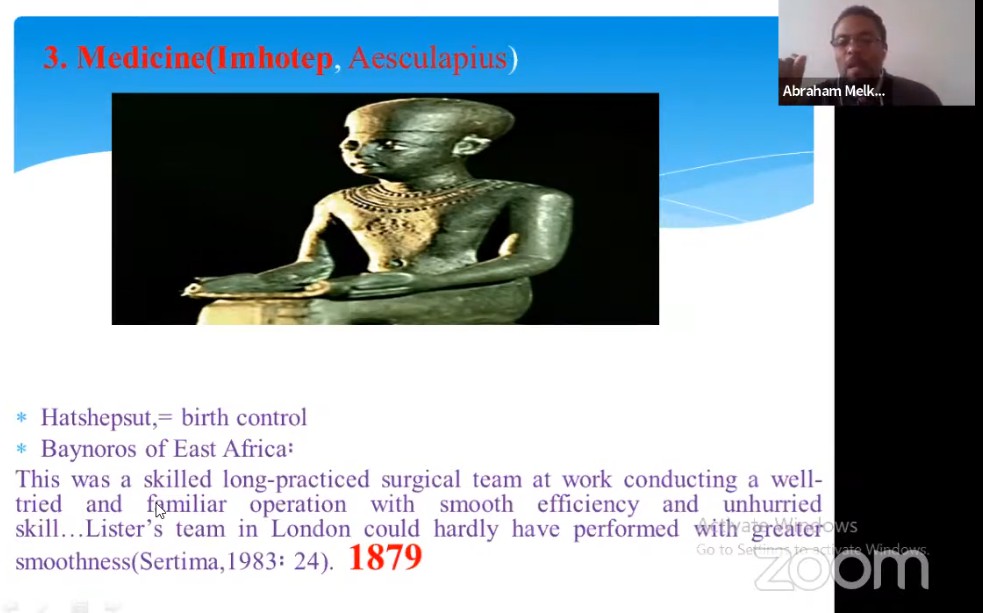
The ancient civilization of medicine in the Ethiopian Negro is also not inferior to other ancient civilizations. Two figures of ancient civilization in the field of medicine are Asclepius and Imhotep. Both are figures of ancient civilizations in the field of medicine who are very famous.
Negro is a term that has historically referred to people characterized as being of black African descent. The word negro in Spanish and Portuguese means black, which was later adopted into English. The term may be construed as offensive, non-offensive, or completely neutral, which also depends on the region or country in which the term is spoken. This word has various equivalents in other European languages.
It is very interesting if we learn about the history and civilization of the Negro. Especially if we learn from the African people directly. Where we will learn about Negro civilization and history from direct Negroes who live and work there every day.
STEKOM University on July 18, 2022 has held guest lecturer lectures from Ethiopia directly. The guest lecture is carried out through zoom media which can interactively communicate in two directions. The guest lecturer is Abraham Melkie, Phd from Debre Tabor University in Ethiopia. STEKOM University has several times conducted academic cooperation with the university.
Asclepius was a hero and god of medicine in ancient Greek religion and mythology. He was the son of Apollo and Coronis, or Arsinoe, or Apollo alone. Asclepius represents the healing aspect of the medical arts; his daughters, "Asclepiades", are: Hygieia ("Health, Health"), Iaso (from "healing, restoration, healing", goddess of healing from illness), Aceso (from "healing", goddess of the healing process), Aegle ( goddess of good health) and Panacea (goddess of universal medicine). He also has several sons. He is associated with the Roman/Etruscan gods Vediovis and the Egyptian Imhotep. He shared with Apollo the nickname Paean ("Healer"). Asclepius' wand, a stick wrapped around a snake, (similar to the caduceus) remains a symbol of medicine to this day. The healers and servants who served this god were known as Therapeutae of Asclepius.
The oldest and most prominent Asclepeion (or temple of healing) according to the 1st century BC geographer Strabo is located at Trikala. The 1st century Bethesda Pool, described in the Gospel of John, chapter 5, was discovered by archaeologists in 1964 as part of an asclepeion. One of Asclepius' most famous temples is at Epidaurus in the northeastern Peloponnese, which dates back to the fourth century BC. Another famous Asclepeion was built about a century later on the island of Kos, where Hippocrates, the legendary "father of medicine," probably began his career. Other Asclepieia are located in Gortys (in Arcadia), and Pergamum in Asia.
From the fifth century BC onwards, the cult of Asclepius grew very popular and pilgrims flocked to his temple of healing (Asclepieia) to be healed of their ailments. The purification ritual would be followed by an offering or sacrifice to the deity (according to the manner), and the supplicant would then spend the night in the most sacred part of the shrine – the abaton (or adyton). Any dreams or visions will be reported to a priest who will prescribe appropriate therapy through a process of interpretation. Some healing temples also use sacred dogs to lick the wounds of sick supplicants. In honor of Asclepius, certain types of non-venomous snakes were often used in healing rituals, and these snakes—the Aesculapian Snake—floated freely on the floors of the dormitories where the sick and wounded slept. These snakes were introduced at the founding of every new temple of Asclepius throughout the classical world.
Several religious movements later claimed to have links to Asclepius. In the 2nd century AD, the controversial miracle worker Alexander claimed that his god Glycon, a serpent with a "head of linen" was an incarnation of Asclepius. The Greek rhetorician and satirist Lucian produced Alexander the False Prophet to denounce imposters for future generations. He described Alexander as possessing a character "consisting of lies, deceit, perjury, and malice; fluent, courageous, courageous, diligent in the execution of schemes, reasonable, convincing, masquerading as good, and wearing an appearance completely counter to his goals. " In Rome, the College of Aesculapius and Hygia was an association (collegium) that served as a funeral society and dining club that also participated in the cult of the Empire.
Imhotep (sometimes spelled Immutef, Im-hotep was the first known architect and doctor in history. As one of the right-hand men of king Djoser, he built the Pyramid of Djzoser in Saqqara, Egypt circa 2630-2611 BC, during the reign of Egypt's third dynasty. Possibly, he was the first person to use pillars in architecture.His name means someone in peace.
Imhotep served as chancellor to the king and high priest of the god Ra at Heliopolis. He is the son of Ptah. He was a very smart person, therefore he was given many titles. His full title was: Chancellor of Lower Egypt, First after the King of Upper Egypt, Administrator of the Grand Palace, Descendant of Nobles, High Priest of Helopolis, Builder, Sculptor, and Master of the Pots. Imhotep is best known as the founder of ancient Egyptian medicine, and the author of the Edwin Smith papyrus, which deals with curses, minor ailments and anatomical observations.
Two thousand years after his death, he was elevated to the status of a god. Imhotep became a god of medicine and healing, like Asclepius in ancient Greek culture.
The location of Imhotep's grave is not yet known. Egyptian historians have tried to find it but so far have not been found. Many believe that his tomb is at Saqqara. The history of Imhotep is confirmed by two inscriptions made during his lifetime on the base or pedestal of one of the statues of Djoser and also by a graffiti on the walls surrounding the surrounding Sekhemkhet pyramid which has not been completed. Recent inscriptions show that Imhotep outlived Djoser and continued to serve in the construction of the pyramid of king Sekhemkhet which was abandoned due to his short reign.
In addition to the two medical figures above, Mr. Abraham also explained about how many medical techniques were known in the ancient Negro civilization. Among them is Hatshepsut which is an ancient birth control technique that has been known in the ancient Negro civilization. Next up is Baynoros from East Africa. This is a team of skilled surgeons who have long trained on the job performing well-tried and billion-dollar surgeries with fluid efficiency and unhurried skill. Lister's team in London could hardly perform with greater fluency (Sertima, 1983: 24).
Guest lecturer - Learn Negroid Civilization from Ethiopian lecturer 2022 part 2
International Webinar
Kembali ke Berita
International Webinar
Rabu, 9 November 2022
Priyadi, S.Kom, M.Kom
0 Dilihat