
At about 7,000 years ago, nomadic early humans who lived in the African savanna, are believed to be the first humans to record the movement of stars at the Nabta Playa site. They are a group of hunters and gatherers of livestock, because they are also used for ritual worship of these animals. These observations marked the beginning of the emergence of astronomy before it finally became as established as it is today. But actually not only in astronomy, other scientific disciplines also require thousands of years of observation to become what is known today. Nabta Playa became a milestone for astronomical observations, before being followed by ancient civilizations, such as the Egyptians, Central America, India, China, Europe, and the Archipelago. The African Negro nation is one of the nations that has a very advanced astronomical civilization in the past.
Negro is a term that has historically referred to people characterized as being of black African descent. The word negro in Spanish and Portuguese means black, which was later adopted into English. The term may be construed as offensive, non-offensive, or completely neutral, which also depends on the region or country in which the term is spoken. This word has various equivalents in other European languages.
It is very interesting if we learn about the history and civilization of the Negro. Especially if we learn from the African people directly. Where we will learn about Negro civilization and history from direct Negroes who live and work there every day.
STEKOM University on July 18, 2022 has held guest lecturer lectures from Ethiopia directly. The guest lecture is carried out through zoom media which can interactively communicate in two directions. The guest lecturer is Abraham Melkie, Phd from Debre Tabor University in Ethiopia. STEKOM University has several times conducted academic cooperation with the university.
Continuing the previous article which discussed the presentation of Mr. Abraham, this article is a continuation which discusses the presentation of the next Mr. Abraham which discusses the ancient civilization of the African Negro on astronomy. One of the evidences of ancient African civilization about astronomy is Nabta Playa. Nabta Playa was once a large internally drained basin in the Nubian Desert, located about 800 kilometers south of modern-day Cairo. Today the region is characterized by many archaeological sites. The archaeological site of Nabta Playa, one of the earliest of the Egyptian Neolithic Period, is dated to about 7500 BC.
Even though the western Egyptian desert is currently completely dry, this was not always the case. There is good evidence that there were several humid periods in the past (when rainfall was up to 500 mm per year), most recently during the last interglacial period and the beginning of the last glaciation stretching between 130,000 and 70,000 years ago. During this time, the area was a savanna and supported many animals such as the extinct buffalo and large giraffe, varieties of antelope and antelope. Beginning around the 10th millennium BC, this region of the Nubian Desert began to receive more rainfall, filling the lake. Early people may have been attracted to the area because of its water sources.
Archaeological finds may indicate human occupation of the region at least around the 10th and 8th millennium BC. Fred Wendorf, the discoverer of the site, and ethno-linguist Christopher Ehret have suggested that the people who occupied the area at that time were early herders, or like Saami practiced semi-pastoralism (although this is disputed by other sources as the remains of cattle were found in the area). Nabta has been shown to be morphologically wild in several studies, and nearby Saharan sites such as Uan Afada in Libya maintain wild Barbary sheep, animals that were never domesticated). People at that time consumed and kept wild sorghum, and used ceramics adorned with intricate painting patterns probably made using combs made of fishbones and is a common pottery tradition closely associated with the southern part of the Sahara (eg the mesolithic Khartoum and various contemporary sites in Chad) in that period. Analysis of human remains by Fred Wendorf and reported in the "Holocene Settlement of the Egyptian Sahara", based on osteological data suggesting a sub-Saharan African origin for the inhabitants of the site, Analysis of teeth and skeleton by Joel D. Irish also tentatively demonstrates affinity and origin Sub-Saharan Africa especially for the inhabitants of Nabta Playa (with sub-Saharan tendencies detected most frequently), but also possibly a North African trend in some, concluding that, "Henneberg et al. suggest that the Nabta Playa people may have the most similarity to the Negroes from south of the Sahara. Current qualitative dental comparisons temporarily support this conclusion." Several researchers, including Christopher Ehret, have suggested a Nilo-Saharan linguistic affinity for the Nabta people.
In the 7th millennium BC, larger organized settlements were found in the region, relying on deep wells for water sources. Small huts were built in a straight line. The diet includes wild fruits, nuts, millet, sorghum and tubers.
Also at the end of the 7th millennium BC, but slightly later than the time mentioned above, goats and sheep, apparently imported from West Asia, appeared. Many large fireplaces also appeared.
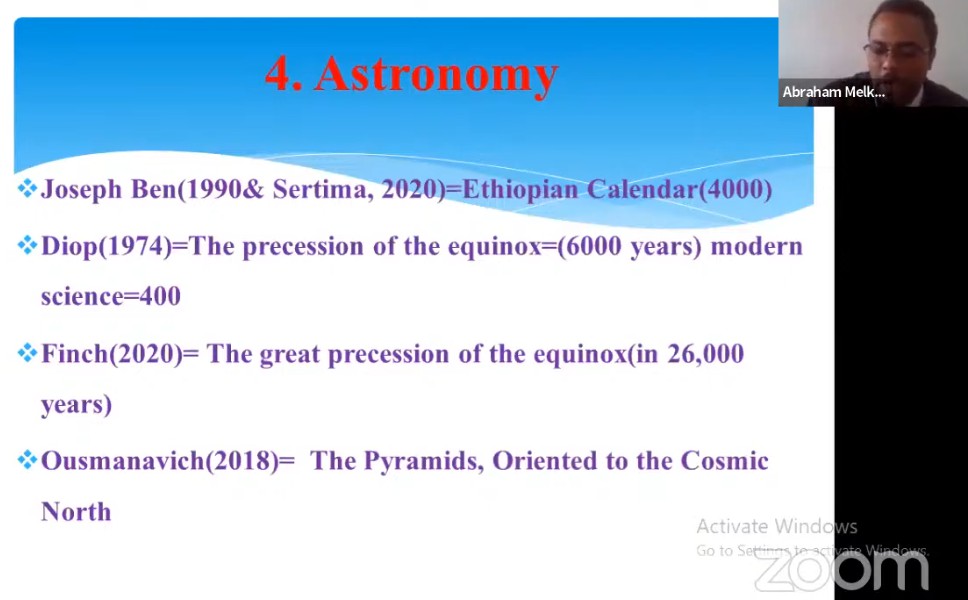
Guest lecturer - Learn Negroid Civilization from Ethiopian lecturer 2022 part 3
International Webinar
Kembali ke Berita
International Webinar
Rabu, 9 November 2022
Priyadi, S.Kom, M.Kom
0 Dilihat