
STEKOM University is determined to improve the quality and reach of its academic activities to an international level. Various international academic activities continue to be held as an effort to improve the quality and academic reach of the institution. This time, STEKOM University held an international webinar entitled “Digital Business vs conventional business which is more efficient and strategic in the world”. The speakers in this webinar came from Indonesia, Malaysia, and Ethiopia.
In this section we will discuss the material that has been presented by Dr. Kindya Issa. Dr. Kindya is a lecturer at Debre Tabor University in Ethiopia. Dr. Kindya in his presentation will convey the same topic in his perspective as academics from universities in North Africa. Before we discuss the material presented by Dr, Kindya, it's a good idea to briefly discuss the University and the city of Debre Tabor in Ethiopia.
Debre Tabor is a city located in the Amhara Region, northern Ethiopia, about 100 km southeast of Gondar and 50 km east of Lake Tana. The city is located at an altitude of 2,706 m above sea level. In this city there is also a university, namely Debre Tabor University, and an airport, namely Debre Tabor Airport.
It is not known exactly when the city was founded. Mordechai Abir states that Debre Tabor was founded by Ras Ali I;[1] however, Richard Pankhurst explains that the founder of Debre Tabor was Ras Gugsa, and it is said that the location was chosen with supernatural help.
Debre Tabor was the capital of Ethiopia during the reign of two emperors, Emperor Tewodros II before he finally moved the capital to Magdala, and John IV. As a result, in the 19th century, the city's population varied depending on whether the emperor was living in the city. When Debre Tabor was the capital during the reign of Emperor John, the population was 30,000, while without the emperor the population was only about 5,000.
According to the 2007 census, the city has a population of 55,596, of whom 27,644 are men and 27,952 are women. 96.72% of the city's population adheres to Ethiopian Orthodox Christianity, while only 2.54% adheres to Islam.
At the beginning of his presentation, Dr. Kindya gave a brief summary of the presentation he was about to deliver. The following is the material presented by Dr. Kindya in a short list:
What is Marketing?
A paradigm shift in marketing
Traditional Marketing
Digital Marketing
Advantages of Traditional Marketing and Digital Marketing
Global e-commerce statistics
Challenges and opportunities of e-commerce adoption in developing countries
Conclusion
Dr. Kindya explained about what is meant by marketing. According to Dr. Kindya There is no universally accepted definition. In 2012, Philip Kotler defined marketing as “The science and art of exploring, creating and delivering value to meet the needs of target markets at a profit. The American Marketing Association (AMA) defines marketing as "The activity, set of institutions, and processes for creating, communicating, delivering, and exchanging offerings that have value for customers, clients, partners, and society at large" (AMA, 2017). So according to him marketing is the creation and satisfaction of demand for your offerings to the market.
Dr. Explanation Kindya continued about market trends. According to him, As the world becomes more digital, the way we market has evolved, globalization and international marketing have taken off. In fact, businesses report that half of revenue is impacted by social selling. The COVID-19 pandemic and the recent crisis have increased reliance on digital banking and e-commerce. As COVID-19 spreads around the world, people everywhere are learning to deal with a new way of life. The companies that are best positioned to survive in this environment are the ones that have started the digital marketplace.
Next Dr. Kindya explained about the advantages of digital marketing. Among the advantages of digital marketing according to him are 1) Digital marketing is cost-effective, 2) Digital marketing is scalable, 3. Digital marketing allows you to target ideal customers 4) Digital marketing allows you to create a Global reach, 5) Digital marketing increases your conversion rate, 6) Digital marketing is a necessity today in the 21st century.
Further explanation about the challenges of digital marketing. “I have conducted research on the challenges and opportunities of e-commerce adoption in developing countries with the case of Ethiopia. I have handled 400 large and medium scale manufacturing industries in Ethiopia in 2018 and my research findings have been dealt with. In the presentation of the data displayed, it can be seen that of the top 10 opportunities for e-commerce technology adoption studied, managers' strategic decision support technology is seen at the top rank. However, the adoption of other technologies has a deviation value that is not too high.
At the end of Dr. Kindya conveyed a conclusion. According to him, digital and traditional marketing are important for efficient and strategic business operations, but the importance of digital and traditional marketing is different and depends on the situation to use digital or traditional marketing. In the digital world, the advantages of digital marketing are greater than traditional marketing.
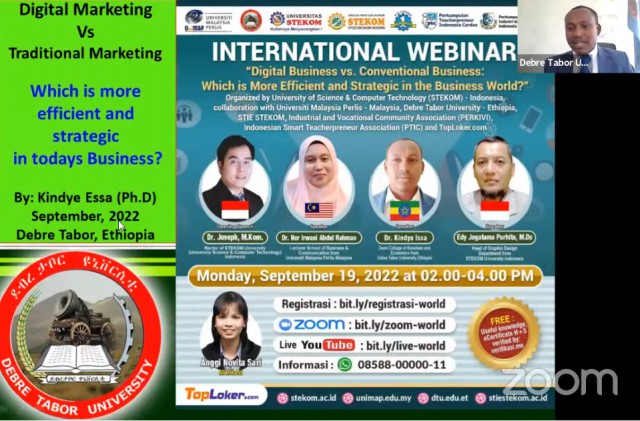
International Seminar “Digital Business vs conventional business” part 2 by Dr Kindya Issa Ethiopia
International Webinar
Kembali ke Berita
International Webinar
Rabu, 26 Oktober 2022
Priyadi, S.Kom, M.Kom
0 Dilihat