
Monday, August 21, 2023 (14.00 - 16.00 WIB)
STEKOM
University, Indonesia - The final round of the international seminar
with the theme "How AI Could Save (Not Destroy) Education"
has arrived. Dr. Edy Jogatama Purhita M.Ds, Head of the Visual
Communication Design Department at STEKOM, Indonesia, was the third
speaker of the event. In his presentation entitled "Opportunities
for Using Artificial Intelligence in Education: Chat GPT Case Study,"
Dr. Purhita discussed the use of artificial intelligence technology,
particularly in the context of education.
* Historical
Background of Artificial Intelligence
Dr. Edy
Jogatama Purhita started his presentation by giving an overview of
the historical background of artificial intelligence (AI)
development. He explained how this technology has made tremendous
progress over time, allowing computers to perform increasingly
complex tasks.
* Impact of GPT Chat in Education
This
presentation continued with a presentation on the impact of using
ChatGPT in education. Dr. Purhita highlighted how ChatGPT's ability
to produce well-structured writing has received attention from the
education world. However, she also revealed that the use of ChatGPT
has triggered reactions from some educational institutions. For
example, in December 2022, the Los Angeles Unified School District
blocked access to the OpenAI ChatGPT website on school networks and
devices in their area. Similar actions were also taken by the New
York City Department of Education.
Limitations of
Using ChatGPT in Building Problem Solving and Critical Thinking
Skills
Dr. Purhita reviewed how while technologies like ChatGPT
have incredible capabilities in text generation, their use may not
necessarily support students in building problem-solving and critical
thinking skills for academic and lifelong success.
* Features and Functions of ChatGPT
Dr. Edy
Jogatama Purhita further explained the various features and functions
of ChatGPT. He described how ChatGPT can be used as a tool to
generate texts of various styles and formats, ranging from scientific
texts to more casual language. This provides flexibility that is
important in educational and research contexts.
* Pros and Cons of ChatGPT
Dr. Purhita
also outlined some of the advantages and disadvantages of using
ChatGPT. Among the advantages are the ability to generate text
quickly and in large quantities, as well as consistency in writing
style. However, weaknesses to be aware of include limitations in
understanding context, limitations in data sources, and reliance on
internet sources that may not always be reliable.
* Use of ChatGPT in Education and Research
Dr. Edy
Jogatama Purhita discussed how ChatGPT can be used in education and
research. He highlighted the potential of ChatGPT in helping to
generate text, facilitate data search, and simplify information.
However, he also emphasized that the use of ChatGPT must be
accompanied by an in-depth understanding of the context and data
sources being used.
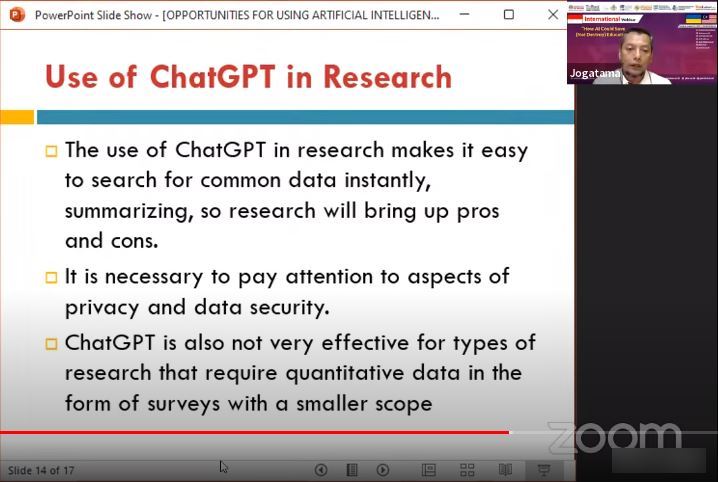
* Conclusion: Using ChatGPT in Research
This article
concludes with an understanding of how the use of ChatGPT in research
has great potential to facilitate various aspects of research.
However, there are drawbacks and challenges that need to be
considered, such as limitations in understanding the context,
reliance on internet sources, and the changing role of the
researcher. Therefore, it is important to use ChatGPT as a research
tool, not a substitute for a comprehensive research process involving
knowledgeable and experienced human contributions.
This seminar
provided an in-depth insight into the role of artificial intelligence
in education and research. With the various opportunities and
challenges highlighted by Dr. Edy Jogatama Purhita, the use of AI
technology in education must be managed wisely and responsive to the
needs of the academic and scientific community. This session closed
the series of presentations from the main speakers of this
international seminar.