
Ethiopian academics explain about the traditions of Ashenda celebrations in Ethiopia. Ashenda is a national festival celebrated by Tigray (Ethiopia), Agew (Ethiopia, Eritrea), Amhara (Ethiopia), and Eritrea. Ashenda also known as "Girls' day" is a festival that Habesha women of all ages look forward to. Although Ashenda is celebrated mainly by teenage girls, women of all age groups can participate in this national festival, during which men are expected to be on their best behavior. Habesha girls prepare for Ashenda celebrations in the leading months. Prior to the celebration, the girl group makes preparations for the holiday by buying new clothes, visiting the hairdresser, setting up drums and harvesting the typical 'Ashenda' grass (which they will tie around their waists for the celebration). The holiday started as a cultural holiday, but developed into a religious holiday. Its origins can be traced to ancient Israel the common way Hebrew women celebrated their Feasts, their triumphs, their heroes (Exodus 15:20). those who celebrate it now see it as a commemoration of the heavenly ascension of the Virgin Mary after the Dormition, a feast called the Filseta. It is usually celebrated between 16 and 26 August every year.
On the first day, the Ashenda girls get together and travel to St. Mary's Church. The local Mary (or any other Tewahedo Orthodox Church in the community), plays music and dances. They then toured the entire village, thanking every household in the community. The Ashenda girls spend about 20 minutes in each home, entertaining their family and themselves, before saying goodbye usually with a gift of money, food or drink. After door-to-door celebrations, the girls find a suitable pitch in or near the village, spending between a day and a week dancing and playing in the field while men passing by are urged to make monetary gifts. All money and gifts collected during the celebrations are then donated to charities, churches or other events.
Ashenda is named after the long, thin "Ashenda" grass that girls tie to hang from their waist in a fashionable pattern. Ashenda grass has become a symbol of religious festivals, when dancing girls move their waists causing the leaves to sway in exciting ways. This festival is also called "Shadey", "Ashendye", "Aynewari", "Solel" and "Ingicha".
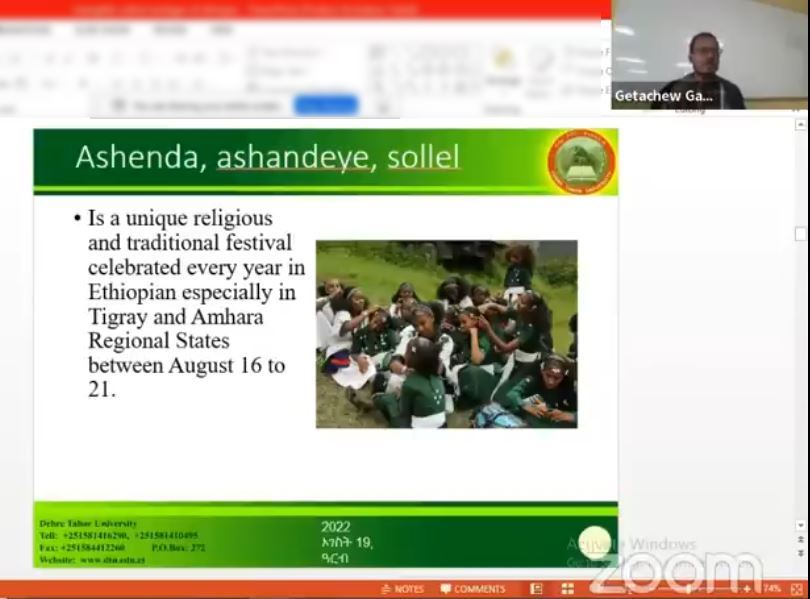
Ashenda is a unique religious and traditional festival celebrated annually in Tigray and Amhara States between 16 to 21 August. Ashenda is a Tigrinya word meaning 'tall green grass whose height is estimated to be around 80–90 centimeters. In the tradition of this religious festival, blades of grass are sprinkled on the floors of houses and shops as a kind of welcoming mat. Young unmarried girls and women skillfully plaited the grass into bundles and wore them over their backs while dancing on the occasion.
The material above was delivered by a presenter from Ethiopia in an international webinar held by STEKOM University in collaboration with Universities from Mexico, Ukraine, Ethiopia and various other parties. The presenter's name is Getachew Gashaw who is an academic in the country.
This international webinar activity is part of the implementation of STEKOM University's commitment to increase various international activities. This was done in order to realize the vision to become an international-class university. Various international activities carried out by STEKOM University continue from year to year. There are international activities that are sustainable and there are also some international activities that are not sustainable. All types of international activities are accommodated and regulated by the International department of STEKOM University.
International Webinar 2022 - Get to know the beauty of diverse cultures between countries – Part 14
International Webinar
Kembali ke Berita
International Webinar
Kamis, 26 Januari 2023
Priyadi, S.Kom, M.Kom
0 Dilihat