
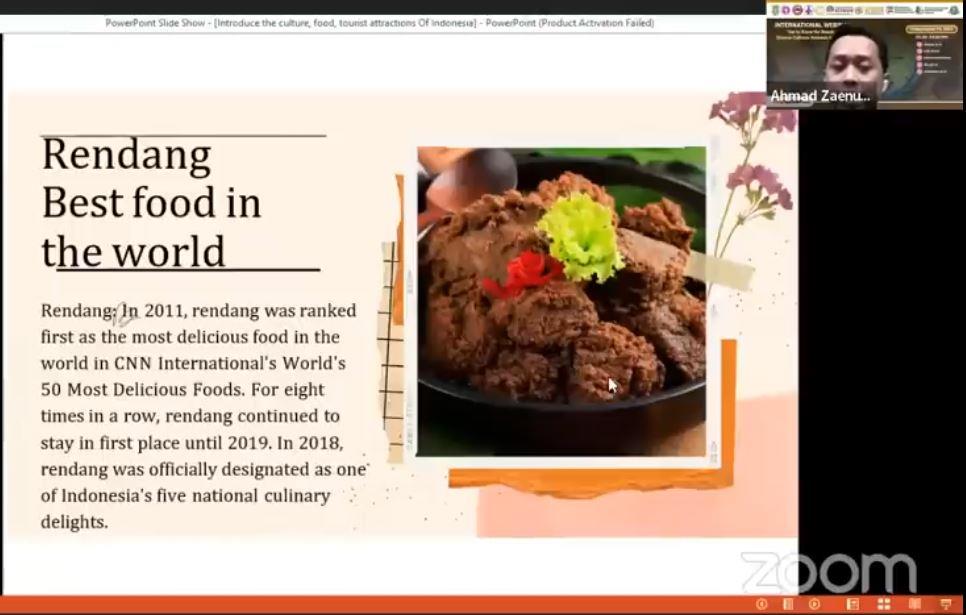
Indonesian academics explain about the traditional food beef rendang which was declared the world's best food in an international webinar. Rendang In 2011, rendang was ranked first as the most delicious food in the world in the World's 50 Most Delicious Foods version of CNN International. For eight times in a row, rendang continues to occupy the first position until 2019. In 2018, rendang was officially designated as one of Indonesia's five national culinary delights.
Rendang or randang in the Minangkabau language is a meat-based Minangkabau dish originating from West Sumatra, Indonesia. Cuisine is processed meat (usually beef or buffalo) or eggs cooked at low temperatures for a long time using various spices and coconut milk. The cooking process takes hours (usually about four hours) until all that is left are the dark black bits of meat and the bran. At room temperature, rendang can last for weeks. Rendang that is cooked in a shorter time and the coconut milk has not dried up is called kalio, which has a light golden brown color.
Rendang can be found in Padang Restaurants around the world. This cuisine is popular in Indonesia and other Southeast Asian countries, such as Malaysia, Singapore, Brunei, the Philippines and Thailand. In the area of origin, Minangkabau, rendang is served in various traditional ceremonies and special events. Although rendang is a traditional Minangkabau dish, the cooking techniques and the choice and use of rendang seasonings vary by region.
Rendang is used as food aid for victims of natural disasters because of its durability and nutritional content, such as the 2018 Lombok earthquake, 2018 Sulawesi earthquake and tsunami, 2019 Bengkulu flood, 2021 Seroja Cyclone storm, and 2022 Cianjur earthquake. Rendang seasoning is processed in a fusion manner (mixing) with other foods such as spaghetti, noodles, burgers, to sushi.
Rendang has a special position in Minangkabau culture. Rendang has its own philosophy for the Minang people of West Sumatra, namely deliberation and consensus, which depart from the four main ingredients that symbolize the integrity of the Minang community. Symbolically, dagiang (beef) represents "niniak mamak" (traditional tribal leaders), karambia (coconut) represents "clever cadiak" (intellectuals), lado (chilli) represents "alim ilama" who are strict to teach religious law, and cookers (spice) symbolize the whole of Minangkabau society.
In the Minangkabau tradition, rendang is a dish that must be served at every traditional celebration, such as various Minangkabau traditional ceremonies, kenduri, or welcoming guests of honor. In the Malay tradition, whether in Riau, Jambi, Bengkulu, Palembang, Lampung, Medan, or the Malay Peninsula, rendang is a special dish served at circumcisions, birthdays, weddings, barzanji, or religious events, such as Eid al-Fitr and Eid al-Adha.
The above material was presented by presenters from Indonesia in an international webinar held by STEKOM University in collaboration with Universities from Mexico, Ukraine, Ethiopia and various other parties. The presenter's name is Ahmad Zaenuri, M.Si who is a lecturer and head of the entrepreneurship study program at STEKOM University. The title of the presentation he delivered was "Introduce the culture, culinary, tourist attractions of Indonesia as a nation's economic asset".
This international webinar activity is part of the implementation of STEKOM University's commitment to increase various international activities. This was done in order to realize the vision to become an international-class university. Various international activities carried out by STEKOM University continue from year to year. There are international activities that are sustainable and there are also some international activities that are not sustainable. All types of international activities are accommodated and regulated by the International department of STEKOM University.
International Webinar 2022 - Get to know the beauty of diverse cultures between countries – Part 16
International Webinar
Kembali ke Berita
International Webinar
Minggu, 29 Januari 2023
Priyadi, S.Kom, M.Kom
0 Dilihat