
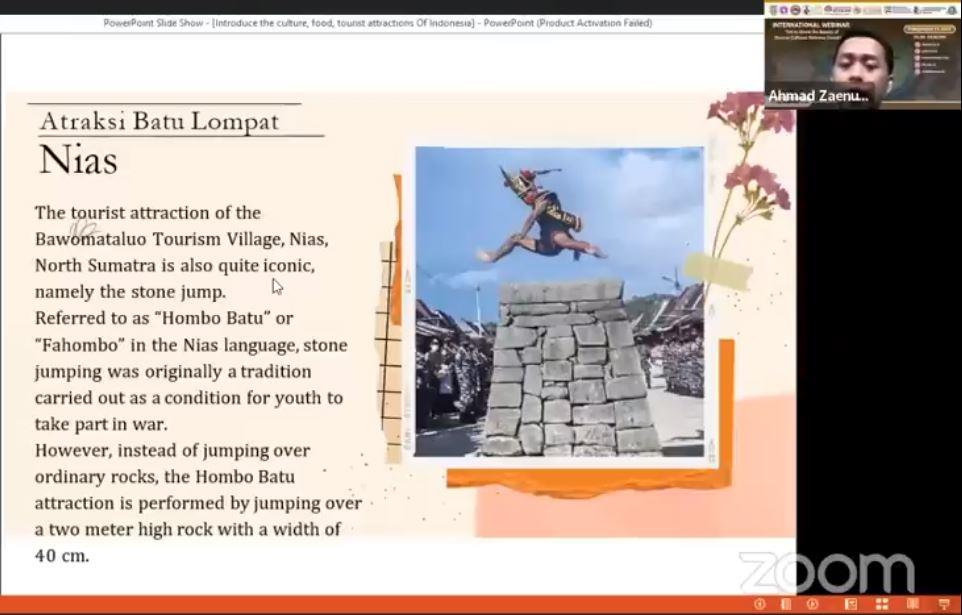
Indonesian academics explain about the stone jumping tradition in Nias in an international webinar. The tourist attraction of Bawomataluo Tourism Village, Nias, North Sumatra is also quite iconic, namely stone jumping. Called "Hombo Batu" or "Fahombo" in the Nias language, stone jumping was originally a tradition that was carried out as a condition for young people to join the war. However, instead of jumping over the usual rocks, the Hombo Batu attraction is performed by jumping over a two-meter high rock with a width of 40 cm.
Bawomataluo in the Nias language means hill of the sun. The name of the village is in accordance with the name of the location which is on a hill with a height of 324 meters above sea level. This village has been built many centuries ago. The Stone Jump tradition is usually carried out by youths by jumping over a 2 meter high pile of stones to show that they deserve to be considered physically mature. Apart from being performed in a traditional way, the stone jumping tradition is also an interesting show, especially for tourists who come there.
South Nias Regency has an area of 1,825.2 km2. Its territory is in the western part of the island of Sumatra with a distance of approximately 92 miles from Sibolga City or Central Tapanuli Regency. The capital city of South Nias is Teluk Dalam which is located on the island of Nias.
The tradition of stone jumping has been going on for centuries. Traditions are preserved along with megalithic culture on an island covering an area of 5,625 km2 with a population of 700,000 people and surrounded by the Indian Ocean. The Fahombo tradition has been passed down from generation to generation to boys. However, not all boys are able to do this tradition, even though they have been trained since childhood. The people of Nias believe that aside from training, there is also a magical element from the ancestral spirits for someone who can jump over rocks perfectly.
Initially, the stone jumping tradition originated from the habit of fighting between tribal villages on the island of Nias. The people of Nias have a tough and strong character inherited from the culture of warriors. In the past, the tribes on Nias Island often fought because they were provoked by feelings of revenge, land restrictions, or slavery issues. Each village then fortified the area with stones or bamboo as high as 2 meters. Therefore, the stone jumping tradition was born and carried out as a preparation before going to war. The nobles from the Balugu strata who ruled Nias Island at that time would determine whether or not a Nias man was fit to become a war soldier.
In ancient times, fahombo attractions not only made Nias youths proud but also their families. Families whose children have succeeded in fahombo will hold a party by slaughtering several cattle. Stone Jumping Tradition as a Cultural Symbol of Nias Now, the stone jumping tradition is not to prepare for war between tribes or between villages but as a ritual and cultural symbol of the Nias people. This tradition becomes a cultural attraction to fill the event which is usually performed with war dance attractions, which are adaptations of wars in the past. However, because war dance involves dozens of people, cultural attractions can only feature stone jumping.
The above material was presented by presenters from Indonesia in an international webinar held by STEKOM University in collaboration with Universities from Mexico, Ukraine, Ethiopia and various other parties. The presenter's name is Ahmad Zaenuri, M.Si who is a lecturer and head of the entrepreneurship study program at STEKOM University. The title of the presentation he delivered was "Introduce the culture, culinary, tourist attractions of Indonesia as a nation's economic asset".
This international webinar activity is part of the implementation of STEKOM University's commitment to increase various international activities. This was done in order to realize the vision to become an international-class university. Various international activities carried out by STEKOM University continue from year to year. There are international activities that are sustainable and there are also some international activities that are not sustainable. All types of international activities are accommodated and regulated by the International department of STEKOM University.
International Webinar 2022 - Get to know the beauty of diverse cultures between countries – Part 20
International Webinar
Kembali ke Berita
International Webinar
Selasa, 31 Januari 2023
Priyadi, S.Kom, M.Kom
0 Dilihat