
Indonesian academics presented Phoenix Tea which is a special tea from China in an international webinar held with STEKOM University. Feng Huang Dan Cong Oolong Tea originates from Guangdong Province. It grows on Mount Fenghuang in Chaozhou City. This region has a temperate and humid climate. Fenghuang danzong grows on a mountain 1000-2000 meters high.
The tea leaves are large and stemmed. The color is dark brown with a hint of red. After brewing, the liquid is golden clear. The aroma evokes the scent of orchids. The taste and texture are earthy and smooth.
The name "Dan Cong" refers to a semi-wild shrub. Dan Cong's meaning is opposite to Garden Tea. As for Dan Cong, it was a tea tree that grew independently and randomly in the wild. It usually grows on mountain slopes, like other native trees. In addition, Dan Cong refers to trees that are neither cared for nor pruned at all. A similar term in English for "Cong" should be "Bush". The "Dan" means single. Originally Dan Cong also meant a single identical bush. In a way, the term Dan Cong is not only used for Phoenix Oolong, but also for Wu-yi oolong. High-grade Wu-yi tea is also supposed to be made from Dan Cong (single bush)
Dan Cong is a very old tea dating back a period of 900 years. Feng Huang Oolong is divided into three quality categories. Feng Huang Shui Xian is the most common, one higher quality grade is Feng Huang Lang Cai and the highest grade of this tea is Feng Huang Dan Cong, which always comes from one specially selected plant and must be harvested only in the fall between one and four in the afternoon and exclusively on cooler, sunny days, to maintain its legendary scent (ten scents of Feng Huang). During the reign of the Song Dynasty, it was the emperor's tea. The long, slightly crinkled brown leaves are highly aromatic and make a sweet infusion with a peach flavor, reminiscent of the popular Chinese longan fruit (with a taste similar to that of lychee).
The health benefits of oolong tea include reduction of chronic health conditions such as heart disease, inflammatory disorders, and high cholesterol, high blood pressure, high blood sugar levels, while providing important antioxidants, promoting superior bone structure, strong skin and good dental health. Oolong tea is fragrant with a fruity taste and pleasant aroma. Despite the caffeine content, it can still be very relaxing to drink. Very good for detoxification, removing toxins and fat out of the body.
The health benefits of oolong tea are basically multiplied due to the combination of the qualities of black tea and green tea. According to the United States Tea Association, oolong tea falls between green and black teas, as the leaves are only partially oxidized. There are many kinds of tea in this world; but oolong tea is perhaps one of the most beneficial.
The origins of oolong tea go back almost 400 years, when it found widespread use in China. This is a semi-green fermented tea, but the fermentation process is stopped as soon as the tea leaves start to change color.
The above material was delivered by a presenter from China in an international webinar held by STEKOM University in collaboration with Universities from Mexico, Ukraine, Ethiopia, China and various other parties. The presenter's name is Xiaobo who comes from China.
This international webinar activity is part of the implementation of STEKOM University's commitment to increase various international activities. This was done in order to realize the vision to become an international-class university. Various international activities carried out by STEKOM University continue from year to year. There are international activities that are sustainable and there are also some international activities that are not sustainable. All types of international activities are accommodated and regulated by the International department of STEKOM University.
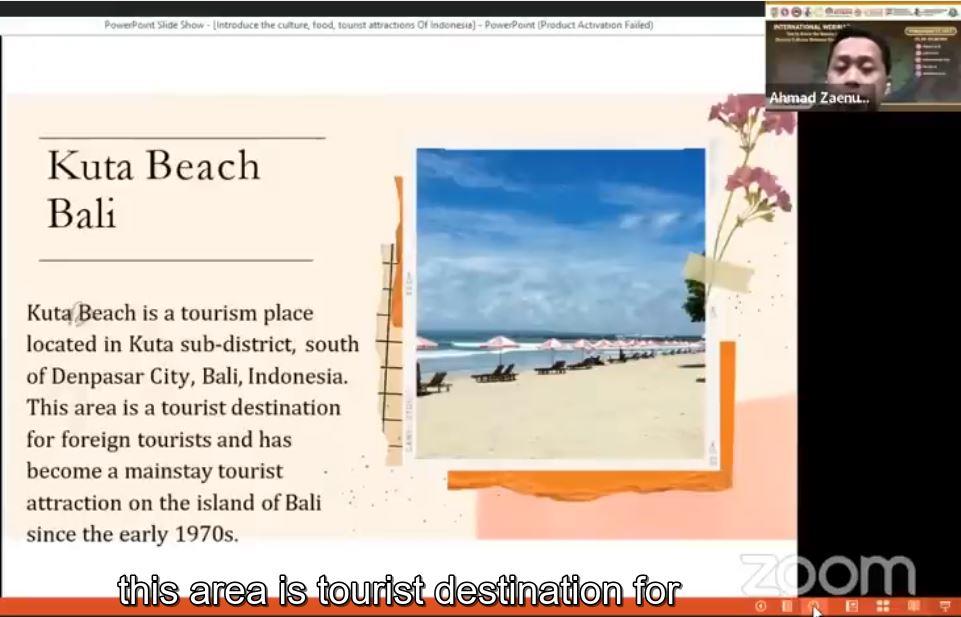
International Webinar 2022 - Get to know the beauty of diverse cultures between countries – Part 27
International Webinar
Kembali ke Berita
International Webinar
Kamis, 2 Februari 2023
Priyadi, S.Kom, M.Kom
0 Dilihat