
Indonesian academics presented the stages of the simple lifestyle of gong fu tes which is a tradition from China in an international webinar held with STEKOM University. In essence, what is wanted in Gongfu Cha is a drink that tastes good and satisfies the soul. Tea masters in China and other Asian tea cultures studied over the years to perfect this method. However, method alone will not determine whether a good cup of tea will result. Basically, two things have to be considered: chemistry and temperature.
Water must be considered carefully when performing Gongfu Cha. Water that tastes or smells bad will adversely affect the brewed tea. However, distilled or very soft water should not be used as this form of water lacks minerals, which will negatively affect the taste of the tea and result in an "even" brew. For this reason, most tea connoisseurs will use clean and good local spring water. If natural spring water is not available, bottled spring water will suffice. Even though mineral water with a high content also needs to be avoided. It is said that hard water needs to be filtered even though the mineral content of even very hard water can be dissolved, and no amount of filtering will affect it.
During the Gongfucha process, the tea master will first determine the appropriate temperature for the tea used, in order to extract the aroma of the tea. The optimal temperature must be achieved and maintained. The water temperature depends on the type of tea used. The guide is as follows:
- 75–85 °C (167–185 °F) for green tea (80 °C (176 °F) average)
- 75–80 °C (167–176 °F) for white tea (usually 75 °C (167 °F))
- 80–85 °C (176–185 °F) for oolong tea (85 °C (185 °F) average)
- 100 °C (212 °F) (boiling) for compressed teas, such as pu-erh tea
The temperature of the water can be determined by the time of day, as well as the size and sizzling sound made by the air bubbles in the kettle.
- At 75–85 °C (167–185 °F), the bubbles that form are known as "crab eyes" and are about 3 millimeters (0.12 in) in diameter. They were accompanied by a loud and rapid hissing sound.
- At 90–95 °C (194–203 °F), the bubble, which is now about 8 millimeters (0.31 in) in diameter and is accompanied by a less frequent hissing sound and a lesser pitch of hissing, is nicknamed "fisheye". .
- When the water is boiling, there is no formation of air bubbles or hissing sound.
At high altitudes, water boils at a lower temperature, so the temperature range above must be adjusted.
The above material was delivered by a presenter from China in an international webinar held by STEKOM University in collaboration with Universities from Mexico, Ukraine, Ethiopia, China and various other parties. The presenter's name is Xiaobo who comes from China.
This international webinar activity is part of the implementation of STEKOM University's commitment to increase various international activities. This was done in order to realize the vision to become an international-class university. Various international activities carried out by STEKOM University continue from year to year. There are international activities that are sustainable and there are also some international activities that are not sustainable. All types of international activities are accommodated and regulated by the International department of STEKOM University.
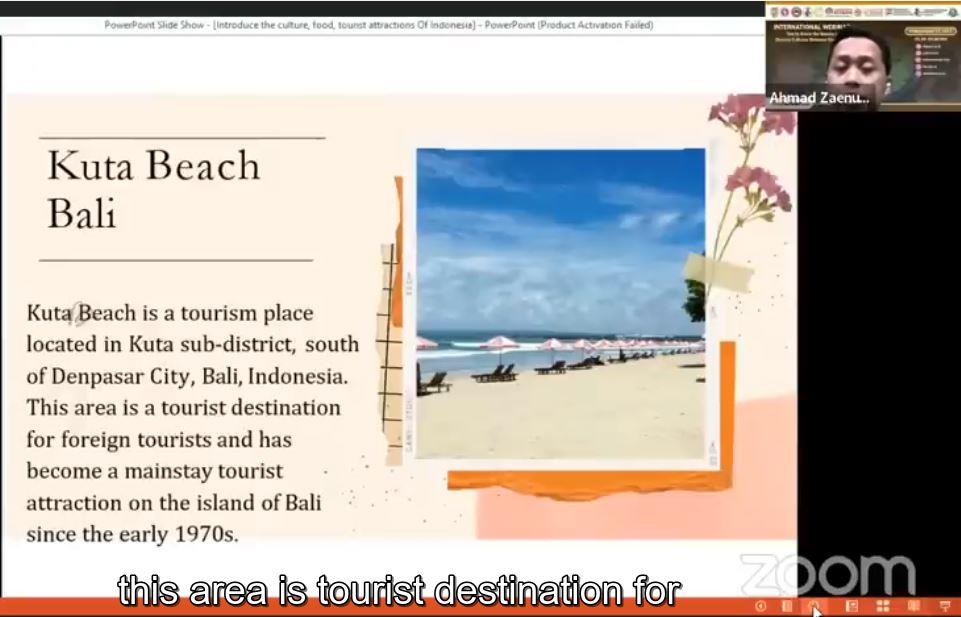
International Webinar 2022 - Get to know the beauty of diverse cultures between countries – Part 28
International Webinar
Kembali ke Berita
International Webinar
Kamis, 2 Februari 2023
Priyadi, S.Kom, M.Kom
0 Dilihat