
Academics from Ukraine explained that each region in Ukraine has its own unique differences. The territory of Ukraine derives its characteristics from a diverse complex of physical-geographical and human factors, including natural phenomena (topography, vegetation, climate) and human characteristics (population, political-administrative boundaries, economic indicators). The most permanent features in the centuries of human records are landscapes. They influence drainage patterns, climate, flora, population density, and the economy. Its most striking feature, the difference in elevation, is seen only where mountains begin, or where the plateau is marked by deep valleys or cliffs. In some places, such as in the northern lowlands, Policea marshes are a common feature; elsewhere, such as on the plains of southern Ukraine, the shift from forest-steppe to steppe vegetation and a drier climate became major factors of regional differentiation. Ukraine can thus be divided into four main natural units: northern, central, southern, and mountainous. The northern belt, commonly known as Polisia, is a sparsely populated region of postglacial, forest, and marsh landscapes. The middle belt is a region of erosive loess landscapes. It has a temperate, subhumid climate and degraded chornozem and chornozem soils that develop under natural forest-steppe vegetation. Possessing excellent conditions for agriculture, the middle belt supports fertile and densely populated agricultural lands. The southern belt differs from the middle belt in a warmer, semi-arid climate. Chornozem and chestnut soils developed under the steppe flora, which until recently was grazed by herds of wild or domestic hoofed animals. Today it is mostly plowed where some crops enjoy additional irrigation, but are less densely populated than the middle belt, except in industrial areas. The Carpathian Mountains, Crimean Mountains, and Caucasus Mountains, together with their respective submontane foothills and depressions, constitute small separate units.
The differentiation of Ukrainian national regions based on human characteristics may involve ethnographical issues. The cultural attributes of the Ukrainian people, which have evolved with respect to their use of the environment and their mutual relations with their neighbors, include subtle differences in language (dialect), music, beliefs, and social behavior, as well as elements of material culture, such as the type and style of houses in clothing, embroidery, pottery, and the like. Such characteristics are best preserved in remote locations with minimum immigration, such as marshy Police or remote valleys of the Carpathian Mountains. Vasyl Horlenko recognized six ethnographic regions and several subregions of Ukraine. Polisia or the northern region (which is closely related to the physical-geographical region of Polisia) has autochthons with ancient cultural features. It can be divided into three sub-regions, the left bank region or Chernihiv Policea, the central region or Kyivan Police (northwest of Kyiv), and the western region or Volhynian Police. The Carpathian ethnographic region is the most complex of all. It includes not only the Carpathian Mountains but also the Tysa Lowland in Transcarpathia and the Dnister Lowland in Subcarpathia, extends north to Roztochia, and includes the western end of the Podolian Upland. The region is bordered by Poland, Slovakia, Hungary and Romania, peoples with whom Ukrainians have long interacted in the region. In the mountains there are still three distinct Ukrainian ethnographic groups (one each from southeast to west), the Hutsuls, Boikos and Lemkos. The remaining areas, on the other hand, are more homogeneous and similar to one another. The Podolian ethnographic region corresponds to the central and eastern parts of the Podolian Upland. The central ethnographic region or #Dnipro stretches south of Kyiv along both sides of the Dnipro River to Kropyvnytskyi in the south and Poltava in the east. This is the heart of Ukraine and is the site of the strongest development of the Ukrainian nationality from the 15th and 16th centuries. Slobidska Ukraine, the fifth major ethnographic region, was settled in the 17th century by Ukrainian Cossacks as military servitors on the border of the Moscow steppes, and thus experienced a long period of Russian-Ukrainian interaction. The region stretches from Sumy through Kharkiv and eastward, with a line across the Russian Federation south of Lgov and Belgorod widening into a wedge south of Voronezh to Novokhopersk and south to Morozovsk in the Rostov oblast. Finally, the ethnographic region of the south or steppes is large and not clearly distinguished. It roughly corresponds to the steppe belt. The region was settled only in the 18th century, by Ukrainian peasants who, more than anywhere else, were influenced by the commerce and urban way of life of the Russians (across the belt), and through interactions with them and with the Germans (in the west, center, and east), Romanians (in the west), Bulgarians (in the west and center), Greeks (in the east), and Caucasians (in the Kuban).
A distinct Ukrainian regional identity has developed among segments of the population that have been isolated from the mass of the Ukrainian people by historical circumstances. The most obvious examples are the populations of Transcarpathia (which existed as a unit under the Kingdom of Hungary, Transylvania, Hungary, the Austro-Hungarian Empire, and Czechoslovakia), Galicia (under the Kingdom of Poland, Austria, and then Poland again), Bukovyna (under Romania). ), the Kholm and Podlachia regions (both mostly under Poland), Polisia (under Lithuania and later Russia, Poland, and Belarus), Slobidska Ukraine (under Muscovy, Russian Empire, Russian Soviet Federative Socialist Republic, and Russian Federation) , and the Kuban and eastern Subcaucasus (under the Russian Empire, RSFSR, and Russian Federation). Groups affected by regionalism make up about one-fifth of Ukraine's population; the rather undifferentiated Central Ukrainian mass makes up the remaining four-fifths.
The above material was presented by a presenter from Ukraine in an international webinar held by STEKOM University in collaboration with Universities from Mexico, Ukraine, Ethiopia and various other parties. The title of the presentation brought by the presenter from Mexico was "Get to know the beauty of diverse cultures between countries". The presenter's name is Natalia Venherska who is an academic with the academic position of associate professor and PhD academic degree in the field of economics at the Zaporizhzhia National University's national economics department.
This international webinar activity is part of the implementation of STEKOM University's commitment to increase various international activities. This was done in order to realize the vision to become an international-class university. Various international activities carried out by STEKOM University continue from year to year. There are international activities that are sustainable and there are also some international activities that are not sustainable. All types of international activities are accommodated and regulated by the International department of STEKOM University.
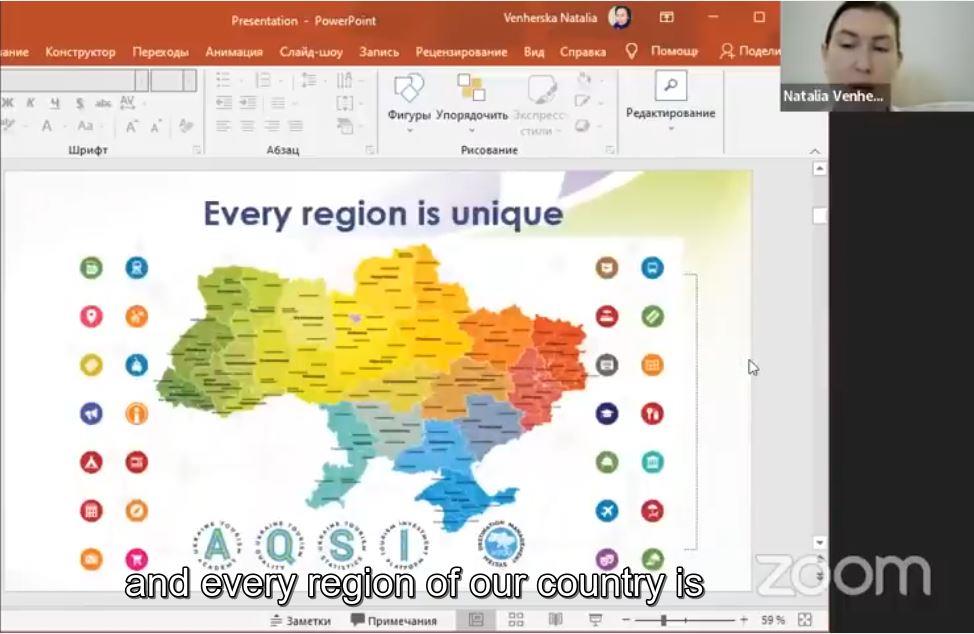
International Webinar 2022 - Get to know the beauty of diverse cultures between countries – Part 7
International Webinar
Kembali ke Berita
International Webinar
Senin, 23 Januari 2023
Priyadi, S.Kom, M.Kom
0 Dilihat