
International presenter from Bangladesh explained about the application of nanotechnology in food processing. Nanoparticles have better properties for encapsulation and release efficiency than traditional encapsulation systems. Nanoencapsulation masks odors or tastes. controls the interaction of active ingredients with the food matrix, controls release of active ingredients, ensures availability at target specific times and rates, and protects them from moisture, heat, chemical, or biological degradation during processing, storage, and use, and also demonstrates compatibility with other compounds in system.
In addition, these delivery systems have the ability to penetrate deep into the tissues due to their smaller size and thereby enable efficient delivery of active compounds to target sites within the body. Various synthetic and natural polymer based encapsulation delivery systems have been elaborated for enhancing the bioavailability and preservation of active food components.
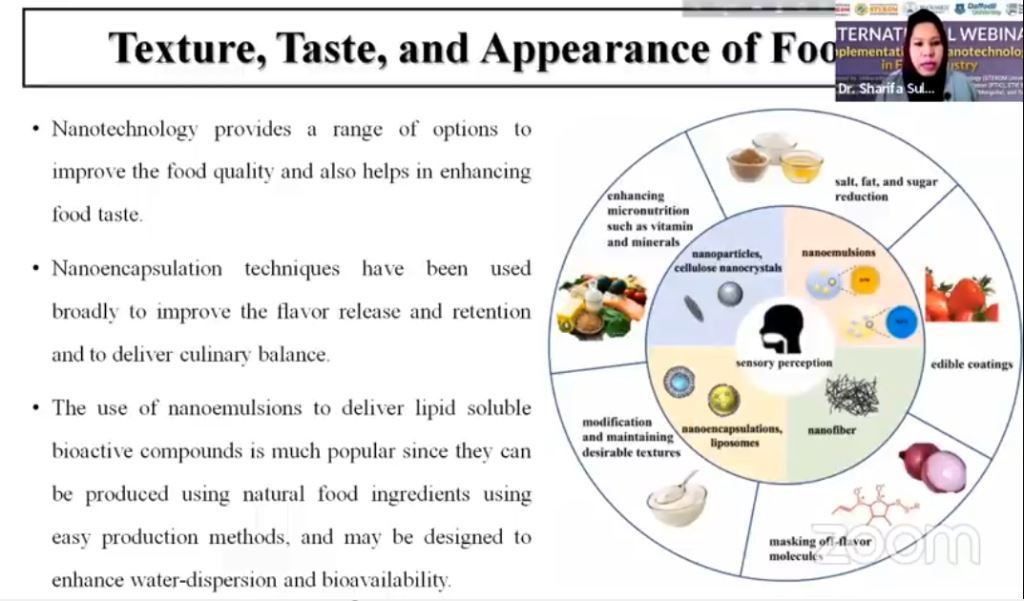
Nanotechnology provides various options to improve the quality of food and also helps improve the taste of food. Nanoencapsulation techniques have been used extensively to enhance flavor release and retention and to provide culinary balance. The use of nanoemulsions to produce fat-soluble bioactive compounds is very popular because they can be produced using natural food ingredients using easy production methods, and can be designed to improve water dispersion and bioavailability.
Nanoparticles provide a promising way to increase the bioavailability of nutraceutical compounds due to their subcellular size leading to higher drug bioavailability. Many metal oxides such as titanium dioxide and silicon dioxide (SiO2,) have been conventionally used as dyes or streamlines in foodstuffs. SiO2, a nanomaterial is also one of the most widely used food nanomaterials as a carrier for fragrances or flavors in food products.
Most of the bioactive compounds are sensitive to high acid environment and gastric and duodenal enzyme activity. The encapsulation of these bioactive compounds not only enables them to resist such adverse conditions but also allows them to be assimilated easily in food products, which is quite difficult to achieve in non-capsule form due to the low water solubility of these bioactive compounds. Small edible capsules based on nanoparticles with the aim of improving drug delivery. Fragile vitamins or micronutrients in the daily diet are created to provide significant health benefits.
Nanocompositing, nano-emulsification and nano-structuring are different techniques that have been applied to encapsulate substances in miniature forms to more effectively deliver nutrients such as proteins and antioxidants for targeted nutritional and health benefits. Polymer nanoparticles were found to be suitable for the encapsulation of bioactive compounds (e.g., flavonoids and vitamins) to protect and transport bioactive compounds to target functions.
The above material was presented by a presenter from Bangladesh in an international webinar entitled "Prospect of Nanotechnology in Food Processing and Food Packaging" which was held by STEKOM University in collaboration with the University of Bangladesh and various other parties. The name of the presenter from Bangladesh is Sharifa Sultana, PhD. The presenter's academic position is Associate Professor & Associate Head, Department of Pharmacy, FAHS at Daffodil International University, Bangladesh.
This international webinar activity is part of the implementation of STEKOM University's commitment to increase various international activities. This was done in order to realize the vision to become an international-class university. Various international activities carried out by STEKOM University continue from year to year. There are international activities that are sustainable and there are also some international activities that are not sustainable. All types of international activities are accommodated and regulated by the International department of STEKOM University.
International Webinar 2022 - Implementation Nano Technology in Food Industry - part-3
International Webinar
Kembali ke Berita
International Webinar
Selasa, 10 Januari 2023
Priyadi, S.Kom, M.Kom
0 Dilihat