
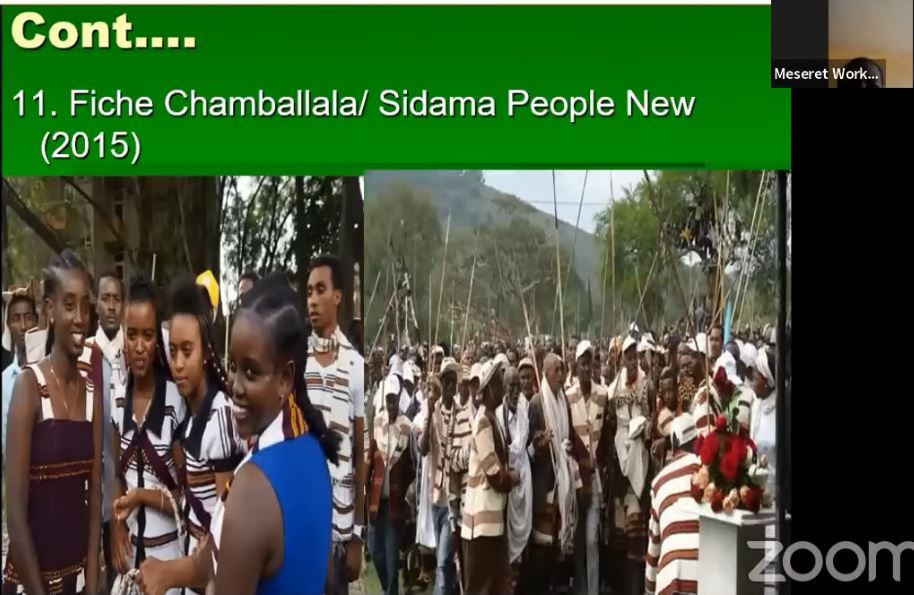
Next, Mr. Meseret explained about Fichee-Chambalaalla. Fichee-Chambalaalla is a New Year festival celebrated among the Sidama people. According to oral tradition, Fichee commemorates a Sidama woman who visited her parents and relatives once a year after her wedding, bringing buurisame, a food made of fake bananas, milk, and butter, which she shared with neighbors. Fichee has since become a unifying symbol of the Sidama people. Every year, astrologers determine the exact date for the festival, which is then announced to the clan. Communal events take place throughout the festival, including traditional songs and dances. Every member participates regardless of age, gender and social status. On the first day, children go from door to door to greet their neighbors who serve them buurisame. During the festival, the clan leader advises the Sidama people to work hard, to respect and support their elders, and not to cut down customary trees, beg, be lazy, false witness and steal. Hence, this festival promotes equality, good governance, social cohesion, peaceful coexistence, and integration among the Sidama clan and various ethnic groups in Ethiopia. Parents passed the tradition on to their children orally and through participation in events during the celebrations. Women in particular, transfer knowledge and skills related to hairdressing and buurisame preparation to their daughters and other girls in their respective villages.
The above material was presented at an international webinar held by STEKOM UNIVERSITY on August 18 2022 by an academic from Debre Tabor University, Ethiopia. The academic's name is Meseret Worku who is a lecturer in the department of history and cultural heritage management. The title of the presentation delivered by Mr. Meseret was "Survey of tangible cultural of Ethiopia". The explanation starts with an introduction, then continues with an explanation of the definition of heritage, and so on.
This activity is part of the implementation of STEKOM University's commitment to increase various international activities in order to realize the vision to become an international-class university. Various international activities carried out by STEKOM University continue from year to year. There are international activities that are sustainable and there are also some international activities that are not sustainable. All types of international activities are accommodated and regulated by the International department of STEKOM University.
According to information obtained from the Sidama Regional Culture and Tourism Office, the Sidama New Year Festival is one of the intangible cultural events passed down from generation to generation in Ethiopia.
The Sidama elders who are called "Ayanto" are the ones who set the exact day of the end of the old year and the beginning of the new year, according to Abebe Tafesse, Public Relations Director of the Regional State Bureau of Culture, Tourism and Sports. Approaching the new year, "Fiche" was officially announced to the public a week earlier after "Ayanto" determined New Year's Day or Chambalala.
About a month before Chambalala, Ayanto held a meeting to choose a leader to pray for for the coming year. These elected elders seclude themselves and fast, purifying themselves so they can predict the coming year for people. It is believed that these elders can predict whether the New Year will come with good weather and peace. Ayanto looks up to the sky (stars) and down to the earth (cecum goat), seeking the wisdom that nature provides.
They slaughter a young goat and read aloud the wisdom of their ancestors, predicting what will happen in Sidama in the coming New Year. An intense look into the cecum (a poach considered the beginning of the large intestine) of a goat is believed to reveal the future to its elders.
Apart from the intestines of the goat, the elders also consulted the stars. They carry out intensive observations and analyzes of the solar system by making individual or group observations for several hours a day or at least four to six days per month before New Year's Day is determined based on their final findings. Their findings helped them not only to determine Fiche's day but also to predict the good and bad of the coming year.
Chambalala, the first day of the Sidama New Year, is a special day for everyone. Children do not work on this day; instead they gather and say, "Aide Chambalala", which means "we have returned" and the mothers answer "ille, ille" which means "nice to meet you today" giving the children different food.
In Fiche Chambalala, cattle are released for grazing. Men and women, young and old, all celebrate the day with joy. Relatives and neighbors gathered and spent the day eating and drinking. They then went to the square to sing and dance, expressing their celebration.
“The stars in the sky guided the wise men to the birthplace of Jesus Christ in ancient times,” Abebe said, citing an anecdote to point out the same to the Sidama elders who also rely on the guidance of the stars to determine the day of Chambalala.
International webinar 2022 – Implementation of local culture in modern technology part 13
International Webinar
Kembali ke Berita
International Webinar
Minggu, 27 November 2022
Priyadi, S.Kom, M.Kom
0 Dilihat