
At an international webinar held by STEKOM UNIVERSITY on August 18 2022, an academic from Debre Tabor University, Ethiopia. The academic's name is Meseret Worku who is a lecturer in the department of history and cultural heritage management. The title of the presentation delivered by Mr. Meseret was "Survey of tangible cultural of Ethiopia". The explanation starts with an introduction, then continues with an explanation of the definition of heritage, and so on.
This activity is part of the implementation of STEKOM University's commitment to increase various international activities in order to realize the vision to become an international-class university. Various international activities carried out by STEKOM University continue from year to year. There are international activities that are sustainable and there are also some international activities that are not sustainable. All types of international activities are accommodated and regulated by the International department of STEKOM University.
Next, Mr. Meseret explained about the cultural heritage in the city of Harar. Harar is known historically as Gey which is a walled city in eastern Ethiopia. This city is also known in Arabic as the Holy City. Harar is the capital of the Harari Region. The city also serves as the administrative center of the East Hararghe Zone in the Oromia Region. This ancient city is located on a hilltop in the eastern part of the country and is about five hundred kilometers from the Ethiopian capital, Addis Ababa, at an altitude of 1,885 meters (6,184 feet).
Over the centuries, Harar has been a major commercial center, linked by trade routes with all of Ethiopia, the entire Horn of Africa, the Arabian Peninsula, Asia, and through its ports, the outside world. Harar Jugol, the old walled city, was listed as a World Heritage Site in 2006 by UNESCO in recognition of its cultural heritage. Due to Harar's long history of involvement during the days of trade in the Arabian Peninsula, the Government of Ethiopia has taken it criminal action to destroy or disturb any historical sites or fixtures in the city. It includes stone houses, museums, and war discarded items. According to UNESCO, the city is "considered the 'fourth holiest city' of Islam" with 82 mosques, three of which date from the 10th century, and 102 shrines.
Yahya Naṣrallah's Fatḥ Madinat Harar, an unpublished history of the city in the 13th century, records that the legendary saint Abadir Umar ar-Rida and several other religious leaders settled on the Harar plateau c. 1216 (612 AH). Harar was then made the new capital of the Adal Sultanate in 1520 by Sultan Abu Bakr ibn Muhammad. The city experienced a political decline during the following Emirate of Harar, only regaining its significance in the Khedivate period of Egypt. During the Ethiopian Empire, the city decayed while retaining a certain cultural prestige.
When Harar was founded is unclear, and various dates have been suggested. In any case, the modern city of Harar dates largely from the early 1700s, but the site itself has been a city site much longer. It is likely that the original inhabitants of the area were the Harla people. Harar was part of the domain of the Harla Kingdom in the sixth century. In the Islamic period, the city was under the alliance of the Confederate States of Zeila. According to the 12th-century Jewish traveler Benjamin of Tudela, the Zeila region was the land of Havilah, bounded by al-Habash to the west.
In the ninth century, Harar came under the Shewa Sultanate of the Maḥzumi dynasty. Islam had gained a foothold on the Harar plateau in the 10th to 11th centuries AD through trade with Zeila. By the 13th century Islam had become the dominant religion in the region.
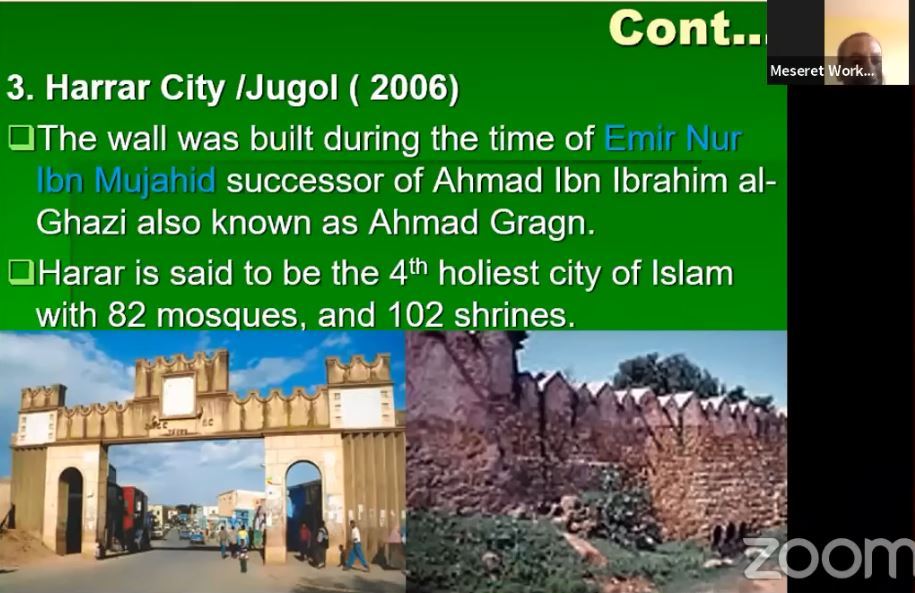
International webinar 2022 – Implementation of local culture in modern technology part 6.
International Webinar
Kembali ke Berita
International Webinar
Selasa, 22 November 2022
Priyadi, S.Kom, M.Kom
0 Dilihat