
At an international webinar held by STEKOM UNIVERSITY on August 18 2022, an academic from Debre Tabor University, Ethiopia. The academic's name is Meseret Worku who is a lecturer in the department of history and cultural heritage management. The title of the presentation delivered by Mr. Meseret was "Survey of tangible cultural of Ethiopia". The explanation starts with an introduction, then continues with an explanation of the definition of heritage, and so on.
This activity is part of the implementation of STEKOM University's commitment to increase various international activities in order to realize the vision to become an international-class university. Various international activities carried out by STEKOM University continue from year to year. There are international activities that are sustainable and there are also some international activities that are not sustainable. All types of international activities are accommodated and regulated by the International department of STEKOM University.
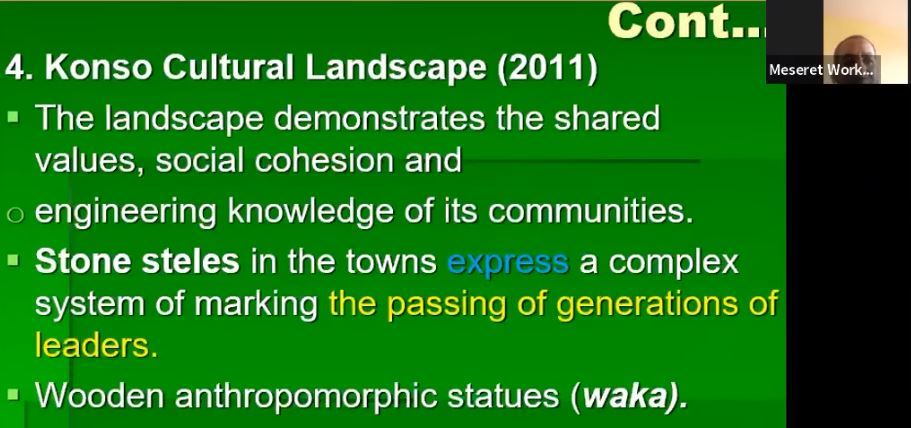
Next, Mr. Meseret explained about the cultural heritage in the Lanscape console. The Cultural Landscape of Konso is an arid property of stone-walled terraces and fortified settlements on the Konso plateau in Ethiopia. It is a spectacular example of a living cultural tradition spanning 21 generations (over 400 years) adapted to its dry and hostile environment. This landscape demonstrates the shared values, social cohesion, and engineering know-how of the community. The site also features anthropomorphic wooden statues - grouped to represent respected members of their community and particularly heroic events - which are a remarkable living testimony of a nearly disappeared funerary tradition. Stone inscriptions in cities express an elaborate system of marking the passing of generations of leaders.
The Konso Cultural Landscape is characterized by broad dry stone terraces which bear witness to the indomitable struggle of humans to harness and exploit the harsh, dry and rocky environment. Terraces hold the soil against erosion, collect maximum water, remove excess, and create terraces used for agriculture. Terraces are a major feature of Konso's landscape and contour hills with dry stone walls, which reach 5 meters in height.
The walled cities and settlements (paletas) of the Konso Cultural Landscape are located on plateaus or hilltops chosen for their strategic and defensive advantages. These cities were surrounded by between one and six rounds of drystone defensive walls, built from locally available stone. The cultural spaces within the walled city, called moras, retain an important and central role in Konso's life. Some walled cities have as many as 17 moras. The tradition of laying generational marker stones called daga-hela, excavated, transported and erected through ritual processes, makes Konso one of the last megalithic societies.
The forest is traditionally used as a burial place for ritual leaders and for medicinal purposes. Wooden anthropomorphic statues (waka), carved from hardwood and modeled after the deceased, were erected as grave markers. Water reservoirs (harda) located in or near these forests, are constructed communally and, like terracing, are maintained by very specific communal social and cultural practices.
Criterion (iii): The Konso Cultural Landscape integrates spectacularly executed dry stone terrace works still in active use by the Konso people who made them. They testify to the enormous effort required to use the hostile environment in an area covering more than 230 square km, an effort that is an example of human great achievement. The connection between these stone terraces and the fortified city in the center is a remarkable feature of the cultural landscape, which also testifies to the living tradition of inscription installation. The Konso stone inscription was erected to commemorate and mark the transfer of responsibility from the older to the younger. Konso were among the people who erected the last inscriptions and thus their continued practice bears a remarkable testimony to an ongoing cultural tradition.
Criterion (v): The relationship between the stone terraces and the fortified city in the Konso Cultural Landscape, and its highly organized social system, illustrating outstanding examples of traditional human settlement and land use, based on shared values that led to the creation of a cultural and socio-economic order Konso. Dry stone terraces exhibit sophisticated adaptive strategies to the environment and the labor required to build these terraces required strong cohesion and bonds of unity among clans. This interaction with the environment is based on indigenous engineering knowledge and requires the traditional division of labour, which is still used to consistently carry out maintenance and conservation work.
The boundaries of the Konso Cultural Landscape coincide with natural features, such as rivers or the banks of densely terraced landscapes, and are bounded by the cultural and socioeconomic history of the Konso people. All components relevant to understanding traditional systems have been included, such as the key tangible attributes of terracing, walled settlements, sacred forests, shrines, and burial sites. The distinct character of the landscape is clearly susceptible to the spread of fortified settlements, if houses are built outside the city walls.
The Konso Cultural Landscape has largely retained its original shape and design. The materials used for the construction of the terraces and city walls are indigenous and their preservation continues to follow traditional practices practiced by members of the community. The terrace continues its original setup, use and function. The walled cities are still inhabited by people and remain organized following the traditional system. The traditional protected forest is still protected and used for rituals and burials and water reservoirs are still used and periodically conserved. Associated traditions, which continue to shape the landscape, such as the ritual erection of generation stones and the man-hood and generation trees continue to be actively practiced. The same applies to the use of moras and the establishment of wakas in cemeteries. Society maintains traditional codes of respect for culture and observance of age groups (hela) and wards (kanta), who are responsible for the protection and preservation of attributes and continue traditional guardianship.
This property is protected by traditional, regional and federal laws. The area's proclamation to provide for protection of the Konso Cultural Landscape Heritage (2010) provides protection for the nominated areas including 12 walled cities and supports traditional management systems. Traditional codes of management are practiced side by side with modern administrative systems and elected community members and elders ensure the protection and management of cultural property. In addition, management committees have been set up at various levels – community and district – and a Konso Cultural Landscape Management Office with government personnel has been set up on site, primarily to handle planning, funding, monitoring and conservation tasks. Construction was strictly regulated in a 2010 proclamation and construction may not take place within 50 meters of the outer walls of the fortified city.
A management plan lays out in detail the current management structure and describes how the people of Konso, through the recognized village committee and district management committee, will work to ensure the required conservation standards. The strategy for managing presentations and visitors could still be better handled by the community so that it would be more beneficial for the community itself. Supportive funding, including through international cooperation, can contribute to the long-term sustainability of traditional management systems.
International webinar 2022 – Implementation of local culture in modern technology part 7.
International Webinar
Kembali ke Berita
International Webinar
Selasa, 22 November 2022
Priyadi, S.Kom, M.Kom
0 Dilihat