
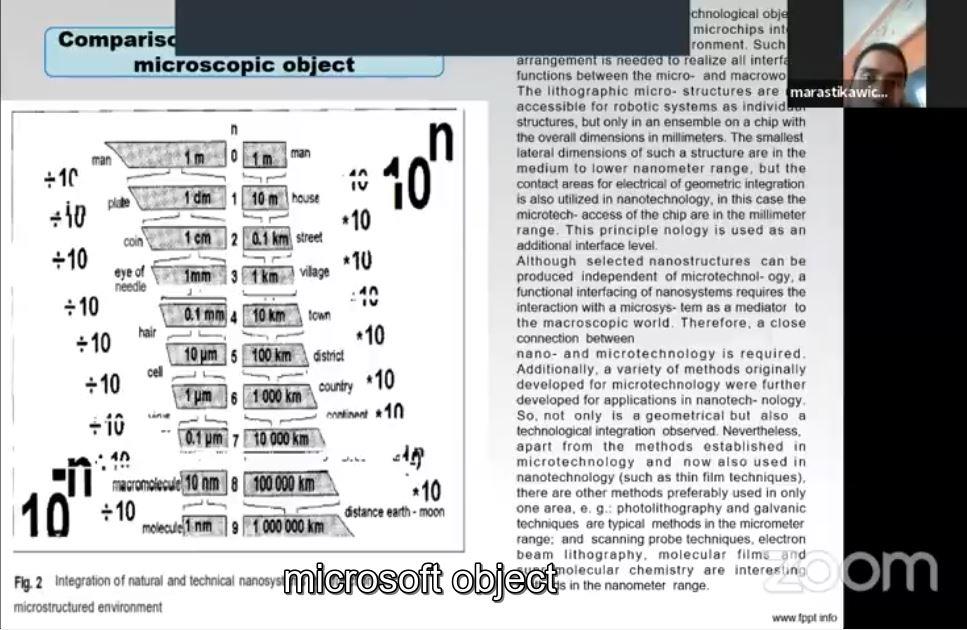
An international academic presenter from Indonesia explained about the comparison of microscopic and macroscopic objects in relation to nanotechnology. The key difference between macroscopic and microscopic properties is that macroscopic properties are properties of large amounts of matter whereas microscopic properties are properties of constituents of large amounts of matter.
The term microscopic refers to anything that is invisible to the naked eye. Hence, microscopic properties refer to the properties of matter at the microscopic level. However, the term macroscopic refers to things that we can see with the naked eye. So, macroscopic properties are properties of matter at the visible level. Moreover, the units of measurement are different for these two types of properties.
The macroscopic properties of matter are the properties in bulk matter. These properties arise according to how the material elements are arranged in matter and how the particles are put together. This is a property that can be visualized with the naked eye; thus, we can take measurements easily. Some common examples of macroscopic properties include pressure, volume, temperature, etc.
For example, if we consider diamond and graphite, both of these structures are made up of only carbon atoms, but the spatial arrangement of these carbon atoms is different from one another. Therefore their macroscopic properties are also different from each other; the density and hardness of diamond is very high compared to graphite and the volume of the two structures is different if we consider the same mass as they have different densities. This difference in properties arises because of the difference in the arrangement of the carbon atoms and the differences in the chemical bonds that hold them together.
Microscopic properties are properties that make up bulk matter. It means; it is a property of the atoms, ions or molecules of matter that make up matter. These constituents are invisible to the naked eye; therefore, the units of measurement are also different from the macroscopic scale. For example, measurements are made in millimeters, micrometers, nanometers, picometers, etc.
The term "macroscopic" refers to large things that are visible to the naked eye while the term "microscopic" refers to small things that are invisible to the naked eye. Therefore, the key difference between macroscopic and microscopic properties is that macroscopic properties are properties of matter in bulk, whereas microscopic properties are properties of constituents of matter in bulk. In other words, microscopic properties are invisible to the naked eye, but macroscopic properties are visible to the naked eye.
In addition, the units of measurement for these properties are also different; for macroscopic properties, the unit of measurement is on a scale visible to the naked eye. This includes centi-, kilo-, mega-, etc. For microscopic properties, the units of measurement are on a scale invisible to the naked eye and include milli-, micro-, nano-, pico-, etc.
The term "macroscopic" refers to large things that are visible to the naked eye. The term "microscopic" refers to tiny things that are invisible to the naked eye. Therefore, the key difference between macroscopic and microscopic property is that macroscopic property is the property of matter in bulk whereas microscopic property is the property of constituents of matter in bulk. In other words, microscopic properties are invisible to the naked eye but macroscopic properties are visible to the naked eye.
The above material was presented by a presenter from Bangladesh in an international webinar held by STEKOM University in collaboration with the University of Bangkadesh and various other parties. The name of the presenter is Marastika Wicaksono Aji Bawono, S.Kom., M.M., M.Kom. who is a lecturer at STEKOM University, Indonesia.
This international webinar activity is part of the implementation of STEKOM University's commitment to increase various international activities. This was done in order to realize the vision to become an international-class university. Various international activities carried out by STEKOM University continue from year to year. There are international activities that are sustainable and there are also some international activities that are not sustainable. All types of international activities are accommodated and regulated by the International department of STEKOM University.
International Webinar 2022 - Implementation of Nano Technology in Food Industry - part 6
International Webinar
Kembali ke Berita
International Webinar
Rabu, 11 Januari 2023
Priyadi, S.Kom, M.Kom
0 Dilihat