
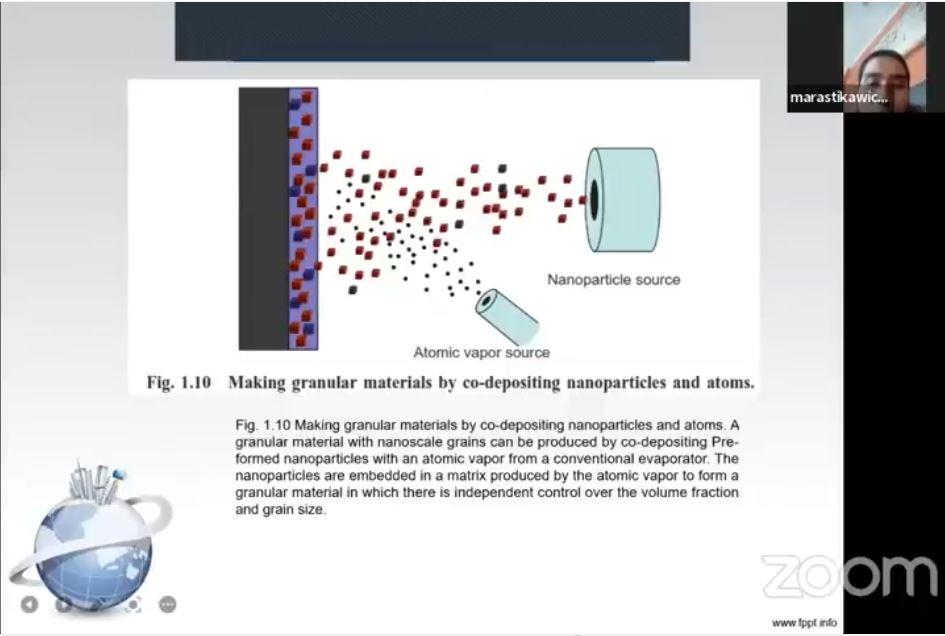
STEKOM university lecturer explains about the manufacture of nanoparticles and atoms in an international seminar. Making granular materials by depositing nanoparticles and atoms. Granular materials with nanoscale grains can be produced by depositing preformed nanoparticles with atomic vapor from a conventional evaporator. The nanoparticles are embedded in a mattix generated by atomic vapor to form a granular material in which there is independent control over the volume fraction and grain size.
The presenter shows an image of silver nanoparticles attacking bacteria. Electron microscopic image of Paeruginosa bacteria after being exposed to silver nanoparticles. Particles with sizes ranging from 1-10 nm actively interfere with cell function. The inset shows a high-resolution image of some of the particles attached to the outer membrane of a cell. Reproduced by permission of the Physics Institute of J. R. Morones et al.
Next the presetator shows an image of silver nanoparticles attached to HIV-1 virus, (a) Computer generated image of HIV virus, showing glycoprotein 'knob' (Reproduced with permission from www.virology net/Big_Virology/BVretro html). (b) Electron microscopy image, with inset superimposed knob positions. (c) Electron microscopy image of the virus after attachment of silver nanoparticles, Reproduced by permission of BioMed Central from L. Elechoguerra et al.
Pringle hierarchies of supramolecular structural constructs in nature (eg proteins from protein complexes) consisting of simpler bushing blocks (eg atoms or amino acids) have specific assignments, with three of them identical in all blocks: a coupling unit (carboxyl sec complementary coupling group (amino group), central linking group (methane group of the central carbon), and variable unit (bonded to the central carbon). These four units are linked by bonds that are stronger (resistant to hydrolysis) than bonds between individual building blocks (peptide bonds) ion-resistant to hydrolysis).
Using these hierarchies and enzymes as highly specific molecular tools, nature has managed to realize extremely complex three-dimensional structures of thousands of atoms in highly defined and functionally optimized ways, without the need for macroscopic tools. Only the modular arrangement combined with the resulting control of binding forces and intramolecular mobility (and through the application of self-assembly mechanisms) overcomes the optimization problem.
Classical synthetic chemistry as well as supramolecular chemistry has not been able to implement this strategy using an analogous approach by connecting modules of molecular constructs with decreasing bond strength through increasing unit size (Section).
Even more than microtechnology, the electrostatic principle becomes increasingly important with decreasing dimensions. Due to the short distance. moderate voltage also results in high field strengths and therefore significant deflections of electrostatically controlled objects. Tweezers have been prepared based on carbon nanotubes with a thickness of 50 nm and a length of about 1 pm. The nanotubes are then attached to the tip of a glass needle, which has two thin-film electrodes so that a field can be applied between the two nanotubes. Voltages below 10V result in closing of the gaps between the nanotubes (Fig. 120). It is possible to manipulate e.g. polymer nanoparticles)
The electrically controlled mechanical resonance structure with high resonance frequency was nanostructured as a freestanding crystalline Si structure. The 2 pm x 2 pm structures were connected laterally by rods, and resulted in a lattice with a periodicity of 315 nm and a minimum structure width of only 50 nm. The resonators are capacitively addressable and exhibit resonant frequencies above 40 MHz. Such resonators are potentially of interest as mechanical transducers for molecular sensors or for the characterization of materials from the smallest sample volumes2).
The above material was presented by a presenter from Bangladesh in an international webinar held by STEKOM University in collaboration with the University of Bangkadesh and various other parties. The name of the presenter is Marastika Wicaksono Aji Bawono, S.Kom., M.M., M.Kom. who is a lecturer at STEKOM University, Indonesia.
This international webinar activity is part of the implementation of STEKOM University's commitment to increase various international activities. This was done in order to realize the vision to become an international-class university. Various international activities carried out by STEKOM University continue from year to year. There are international activities that are sustainable and there are also some international activities that are not sustainable. All types of international activities are accommodated and regulated by the International department of STEKOM University.
International Webinar 2022 - Implementation of Nano Technology in Food Industry - part 9
International Webinar
Kembali ke Berita
International Webinar
Minggu, 15 Januari 2023
Priyadi, S.Kom, M.Kom
0 Dilihat