
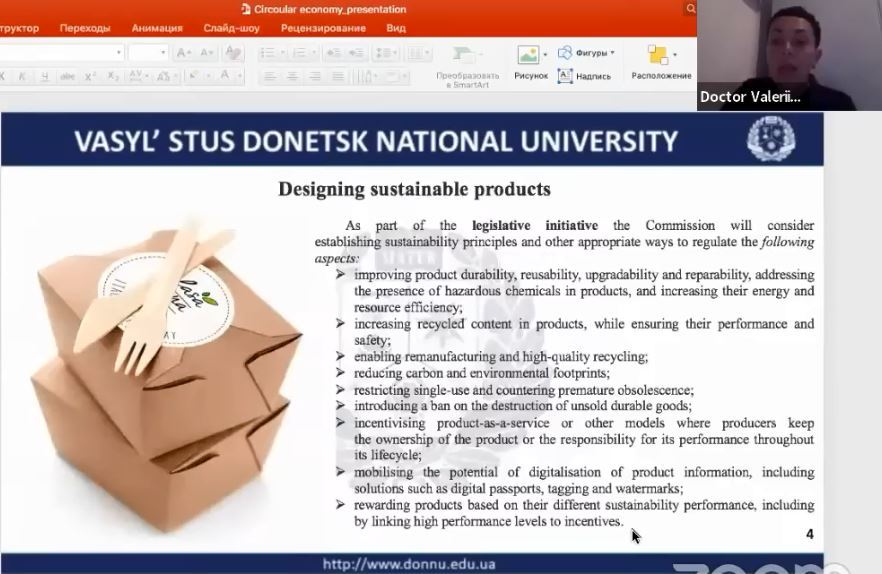
Sustainable product design has an important role in the economic planning of the European Commission. As part of its legislative initiatives, the Commission will consider establishing sustainability principles and other appropriate means of regulating the following aspects:
- increase product durability, reusability, upgradability and repairability, address the presence of hazardous chemicals in products, and increase their energy and resource efficiency;
- increase the recycled content in products, while ensuring their performance and safety;
- enable high-quality remanufacturing and recycling;
- reduce carbon and environmental footprint;
- limiting single use and fighting premature obsolescence;
- Introducing a ban on destroying unsold durable goods;
- incentivize product as a service or other models in which the manufacturer retains ownership of the product or is responsible for its performance throughout its life cycle;
- mobilize the digitalization potential of product information, including solutions such as digital passports, tagging, and watermarks;
- rewarding products based on different operations, including by linking high levels of performance with incentives.
The STEKOM University international webinar presenter who delivered the material was Veleriia lymar from Ukraine. He is a Doctor in economics. The functional position of the scholar is Associate professor. At his campus, Mr. Veleriia plays the role of Acting. head of the department of international relations and foreign policy. The campus where he is domiciled is 'Vasyl' Stus Donetsk National University, Ukraine.
The title of the presentation delivered by Mr. Veleriia was "Analyzing a New Circular Economy Action Plan". At the beginning of his presentation, Mr. Veleriia explained about the new circular economy action plan developed by the European Commission. The European Commission adopted a new circular economy action plan (CEAP) in March 2020 Europe. It is one of the key building blocks of the Green Deal, Europe's new agenda for sustainable growth. The EU's transition to a circular economy will reduce pressure on natural resources and will create sustainable growth and jobs. It is also a prerequisite for achieving the EU's 2050 climate neutrality target and for halting biodiversity loss.
The webinar activity is part of the implementation of STEKOM University's commitment to increase various international activities in order to realize the vision to become an international-class university. Various international activities carried out by STEKOM University continue from year to year. There are international activities that are sustainable and there are also some international activities that are not sustainable. All types of activities are accommodated internationally and regulated by the International department of STEKOM University.
By hiding the potential impact of your product – and then finding ways to reduce this problem through eco-friendly design – you can create a design that is functional, aesthetic and successful without locking in unnecessary environmental impact.
Decisions made with your client will impact the entire design process and the environmental impact of the work. It is therefore best to ask the client to briefly identify the most important to least important items so that we can accommodate these to environmental preferences. In a friendly briefing, provide the client with eco-friendly design options to consider. Do the impact of the product throughout its life cycle – can design solutions be developed to make it last longer, use fewer materials, or be fully recyclable?
Development of modifiable prototypes to reduce the amount of prototyping required if design changes are made. Building a prototype until it reaches the best level of its design is a better gimmick than having to mass produce it more than once because the design changes slightly.
Selection of low impact materials which will increase product longevity. Avoiding non-recyclable clutch materials will also increase product sustainability. Recyclable preference materials in product destination countries also give effect to the sustainability of the product. Using design techniques such as honeycomb can also reduce the amount of material used.
International Webinar 2022 - The advantages of green engineering part 2
International Webinar
Kembali ke Berita
International Webinar
Selasa, 29 November 2022
Priyadi, S.Kom, M.Kom
0 Dilihat