
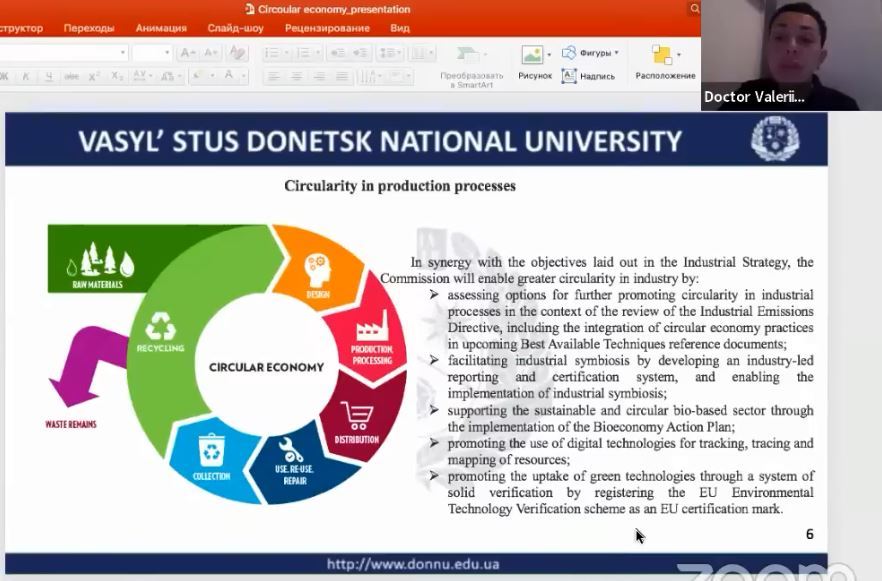
Synergizing with the goals set out in the Industrial Strategy, the European Commission will enable greater circularity in the industry by:
- assessing options for promoting further circularity in industrial processes in the context of protecting the Industrial Emissions Directive, including circular economy integration practices in a future Best Available Engineering reference document;
- facilitating industrial symbiosis by developing reporting and certification systems adopted by the industry, and enabling the implementation of industrial symbiosis;
- support a sustainable and circular bio-based sector through the implementation of the Bioeconomic Action Plan;
- promote the use of digital technologies for resource tracking, tracing and capture;
- Proposed to register the use of green technology through a solid verification system with the EU Environmental Technology Verification scheme as a mark of EU certification.
The STEKOM University international webinar presenter who delivered the material was Veleriia lymar from Ukraine. He is a Doctor in economics. The functional position of the scholar is Associate professor. At his campus, Mr. Veleriia plays the role of Acting. head of the department of international relations and foreign policy. The campus where he is domiciled is 'Vasyl' Stus Donetsk National University, Ukraine.
The title of the presentation delivered by Mr. Veleriia was "Analyzing a New Circular Economy Action Plan". At the beginning of his presentation, Mr. Veleriia explained about the new circular economy action plan developed by the European Commission. The European Commission adopted a new circular economy action plan (CEAP) in March 2020 Europe. It is one of the key building blocks of the Green Deal, Europe's new agenda for sustainable growth. The EU's transition to a circular economy will reduce pressure on natural resources and will create sustainable growth and jobs. It is also a prerequisite for achieving the EU's 2050 climate neutrality target and for halting biodiversity loss.
The webinar activity is part of the implementation of STEKOM University's commitment to increase various international activities in order to realize the vision to become an international-class university. Various international activities carried out by STEKOM University continue from year to year. There are international activities that are sustainable and there are also some international activities that are not sustainable. All types of activities are accommodated internationally and regulated by the International department of STEKOM University.
The new SME Strategy19 will promote circular industry collaboration among SMEs building training, advice under the European Enterprise Network on cluster collaboration, and knowledge transfer through the European Resource Efficiency Knowledge Centre.
There is only one planet Earth, but by 2050, the world will consume it as if there were three. Global consumption of materials such as biomass, fossil fuels, metals and minerals is expected to double in the next forty years, while annual waste generation is projected to increase by 70% by 20503.
As half of total greenhouse gas emissions and more than 90% of the loss of biodiversity and water stress come from resource extraction and processing, the European Green Deal4 launched a common strategy for an economic climate that is neutral, resource-efficient and competitive. Elevating the circular economy from pioneer to mainstream economic player will make a decisive contribution to achieving climate neutrality by 2050 and unifying economic growth from the use of resources, while ensuring the long-term sustainability of the EU and leaving no one behind.
To fulfill this ammunition, the EU needs to accelerate the transition towards a regenerative growth model that gives more to the planet than it needs, progresses to keep its resource consumption within planetary limits, and therefore to reduce its consumption footprint and double its circle. level of material use in the next decade.
International Webinar 2022 - The advantages of green engineering part 4
International Webinar
Kembali ke Berita
International Webinar
Selasa, 29 November 2022
Priyadi, S.Kom, M.Kom
0 Dilihat