
Trade growth slows sharply in 2023 as the global economy faces strong headwinds. That was the first sentence delivered by DR Mohd Zukime in his presentation. The basic data that became the reason for DR Mohd Zukime conveying this were: The volume of world trade in merchandise is expected to grow 3.5% in 2022 before slowing down to 1.0% in 2023 (revised down from 3.4%); World GDP at market exchange rates will increase by 2.8% in 2022 and by 2.3% in 2023 (revised downward from 3.2%); Trade and output will be weighed down by a number of related shocks, including the war in Ukraine, high energy prices, inflation and monetary tightening; CIS region merchandise exports fell 10.4% quarter-on-quarter in Q2 while imports plunged 21.7%; The Middle East will have the strongest trade volume growth of any region in 2022 in terms of both exports (14.6%) and imports (11.1%); The value of traded merchandise in US dollars increased by 17% YoY in the second quarter of 2022; Energy prices were up 78% year-on-year in August while food prices were up 11%, grain prices were up 15% and fertilizer prices were up 60%.
Challenges And Opportunities Confronting Global Supply Chain Partners of All Regions, Sectors and Sizes, and Getting Started on the Work of Shaping Sustainable and Inclusive Solutions. All of that needs to be formulated into the right problem mapping construction. Global Supply Chain Sustainability can be formulated by constructing the following questions:
- How long will the bottlenecks, shortages and delays that plague global supply chains last? Which challenges are caused by temporary imbalances, and which are structural? What are the implications for inflation and economic stability?
- What do importers, exporters, trading companies and logistics providers need from governments and international organizations, and from each other? Where do the opportunities lie for resource sharing and collaboration across sectors? Is the regulatory framework fit for purpose?
- Which countries, sectors and groups suffer most from congestion, scarcity and rising costs, and why does this threaten their long-term participation in global trade?
- To what extent can trade facilitation measures reduce friction in the supply chain? Where will they have the most impact? Are there new technologies that can help make our supply chain more resilient and flexible without sacrificing efficiency?
The presenter who delivered the material was DR Mohd Zukime Mat Junoh from University Malaysia Perlis, Malaysia. This material was presented at an international webinar organized by the University of Science & Computer Technology (STEKOM University) in collaboration with the Karachi Institute of Economics & Technology (Pakistan), Universiti Malaysia Perlis (Malaysia), STIE STEKOM, Association of Industrial and Vocational Communities (PERKIVI), Indonesian Smart Teacherpreneur Association (PTIC) and TopLoker.com. The webinar will be held on December 8, 2022 online using zoom media. All scheduled international presenters managed to attend and fill in the material well.
The webinar activity is part of the implementation of STEKOM University's commitment to increase various international activities in order to realize the vision to become an international-class university. Various international activities carried out by STEKOM University continue from year to year. There are international activities that are sustainable and there are also some international activities that are not sustainable. All types of international activities are accommodated and regulated by the International department of STEKOM University.
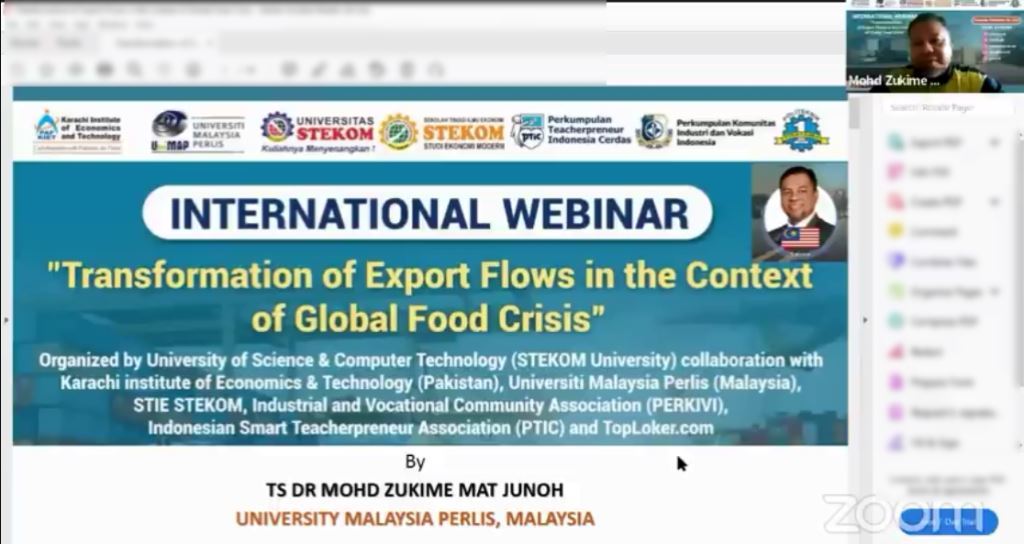
International Webinar 2022 - Transformation of Export Flows in the Context of Global Food Crisis - Part 1
International Webinar
Kembali ke Berita
International Webinar
Rabu, 14 Desember 2022
Priyadi, S.Kom, M.Kom
0 Dilihat