
The world food programe[a] (WFP) is an international organization within the United Nations that provides food assistance worldwide. It is the world's largest humanitarian organization and a leading provider of school meals. Founded in 1961, WFP is headquartered in Rome and has offices in 80 countries. In 2021, it supports more than 128 million people in more than 120 countries and territories.
In addition to emergency food assistance, WFP offers technical and development assistance, such as building emergency preparedness and response capacity, managing supply chains and logistics, promoting social security programs, and strengthening climate change resilience. It is also a major provider of direct cash assistance and medical supplies, and providing passenger services for humanitarian workers.
WFP is an executive member of the United Nations Sustainable Development Group, a consortium of United Nations entities that aims to fulfill 17 Sustainable Development Goals (SDGs), with a priority of achieving SDG 2 for "no hunger" by 2030.
The world food programe was awarded the Nobel Peace Prize in 2020 for its efforts to provide food aid in conflict areas, and to prevent the use of food as a weapon of war and conflict.
WFP was founded in 1961 after the 1960 Conference of the Food and Agriculture Organization (FAO), when George McGovern, director of the US Food for Peace Program, proposed creating a multilateral food assistance program. WFP launched its first program in 1963 by FAO and the UN General Assembly based on a three year trial, supporting the Nubian population of Wadi Halfa in Sudan. In 1965, this program was extended on an ongoing basis.
WFP works across the broad spectrum of the Sustainable Development Goals, due to the fact that food shortages, hunger, malnutrition and foodborne diseases lead to poor health, which then impacts other areas of sustainable development, such as education, employment and poverty (Sustainable Development Goal Four, Eight and One respectively).
WFP's operations are funded by voluntary donations primarily from world governments, but also from companies and private donors. In 2021, funding will reach a record USD 9.6 billion – 15 percent more than in 2020 – compared with a funding requirement of USD 14.8 billion. That year, the United States was the largest donor.
WFP is governed by an executive board composed of representatives from 36 member countries, and provides intergovernmental support, direction and oversight of WFP activities. The EU is a regular observer at WFP and, as a major donor, participates in the work of its executive board. WFP is headed by an executive director, who is jointly appointed by the UN Secretary-General and the United Nations Food and Agriculture Organization (FAO) director-general. Executive directors are appointed for a fixed term of five years and are responsible for the administration of the organization and the implementation of programs, projects and other activities. David Beasley, formerly Governor of the US state of South Carolina, was appointed in March 2017. He heads the WFP secretariat, which is headquartered in Rome. As of September 2021, WFP has over 21,000 staff.
The organization will later have a big role and responsibility in dealing with current global food issues. In a world of plenty, where enough food is produced to feed everyone on the planet, hunger must be a thing of the past. However, conflict, climate change, disasters, inequality and - most recently - the COVID-19 pandemic mean that one in nine people in the world will still go to bed hungry. And things like that are sometimes very difficult to avoid.
The presenter who delivered the material was Abdullah Athar, Senior Lerturer College of Management Science from Pakistan. This material was presented at an international webinar organized by the University of Science & Computer Technology (STEKOM University) in collaboration with the Karachi Institute of Economics & Technology (Pakistan), Universiti Malaysia Perlis (Malaysia), STIE STEKOM, Association of Industrial and Vocational Communities (PERKIVI), Indonesian Smart Teacherpreneur Association (PTIC) and TopLoker.com. The webinar will be held on December 8, 2022 online using zoom media. All scheduled international presenters managed to attend and fill in the material properly.
The webinar activity is part of the implementation of STEKOM University's commitment to increase various international activities in order to realize the vision to become an international-class university. Various international activities carried out by STEKOM University continue from year to year. There are international activities that are sustainable and there are also some international activities that are not sustainable. All types of international activities are accommodated and regulated by the International department of STEKOM University.
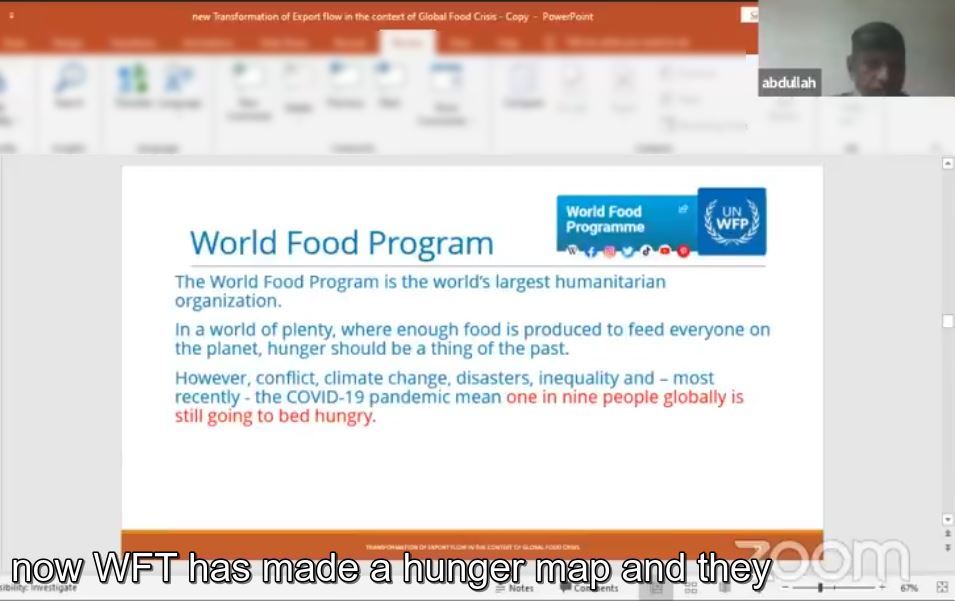
International Webinar 2022 - Transformation of Export Flows in the Context of Global Food Crisis - Part 10
International Webinar
Kembali ke Berita
International Webinar
Senin, 19 Desember 2022
Priyadi, S.Kom, M.Kom
0 Dilihat