
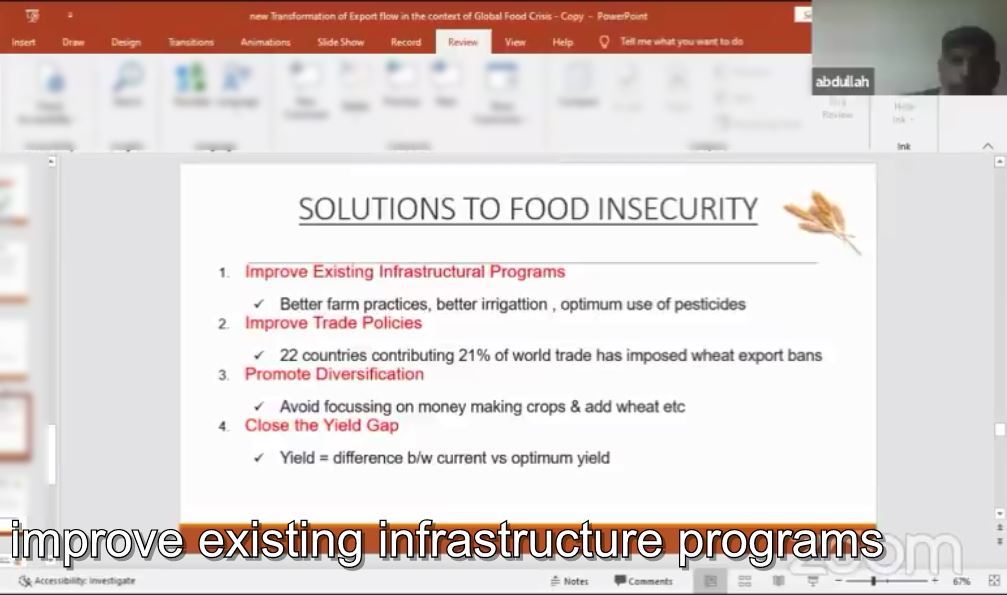
Academics from Pakistan say that one of the solutions to food
vulnerability is to improve infrastructure, especially those that
support agriculture. With an increase in agricultural infrastructure,
agricultural irrigation will become easier. In addition, the use of
pesticides becomes more optimal benefits. So that in the end the
practice of farming becomes much easier.
In general,
infrastructure—for example, transportation, electricity, water, and
telecommunication systems—also supports economic activity and
catalyzes growth and development. The world spends more than $2.5
trillion per year on infrastructure, but $3.7 trillion per year will
be needed until 2035 just to keep pace with projected GDP growth. 1
National, state, and local governments are devoting increasing
amounts of capital to meeting this need , and for good reason.
McKinsey Global Institute estimates that infrastructure has a
socioeconomic return of about 20 percent. In other words, a $1
investment in infrastructure can increase GDP by 20 cents in the long
run.
However, the benefits from infrastructure can
be fully realized only when the project generates tangible public
benefits. Unfortunately, many governments find it difficult to choose
the right project—the one that is most profitable. Moreover,
infrastructure can provide social and economic benefits only if
capital and operational costs can be financed sustainably, either
from project-generated revenues or from government sponsors. Too many
projects become an economic burden and a financial drain when the
government borrows money for an enterprise and neither the direct nor
indirect economic revenues and benefits adequately cover the
costs.
Climate change and the global economy as well
as new regulations and evolving consumer needs are bringing new
challenges to today's growers and formulators. Alongside traditional
solutions for weed dewatering and growth control, new alternatives
are emerging, giving customers the flexibility and confidence to
adapt their formulations to their conditions and needs. A prominent
example is the herbicide glufosinate, which provides fast and
efficient control of many weeds and unwanted plants.
Access
to clean, reliable energy enables farmers and agribusinesses to
increase food production and engage in value-added processing. It
also allows farmers living in off-grid areas to replace expensive
diesel generators with newer, cleaner technologies, such as solar
food dryers and solar water irrigation. The agricultural solar market
is still in its early stages of development and barriers include the
relatively high cost of the technology, limited awareness of its
benefits, lack of proper policy incentives and limited access to
finance for farmers and suppliers to make solar technology more
affordable.
If various infrastructures supporting
community productivity can be built properly, it is not impossible
that various problems of food vulnerability can be properly
anticipated. From upstream such as supporting production activities,
continuing to maintenance infrastructure, harvesting, to distribution
of food products, if all of that can be simplified then logically the
problems of food vulnerability will not be a worry anymore.
The
presenter who delivered the material was Abdullah Athar, Senior
Lerturer College of Management Science from Pakistan. This material
was presented at an international webinar organized by the University
of Science & Computer Technology (STEKOM University) in
collaboration with the Karachi Institute of Economics &
Technology (Pakistan), Universiti Malaysia Perlis (Malaysia), STIE
STEKOM, Association of Industrial and Vocational Communities
(PERKIVI), Indonesian Smart Teacherpreneur Association (PTIC) and
TopLoker.com. The webinar will be held on December 8, 2022 online
using zoom media. All scheduled international presenters managed to
attend and fill in the material properly.
The
webinar activity is part of the implementation of STEKOM University's
commitment to increase various international activities in order to
realize the vision to become an international-class university.
Various international activities carried out by STEKOM University
continue from year to year. There are international activities that
are sustainable and there are also some international activities that
are not sustainable. All types of international activities are
accommodated and regulated by the International department of STEKOM
University.
International Webinar 2022 - Transformation of Export Flows in the Context of Global Food Crisis - Part 17
International Webinar
Kembali ke Berita
International Webinar
Rabu, 21 Desember 2022
Priyadi, S.Kom, M.Kom
0 Dilihat