
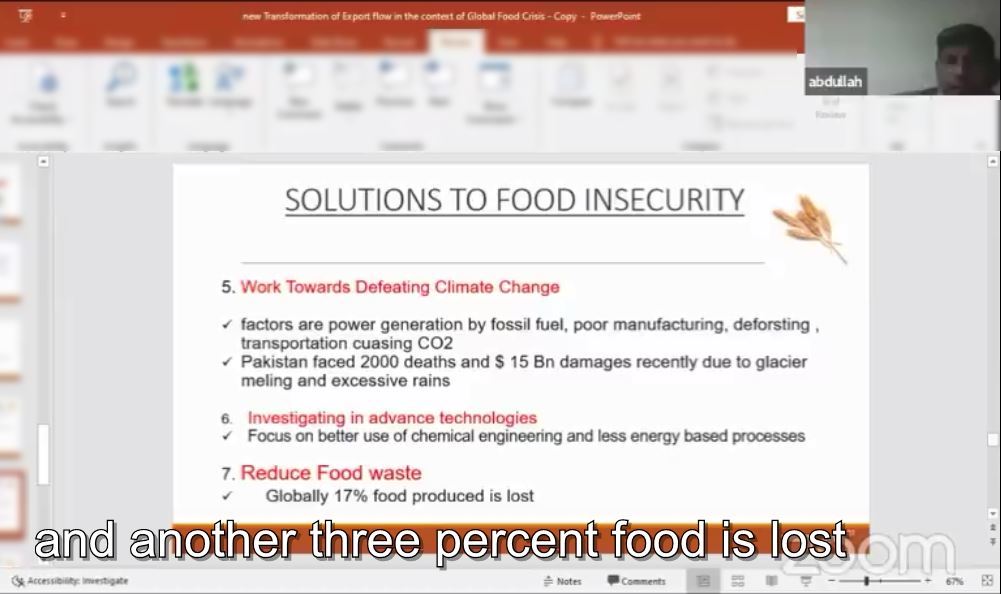
Pakistani academics say that one solution to food insecurity is reducing food wastage. Where currently around 17 percent of food produced globally is experiencing loss. In addition, about 40 percent of energy is used in the agricultural food chain.
Recent developments in food systems and value chains have yielded positive results and progress in feeding the world, but at the same time they have had serious side effects on our natural resource base, our health and nutrition.
The extensive use of chemical fertilizers and pesticides has damaged our soil. The cultivation of monocultures to increase the productivity of staple crops has constrained biodiversity and affected the diversity of our diets. Long energy-intensive value chains and modern retail systems, with food spread across the globe, contribute to increasing carbon footprints.
FAO supports countries to ensure sustainable food systems, promotes healthy balanced diets, and raises awareness of the need to reduce food loss and waste for effective climate action.
Currently, a third of the food we produce is lost or wasted. Food loss and waste is responsible for 8 percent of total GHG emissions, at a cost of up to USD 2.6 trillion per year, including USD 700 billion in environmental costs and USD 900 billion in social costs. Reducing food loss and wastage makes economic and environmental sense.
Food waste is a huge global problem. In fact, if food waste were a country, it would be the third largest emitter of greenhouse gases, right after the US and China (FAO). This food loss and wastage occurs at all stages of the food system. We often hear about food being wasted in our homes or lost at the farm level. Yet little is said about the missing food at the trader and buyer level.
Most of the food we eat is grown, harvested and then transported to warehouses where it is sorted, packaged and stored until it can be sold and transported to its final destination. Merchants buy products in bulk from all over the world, and then they sell these products to supermarkets, retailers and wholesalers. If there is a disturbance in this system or if the food cannot be sold fast enough, it dies and is thrown away. This has negative consequences for all of us: the farmers who grow that food are not paid, traders lose profits, and all the resources used to grow food – including precious water and energy resources – are also wasted. What if we could ensure all food was sold at the right time, in the right place, and to the right people? Of course the problem of food vulnerability can also be handled properly.
The presenter who delivered the material was Abdullah Athar, Senior Lerturer College of Management Science from Pakistan. This material was presented at an international webinar organized by the University of Science & Computer Technology (STEKOM University) in collaboration with the Karachi Institute of Economics & Technology (Pakistan), Universiti Malaysia Perlis (Malaysia), STIE STEKOM, Association of Industrial and Vocational Communities (PERKIVI), Indonesian Smart Teacherpreneur Association (PTIC) and TopLoker.com. The webinar will be held on December 8, 2022 online using zoom media. All scheduled international presenters managed to attend and fill in the material properly.
The webinar activity is part of the implementation of STEKOM University's commitment to increase various international activities in order to realize the vision to become an international-class university. Various international activities carried out by STEKOM University continue from year to year. There are international activities that are sustainable and there are also some international activities that are not sustainable. All types of international activities are accommodated and regulated by the International department of STEKOM University.
International Webinar 2022 - Transformation of Export Flows in the Context of Global Food Crisis - Part 20
International Webinar
Kembali ke Berita
International Webinar
Rabu, 21 Desember 2022
Priyadi, S.Kom, M.Kom
0 Dilihat