
Information technology jobs have expanded the potential of the agricultural segment by utilizing automated systems in various activities. New advances such as precision farming, GPS, sensor systems, robotics have increased with the continuous development and progress in the agricultural segment. Today, with the increasing affordability of digital cameras and computers, computer vision systems can be used for inspection tasks.
The following are reasons why process digital imaging is so useful for agriculture:
- Digital Image Analysis is an effective tool for non-destructive analysis of agricultural objects
- Improvement of digital image retrieval tools not only can process visible images but also images that are not visible to humans such as ultraviolet (UV), Near Infrared (NIR), Infrared (IR).
- The application of image processing techniques in the agricultural sector is carried out by taking images through remote sensing techniques, involving aircraft or satellites, which are then processed and analyzed using a computer. With new technological advances in image capture and data processing, imaging techniques have been developed to solve various problems in agriculture
The application of digital imaging processes in agriculture can be applied to the following areas:
- Fruit quality inspection, sorting and sorting: To improve and maintain the quality of fruits and vegetables and for Classification of agricultural products, image processing and machine learning are used.
- Crop Management: irrigation and weed detection are used for crop assessment using remote sensing.
- Identification of nutritional deficiencies and plant constituents: Nutrient deficiencies and various plant constituents have been identified from the leaves and skin of the product using image processing algorithms.
- Plant and land estimation : Geographic information system (GIS), color and texture segmentation algorithms are used.
Digital process imaging is critical to most precision farming systems, whether to assess differential growth, help create variable application maps, or identify weeds. However, it is also useful to know how they are collected, the different types, and what they can be used for.
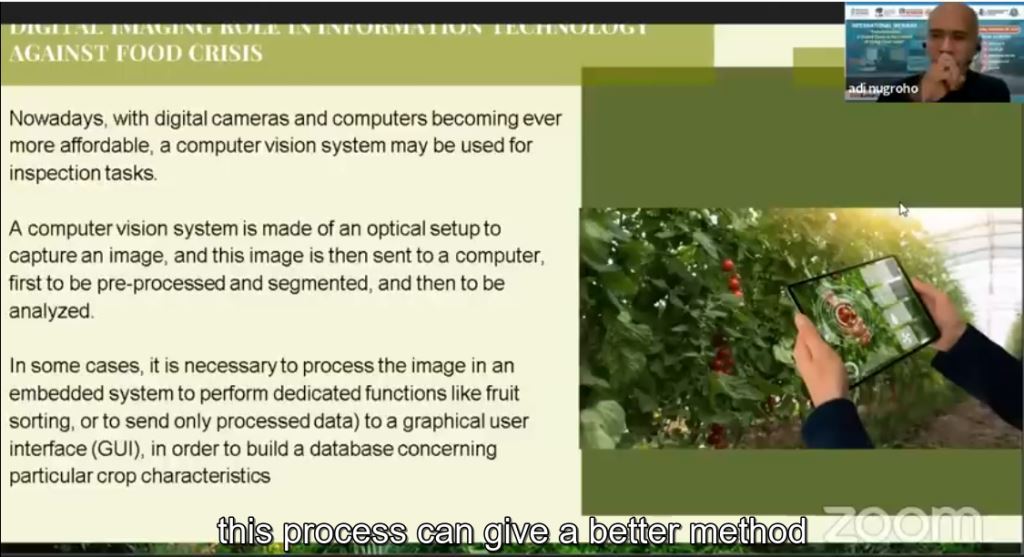
A computer vision system is made up of optical arrangements to capture images, and these images are then sent to a computer, first for processing and segmentation, and then for analysis. In some cases, it is necessary to process images in an embedded system to perform special functions such as sorting fruit, or simply sending the processed data) to a graphical user interface (GUI), to build a database regarding the characteristics of a particular plant.
The presenter who delivered the material was Mr. Adi Nugroho who is a graphic design lecturer at STEKOM University, Indonesia. The title of the presentation presented by Mr. Adi was "Digital Imaging Role in Information Technology Against Food Crysis". This material was presented at an international webinar organized by the University of Science & Computer Technology (STEKOM University) in collaboration with the Karachi Institute of Economics & Technology (Pakistan), Universiti Malaysia Perlis (Malaysia), STIE STEKOM, Association of Industrial and Vocational Communities (PERKIVI), Indonesian Smart Teacherpreneur Association (PTIC) and TopLoker.com. The webinar will be held on December 8, 2022 online using zoom media. All scheduled international presenters managed to attend and fill in the material properly.
The webinar activity is part of the implementation of STEKOM University's commitment to increase various international activities in order to realize the vision to become an international-class university. Various international activities carried out by STEKOM University continue from year to year. There are international activities that are sustainable and there are also some international activities that are not sustainable. All types of international activities are accommodated and regulated by the International department of STEKOM University.
International Webinar 2022 - Transformation of Export Flows in the Context of Global Food Crisis - Part 22
International Webinar
Kembali ke Berita
International Webinar
Minggu, 1 Januari 2023
Priyadi, S.Kom, M.Kom
0 Dilihat