
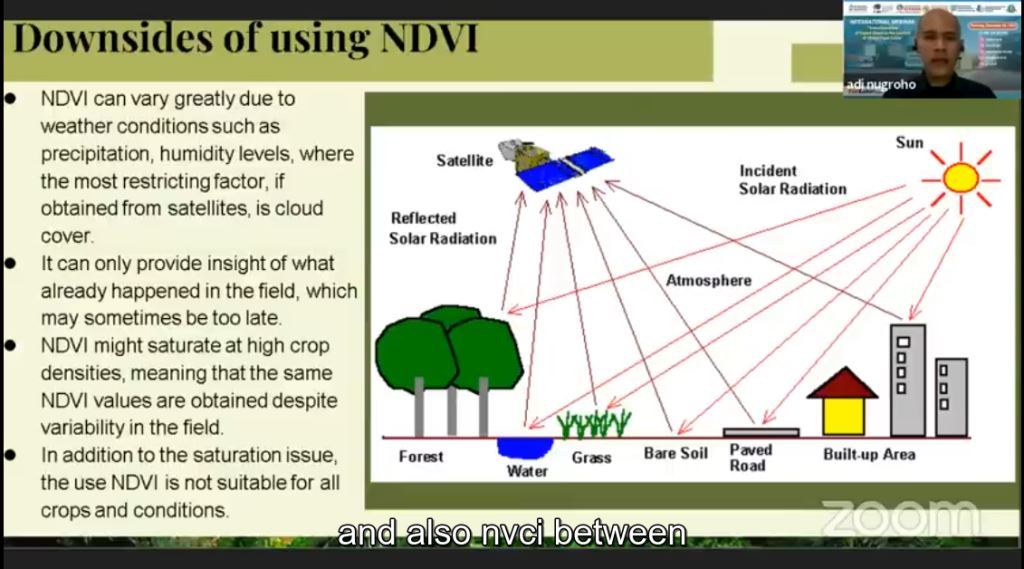
In his presentation on the food crisis and its solutions, Mr. Adi explained that there are many potential uses for NDVI digital image processing for agriculture. However, there are some disadvantages to using NDVI for agriculture. Following are some of the disadvantages of using NDVI for agriculture:
- NDVI can vary greatly due to weather conditions such as rainfall, humidity levels, where the most limiting factor, if obtained from satellite, is cloud cover.
It can only give an idea of what has happened on the pitch, which is sometimes too late.
- NDVI may be saturated at high plant densities, meaning that the same NDVI value is obtained despite the variability in the field.
- Apart from the saturation problem, the use of NDVI is not suitable for all crops and conditions.
Other vegetation indices may have lower sensitivity to saturation and be used in different models. These indices include MSAVI, CVI, reNDVI, MTCI and others.
NDVI, or Normalized Difference Vegetation Index, is a tool used to monitor plant health and growth. It is a measure of surface greenery and provides an automated way to monitor plant development and health throughout the growing season. The advantage of using NDVI over traditional methods, such as chlorophyll fluorescence, is that it can be measured from space or by drone, without the need for on-site equipment.
The use of NDVI as a crop monitoring tool has been well studied over the last decades, and has proven to be an effective tool for many applications. Several models have been developed to use NDVI to predict plant biomass and yield, manage nitrogen fertilization, irrigation management and other uses. Colored maps, showing variability in the field can be produced based on NDVI values.
NDVI is obtained by measuring the difference between reflected near-infrared light and reflected visible red light and calculating it by the total amount of radiation emitted from the earth's surface:
NDVI = (NIR – RED)/(NIR + RED)
Green plants absorb light energy from their environment and use it to synthesize sugars and other organic compounds. As a result, they reflect more near infrared light and absorb visible red light. In general, higher values indicate more healthy vegetation or plants, while lower values indicate less healthy plants or plants that are not growing properly. NDVI values between 0 and 1 are generally considered optimal for plant growth; a value less than 0 indicates an area with too little vegetation for photosynthesis to occur effectively (such as during a drought). While the negative NDVI value corresponds to the character of the digital image of water.
The presenter who delivered the material was Mr. Adi Nugroho who is a graphic design lecturer at STEKOM University, Indonesia. The title of the presentation presented by Mr. Adi was "Digital Imaging Role in Information Technology Against Food Crysis". This material was presented at an international webinar organized by the University of Science & Computer Technology (STEKOM University) in collaboration with the Karachi Institute of Economics & Technology (Pakistan), Universiti Malaysia Perlis (Malaysia), STIE STEKOM, Association of Industrial and Vocational Communities (PERKIVI), Indonesian Smart Teacherpreneur Association (PTIC) and TopLoker.com. The webinar will be held on December 8, 2022 online using zoom media. All scheduled international presenters managed to attend and fill in the material properly.
The webinar activity is part of the implementation of STEKOM University's commitment to increase various international activities in order to realize the vision to become an international-class university. Various international activities carried out by STEKOM University continue from year to year. There are international activities that are sustainable and there are also some international activities that are not sustainable. All types of international activities are accommodated and regulated by the International department of STEKOM University.
International Webinar 2022 - Transformation of Export Flows in the Context of Global Food Crisis - Part 29
International Webinar
Kembali ke Berita
International Webinar
Selasa, 3 Januari 2023
Priyadi, S.Kom, M.Kom
0 Dilihat