
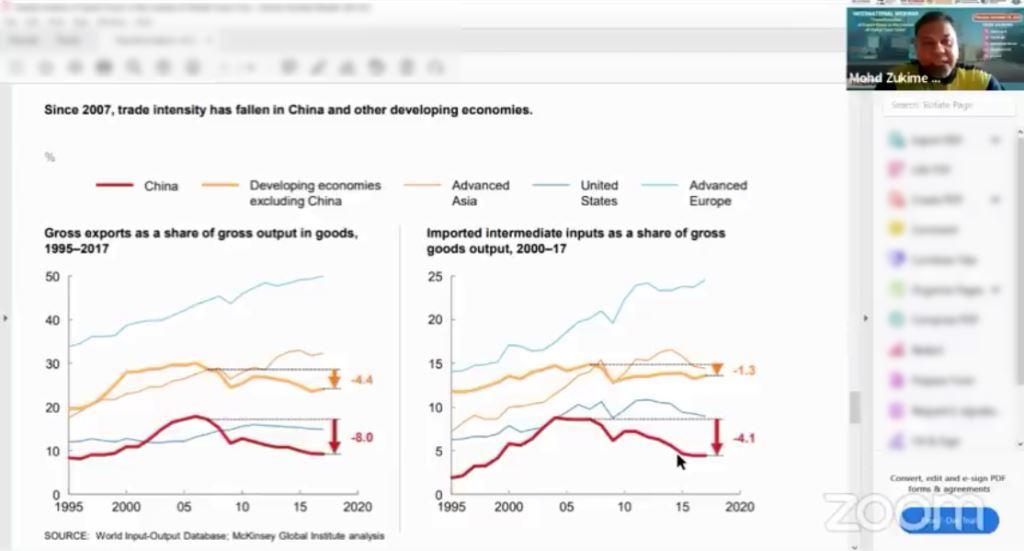
According to World Bank data, 45.8 percent of people worldwide are now connected online. The existence of instant and cheap digital communications has one clear effect which is to lower transaction costs and allow for more trade flows. But the impact of next-generation technologies on global flows of goods and services will not be so simple. Several advances, such as digital platforms, blockchain, and the Internet of Things, will continue to reduce transaction and logistics costs. Reducing trade flows in some cases, either by changing the economy and location of production or by changing the actual goods and services demanded. Digital platforms, logistics technology and advances in data processing will continue to reduce cross-border transaction costs and enable all kinds of flows in the goods production value chain, logistics costs can be very large. So that new technologies will change costs throughout the global value chain. However, the right policies are needed to optimize the use of technology in the supply chain.
Policies that need to be implemented in technology adoption to optimize supply chain savings are:
1. Address current humanitarian needs to meet WFP's US$22.2 billion funding needs by 2022 through cash or in-kind donations that will enable the organization to feed 152 million people in need.
2. Support and join global and regional initiatives set up to coordinate international response to this unprecedented crisis including, but not limited to, the Global Alliance for Food Security (GAFS), the complementary Food Security & Agriculture Mission (FARM), Food Coalition IFI Schools and Action Plans to Address Food Insecurity.
3. Ensure open trade in food, fuel, pesticides and fertilizers to avoid export restrictions and import subsidies, and exclude humanitarian aid from restrictive trade policies.
4. Invest in strategic development solutions that help build resilient communities and drive climate action, social protection, and sustainable food systems, enabling humanitarian and development organizations to change lives over the long term and plan to scale as needs grow.
5. Commit to a political solution to secure stability and peace, prevent famine as a weapon of war and ensure humanitarian access to affected populations including the immediate reopening of Black Sea ports.
The presenter who delivered the material was DR Mohd Zukime Mat Junoh from University Malaysia Perlis, Malaysia. This material was presented at an international webinar organized by the University of Science & Computer Technology (STEKOM University) in collaboration with the Karachi Institute of Economics & Technology (Pakistan), Universiti Malaysia Perlis (Malaysia), STIE STEKOM, Association of Industrial and Vocational Communities (PERKIVI), Indonesian Smart Teacherpreneur Association (PTIC) and TopLoker.com. The webinar will be held on December 8, 2022 online using zoom media. All scheduled international presenters managed to attend and fill in the material well.
The webinar activity is part of the implementation of STEKOM University's commitment to increase various international activities in order to realize the vision to become an international-class university. Various international activities carried out by STEKOM University continue from year to year. There are international activities that are sustainable and there are also some international activities that are not sustainable. All types of international activities are accommodated and regulated by the International department of STEKOM University.
International Webinar 2022 - Transformation of Export Flows in the Context of Global Food Crisis - Part 4
International Webinar
Kembali ke Berita
International Webinar
Rabu, 14 Desember 2022
Priyadi, S.Kom, M.Kom
0 Dilihat