
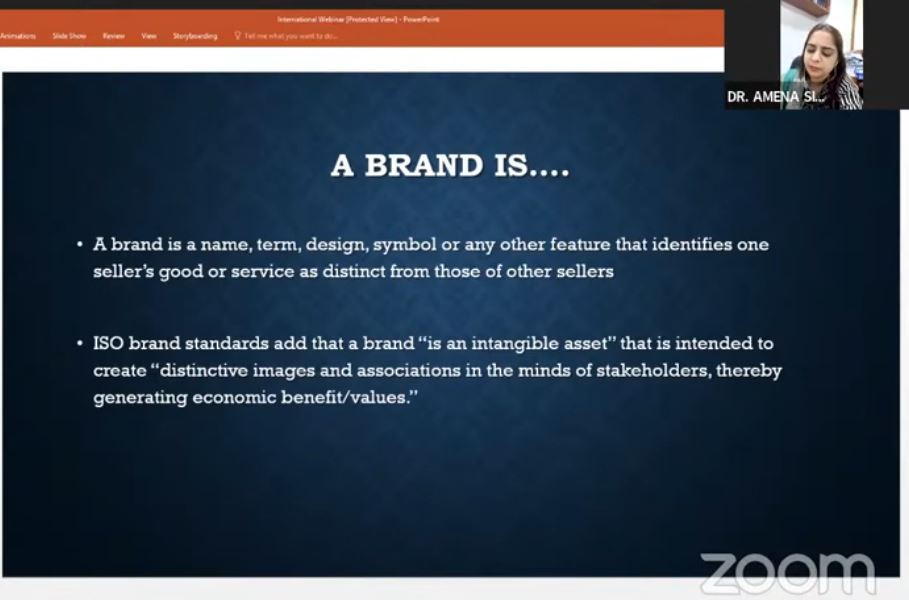
Brand is a name, term, design, symbol or any other feature that distinguishes the goods or services of one seller from those of other sellers. Brands are used in business, marketing and advertising for recognition and, most importantly, to create and store value as Brand equity for identified objects, for the benefit of Brand customers, their owners and shareholders. Brand names are sometimes distinguished from generic brands or store brands.
The practice of branding - in the original literal sense of marking by burning - is thought to have started with the ancient Egyptians, who are known to have been involved in branding cattle as early as 2,700 BC. Branding is used to distinguish one's cattle from another's livestock through a distinctive symbol that is burned into the skin of the animal with hot branded iron. If someone stole one of the cattle, anyone seeing the symbols could deduce the true owner. The term has expanded to mean strategic personality for a product or company, so that "Brand" now suggests value and promise that consumers can perceive and buy. It includes a business voice and tone of voice. Over time, the practice of object branding expanded into a wider range of packaging and goods offered for sale including oils, wines, cosmetics, and fish sauce and, in the 21st century, extended further into services (such as legal, financial, and medical ). Branding in terms of painting cows with symbols or colors at flea markets is considered one of the oldest forms of practice.
In the modern era, the concept of branding has been broadened to include the dissemination by managers of techniques and marketing and communication tools that help differentiate a company or product from competitors, aiming to create a lasting impression in the minds of customers. The key components that make up the Brand toolbox include Brand identity, personality, product design, Brand communications (such as logos and Trademarks), Brand awareness, Brand loyalty, and various branding strategies (Brand management). Many companies believe that there are often very few differences between product types in the 21st century, therefore branding is one of the last remaining forms of product differentiation.
Brand equity is the measurable totality of Brand value and is validated by observing the effectiveness of these Brand components. As markets become increasingly dynamic and volatile, Brand equity is built by applying marketing techniques to increase customer satisfaction and customer loyalty, with side effects such as reduced price sensitivity. A brand, at its core, is a promise to its customers about what Branda can expect from the product and possibly including emotional and functional benefits. When a customer is familiar with a brand or likes it better than its competitors, a company has achieved a high level of brand equity. Specific accounting standards have been devised to assess Brand equity. In accounting, Brand, which is defined as an intangible asset, is often the most valuable asset on a company's balance sheet. Brand Owners manage Brand Branda carefully to create value for shareholders. Brand Valuation is a management technique that assigns a monetary value to Brands, and allows marketing investments to be managed (eg prioritized across Brand portfolios) to maximize shareholder value. Although only acquired brands appear on a company's balance sheet, the idea of placing a value on brands forces marketing leaders to focus on long-term brand management and value management.
The word "Brand" is often used as a metonym to refer to a company that is highly identified with the Brand. Marque or make is often used to indicate a motor vehicle brand, which can be distinguished from a car model. Concept brands are brands that are associated with an abstract concept, such as breast cancer awareness or the environment, rather than a specific product, service or business. Commodity Brands are Brands related to commodities.
The material above was presented by a presenter from Pakistan in an international webinar held by STEKOM University in collaboration with Universities from Pakistan, Malaysia, and various other parties. The name of the presenter is Dr. Amena Sibghatullah who is an assistant professor and head of marketing college of management science, KIET University, Pakistan.
This international webinar activity is part of the implementation of STEKOM University's commitment to increase various international activities. This was done in order to realize the vision to become an international-class university. Various international activities carried out by STEKOM University continue from year to year. There are international activities that are sustainable and there are also some international activities that are not sustainable. All types of international activities are accommodated and regulated by the International department of STEKOM University.
International Webinar 2023 - The Role of Digital Based Innovative to Improve Competitiveness – Part 15
International Webinar
Kembali ke Berita
International Webinar
Rabu, 8 Februari 2023
Priyadi, S.Kom, M.Kom
0 Dilihat