
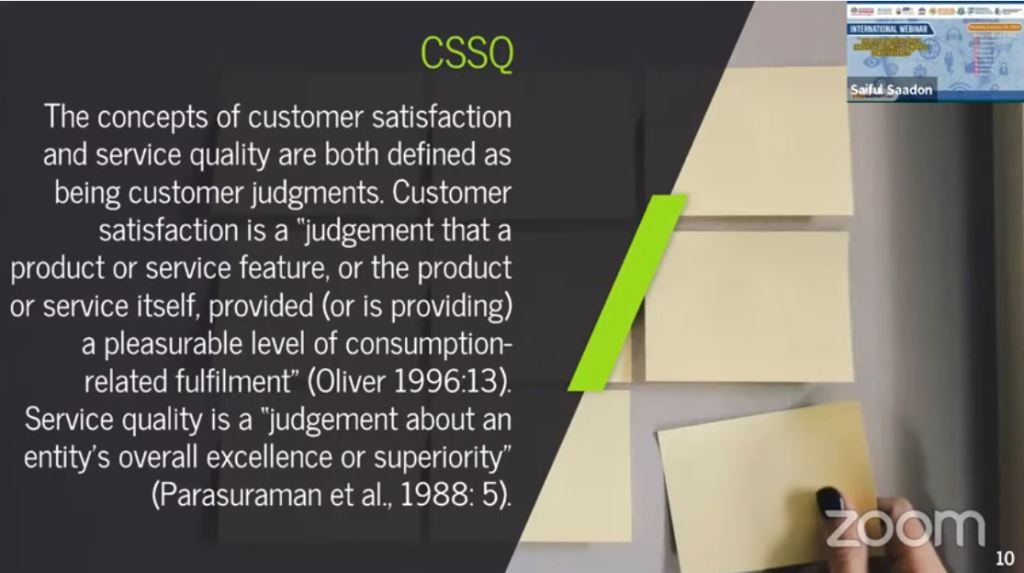
Digital channels are a well-established means of accessing information and goods. The online market has considerable economic significance. In response to the widespread use of technology, the idea of market space is used instead of the term traditional market (Rayport and Sviolka, 1994). The concepts of customer satisfaction and service quality are both defined as customer ratings. Customer e-ltisye-lenl (0) cor aw (Ulex gn cg UL ] product or service features, or the product or service itself, provides (or provides) a pleasurable level of consumption satisfaction” (Oliver 1996:13) Service quality is “ judgment about the entity's overall superiority or superiority" (Parasuraman et al., 1988: 5).
Customer satisfaction (often abbreviated as CSAT) is a term often used in marketing. It is a measure of how the products and services provided by the company meet or exceed customer expectations. Customer satisfaction is defined as "the number of customers, or percentage of total customers, whose reported experience with the company, its products, or services (ratings) exceeds the specified satisfaction goal." Customers play an important and essential role in keeping the product or service relevant; therefore, it is in the best interest of business to ensure customer satisfaction and build customer loyalty.
The Marketing Accountability Standards Board (MASB) endorses the definitions, objectives and measures that appear in Marketing Metrics as part of the ongoing Common Language in Marketing Projects. In a survey of nearly 200 senior marketing managers, 71 percent answered that they find customer satisfaction metrics very useful in managing and monitoring their business. Customer satisfaction is seen as a key performance indicator in business and is often part of the Balanced Scorecard. In a competitive marketplace where businesses compete for customers, customer satisfaction is seen as a key differentiator and is increasingly becoming an important element of business strategy.
In the research literature, the antecedents of customer satisfaction are studied from different perspectives. This perspective extends from the psychological to the physical as well as from a normative perspective. However, in much of the literature, research has focused on two basic constructs, (a) expectations prior to purchasing or using a product and (b) customer perceptions of the product's performance after using it.
Customer expectations about a product depend on how the customer thinks the product will function. Consumers are thought to have different "types" of expectations when forming opinions about anticipated product performance. Miller (1977) describes four types of expectations: ideal, expected, minimum tolerable, and desirable. Day (1977) outlines various types of expectations, including those about costs, product characteristics, benefits, and social values.
It is assumed that customers judge products based on a limited set of norms and attributes. Olshavsky and Miller (1972) and Olson and Dover (1976) designed their research to manipulate actual product performance, and their goal was to find out how perceived performance ratings are affected by expectations. These studies are about explaining the difference between perceived expectations and performance."
In several research studies, scholars have been able to establish that customer satisfaction has a strong emotional, namely affective, component. Still others suggest that the cognitive and affective components of customer satisfaction reciprocally influence each other over time to determine overall satisfaction.
Especially for durable goods that are consumed over time, there is value in taking a dynamic perspective on customer satisfaction. In a dynamic perspective, customer satisfaction may develop over time as customers repeatedly use products or interact with services. The satisfaction experienced with each interaction (transactional satisfaction) can affect the overall cumulative satisfaction. Scholars point out that it is not only overall customer satisfaction, but also customer loyalty that develops over time.
The above material was presented by presenters from Malaysia in an international webinar held by STEKOM University in collaboration with Universities from Pakistan, Malaysia, and various other parties. The name of the presenter is DR. Saiful izwaan Bin Saadon who is a senior lecturer at the faculty of maritime studies, Universiti Malaysia Terengganu. The title of the presentation is "Service Quality For Digital Based Innovation Business As A Tool For Customer Satisfaction".
This international webinar activity is part of the implementation of STEKOM University's commitment to increase various international activities. This was done in order to realize the vision to become an international-class university. Various international activities carried out by STEKOM University continue from year to year. There are international activities that are sustainable and there are also some international activities that are not sustainable. All types of international activities are accommodated and regulated by the International department of STEKOM University.
International Webinar 2023 - The Role of Digital Based Innovative to Improve Competitiveness – Part 27
International Webinar
Kembali ke Berita
International Webinar
Kamis, 16 Februari 2023
Priyadi, S.Kom, M.Kom
0 Dilihat