
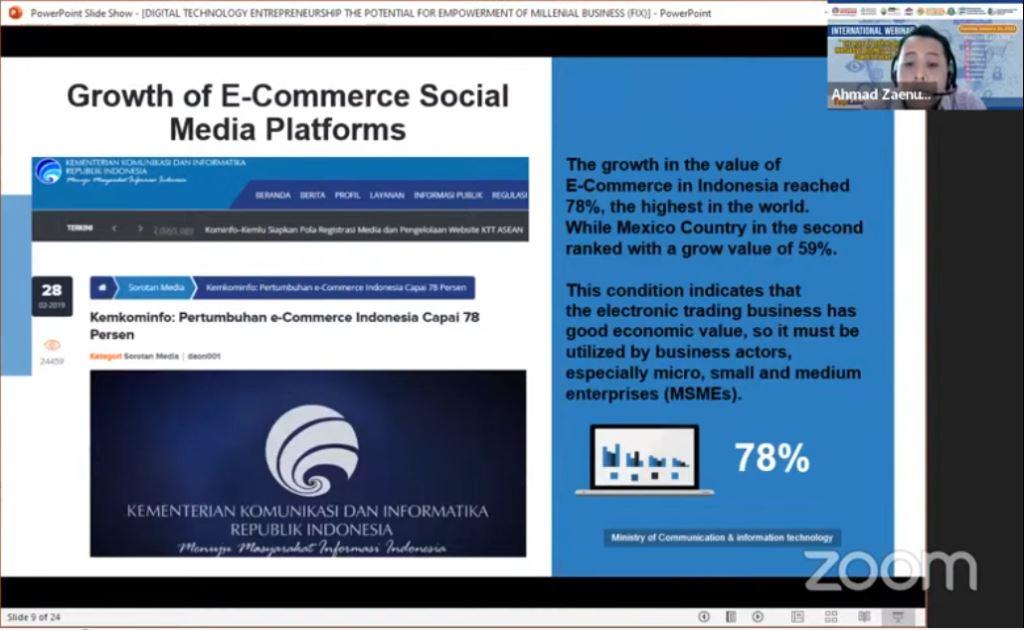
The growth in the value of E-Commerce in Indonesia reached 78%, the highest in the world. While Mexico Country is in second place with a growth value of 59%. This condition indicates that the e-commerce business has good economic value, so it must be utilized by business actors, especially micro, small and medium enterprises (MSMEs).
The social commerce industry in Indonesia is expected to grow by 55.0% on an annual basis to reach US$8,675.5 million in 2022. The social commerce industry is expected to grow steadily over the forecast period, recording a CAGR of 47.9% during 2022-2028. The GMV of social commerce in the country will increase from US$8,675.5 million in 2022 to US$86,750.1 million in 2028.
Although the social commerce industry has increased globally over the last four to eight quarters, this concept is nothing new in Indonesia. Local fashion brand Sophie Paris and Swedish cosmetics brand Oriflame, both driving group buying, were quite popular in the early 2010s. Their agents, who are mostly women, are part of various groups on WhatsApp, where they will sell products to earn extra income.
As social media platforms begin to gain increasing traction among consumers, these agents turn to platforms such as Facebook to sell products to a wider audience, resulting in increased sales. In particular, the largest internet forum in Indonesia, Kaskus, has a special section for commercial activities. The platform recorded a total transaction of US$40.6 million in 2012. In addition, several local merchants and shops have created Facebook pages to sell their wares in the country over the years.
New era social commerce startups in Indonesia want to leverage this existing foundation to penetrate and gain market share in the growing social commerce industry. Notably, most social commerce startups in the country have adopted a reseller model, in which platforms acquire agents, who in turn sell their products on various social networks. While startups in the social commerce space are supporting industry growth, major tech giants, including social media platforms, are also increasing their investment in the space to capture a larger share of the growing market.
According to the Q4 Global Social Trading Market Survey, more than 30 million Indonesians transact online, of which 60% of sales are generated through e-commerce platforms. The remaining 40% occurs through social media networks in Indonesia in 2021. Therefore, the social commerce market is expected to record strong growth in the next four to six quarters.
In Indonesia, retail has two big challenges - small transaction volume per household and high prices. Due to high supply chain costs and poor road connectivity, daily products are much more expensive in Tier II and Tier III cities than in Tier I cities. This is a problem many social commerce startups in Indonesia are looking to solve. In particular, social commerce startups see community buying as an answer to expensive products in rural areas.
Super, one of the social commerce startups in Indonesia, has adopted the community buying model to offer affordable products for consumers in the country. Companies leverage community leaders and agents to generate more deals in their communities, thereby providing consumers with products at attractive prices.
Super's business model has helped the company reduce product prices by an average of 10% to 20% in Indonesia. Even after retailers have secured a margin for themselves, they can still offer competitive prices to consumers in the country's Tier II and Tier III cities.
The above material was presented by presenters from Indonesia in an international webinar held by STEKOM University in collaboration with Universities from Pakistan, Malaysia, and various other parties. The name of the presenter is Achmad Zaenuri who is a lecturer at STEKOM University and is the head of the entrepreneurship study program.
This international webinar activity is part of the implementation of STEKOM University's commitment to increase various international activities. This was done in order to realize the vision to become an international-class university. Various international activities carried out by STEKOM University continue from year to year. There are international activities that are sustainable and there are also some international activities that are not sustainable. All types of international activities are accommodated and regulated by the International department of STEKOM University.
International Webinar 2023 - The Role of Digital Based Innovative to Improve Competitiveness – Part 6
International Webinar
Kembali ke Berita
International Webinar
Senin, 6 Februari 2023
Priyadi, S.Kom, M.Kom
0 Dilihat