
Creativity is a phenomenon where something new and valuable is formed. The items created may be intangible (such as an idea, scientific theory, musical composition, or joke) or a physical object (such as an invention, printed literary work, or painting).
Scientific interest in creativity is found in a number of disciplines, most notably psychology, business studies, and cognitive science. However, it can also be found in education, humanities (philosophy, arts) and theology, social sciences (sociology, linguistics, economics), engineering, technology and mathematics. This discipline covers the relationship between creativity and general intelligence, personality types, mental and neural processes, mental health, artificial intelligence; the potential for fostering creativity through education, training, leadership, and organizational practices; the factors that determine how creativity is valued and perceived; fostering creativity for the benefit of the national economy; and the application of creative resources to enhance the effectiveness of teaching and learning.
The English word creativity comes from the Latin word creare, "to create, to make": its derivative suffix is also of Latin origin. The word "create" appears in English as early as the 14th century, especially in Chaucer (in The Parson's Tale), to denote divine creation. However, its modern meaning as an act of human creation only emerged after the Enlightenment.
In a summary of scientific research on creativity, Michael Mumford suggests: “Over the last decade, however, we seem to have reached general agreement that creativity involves the production of novel, useful products” (Mumford, 2003, p. 110), or, in the words of Robert Sternberg, production of "something original and worthwhile". Authors have diverged dramatically in their precise definitions beyond this general commonality: Peter Meusburger estimates that more than a hundred different definitions can be found in the literature, usually elaborating on the context (field, organization, environment, etc.) that determines originality and/or suitability objects that are created, and the processes that go through them. As an illustration, one of the definitions given by Dr. E. Paul Torrance in the context of assessing individual creative abilities, described it as “the process of becoming sensitive to problems, deficiencies, gaps in knowledge, missing elements, disharmony, and so on. ; identify difficulties; seek solutions, make guesses, or formulate hypotheses about deficiencies: test and retest these hypotheses and possibly modify and retest them; and finally communicating the results.”
Creativity in general is usually distinguished from innovation in particular, where the emphasis is on implementation. For example, Teresa Amabile and Pratt (2016) define creativity as the production of new and useful ideas and innovation as the implementation of creative ideas, while the OECD and Eurostat state that “Innovation is more than just a new idea or invention. innovation requires implementation, either by being used actively or by being made available for use by other parties, companies, individuals or organizations." There is also emotional creativity which is described as a pattern of cognitive abilities and personality traits related to originality and suitability in emotional experience .
The material above was delivered by a presenter from Ukraine in a visiting lecturer held by STEKOM University in collaboration with Universities from Ukraine. The title of the presentation is "Learning Skills in 21st Century Education and Work Environment".
This international webinar activity is part of the implementation of STEKOM University's commitment to increase various international activities. This was done in order to realize the vision to become an international-class university. Various international activities carried out by STEKOM University continue from year to year. There are international activities that are sustainable and there are also some international activities that are not sustainable. All types of international activities are accommodated and regulated by the International department of STEKOM University.
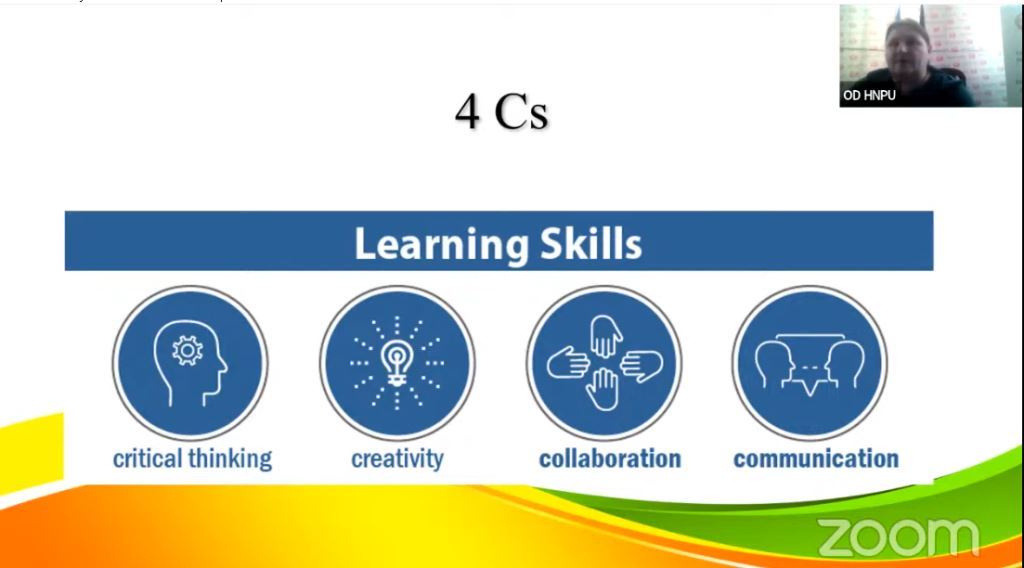
International Webinar 2023 - Visiting Lecture with Lecturer from Hlukhiv National Pedagogical University (Ukraine) – Part 2
International Webinar
Kembali ke Berita
International Webinar
Senin, 20 Februari 2023
Priyadi, S.Kom, M.Kom
0 Dilihat