
Collaboration is a process of two or more people, entities or organizations working together to complete a task or achieve a goal. Collaboration is similar to cooperation. Most collaboration requires leadership, [vague] although this form of leadership can be social in decentralized and egalitarian groups. Teams that work collaboratively often access greater resources, recognition, and rewards when faced with competition for limited resources.
Structured collaboration methods encourage introspection of behavior and communication. The method aims to increase team success when they engage in collaborative problem solving. Collaboration comes in the opposite sense which denotes the idea of adversarial collaboration, although this is not a common use of the term. In its applied sense, "(a) collaboration is a purposeful relationship in which all parties strategically choose to work together to achieve a common outcome."
Founded in 1933 by John Andrew Rice, Theodore Dreier, and other former Rollins College faculty, Black Mountain College is experimental and committed to an interdisciplinary approach, attracting a faculty that includes leading visual artists, poets, and designers.
Operating in a relatively isolated rural location on a shoestring budget, Black Mountain fosters an informal and collaborative spirit. The innovations, connections, and unexpected connections that formed at Black Mountain had a lasting influence on the postwar American art scene, high culture, and eventually pop culture. Buckminster Fuller met student Kenneth Snelson at Black Mountain, and the result was the first geodesic dome (improvised from slats in the school's backyard); Merce Cunningham forms her dance company; and John Cage staging its first occurrence.
Dr. Wolff-Michael Roth and Stuart Lee of the University of Victoria assert that until the early 1990s the individual was the 'teaching unit' and research focus. Both observe that both researchers and practitioners are turning to the idea that "knowing" is better considered as a cultural practice. Roth and Lee also claim that this led to a change in instructional and teaching design where students were encouraged to share ways of doing math, history, science, with one another. In other words, that children take part in the construction of consensual domains, and 'participate in the negotiation and institutionalization of ... meaning'. As a result, they participate in learning communities.
This analysis does not consider the emergence of Learning communities in the United States in the early 1980s. For example, The Evergreen State College, which is widely considered a pioneer in this field, founded the intercollegiate learning community in 1984. In 1985, the college founded The Washington Center for Improving the Quality of Undergraduate Education, which focuses on a collaborative education, including the learning community as one of its centers. The school later became known for unsuccessful collaborations.
The Roman Empire used collaboration through governments with visible control, which lasted from 31 BC to 1453 AD in about fifty countries. The growth of trade was supported by a stable Roman government.[30] Evidence suggests that the Roman Empire and Julius Caesar were influenced by the Greek author Xenophon's 'The Education of Cyrus' on leadership. It says that 'social bonds, not command and control, should be the primary mechanism of governance'. The Roman Empire' extended their citizenship to enemies, former enemies of the state, to those who had helped them. The Romans were very good at co-opting people and ideas. Creating stable empires that benefit the nations that are ruled & allied. Gold and silver were currencies created by the Romans to support a market economy. Leading to trade within the Roman Empire and taxes.
Black Mountain College is a consciously directed liberal arts school that grew out of the progressive education movement. In its day, it was a unique educational experiment for the artists and writers who conducted it, and an important incubator for the American avant garde.
The material above was delivered by a presenter from Ukraine in a visiting lecturer held by STEKOM University in collaboration with Universities from Ukraine. The title of the presentation is "Learning Skills in 21st Century Education and Work Environment".
This international webinar activity is part of the implementation of STEKOM University's commitment to increase various international activities. This was done in order to realize the vision to become an international-class university. Various international activities carried out by STEKOM University continue from year to year. There are international activities that are sustainable and there are also some international activities that are not sustainable. All types of international activities are accommodated and regulated by the International department of STEKOM University.
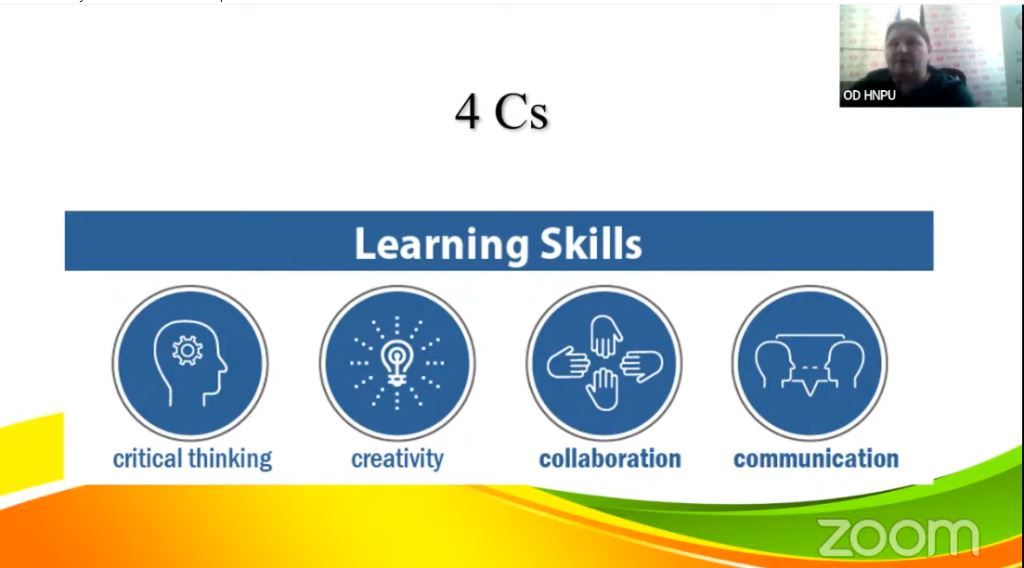
International Webinar 2023 - Visiting Lecture with Lecturer from Hlukhiv National Pedagogical University (Ukraine) – Part 3
International Webinar
Kembali ke Berita
International Webinar
Senin, 20 Februari 2023
Priyadi, S.Kom, M.Kom
0 Dilihat