
Problem solving is the process of achieving goals by overcoming obstacles, which is often part of most activities. Problems requiring solutions range from simple personal tasks (eg how to turn on an appliance) to complex problems in business and technical areas. The former is an example of simple problem solving (SPS) dealing with a single problem, while the latter is complex problem solving (CPS) with many interrelated constraints. Another classification is into well-defined problems with specific constraints and goals, and poorly defined problems where the current situation is distressing but it is not clear what kind of resolution to achieve. Similarly, one can distinguish formal or fact-based problems that require psychometric intelligence, versus socio-emotional problems that depend on modifiable individual or group emotions, such as thoughtful behavior, fashion, or choice of rewards.
Solutions require sufficient resources and knowledge to achieve goals. Professionals such as lawyers, doctors and consultants are mostly problem solvers for problems that require technical skills and knowledge beyond general competence. Many businesses have found profitable markets by identifying a problem and creating a solution: the more widespread and inconvenient the problem, the greater the opportunity to develop scalable solutions.
There are many specialized problem-solving techniques and methods in fields such as engineering, business, medicine, mathematics, computer science, philosophy, and social organizations. Mental techniques for identifying, analyzing, and solving problems are studied in psychology and cognitive science. In addition, mental barriers that prevent people from finding solutions are a widely researched topic: problem-solving barriers include confirmation bias, mental set, and functional persistence.
The term problem solving has slightly different meanings depending on the discipline. For example, these are mental processes in psychology and computerized processes in computer science. There are two types of problems: unclear and obvious; a different approach is used for each. A well-defined problem has a specific end goal and a clearly defined expected solution, whereas a poorly defined problem does not. A well-defined problem allows for more pre-planning than a poorly defined problem. Solving problems sometimes involves dealing with pragmatics, the way context contributes to meaning, and semantics, the interpretation of problems. The ability to understand what the ultimate goal of a problem is, and what rules apply is the key to solving problems. Sometimes problems require abstract thinking or creative solutions.
The material above was delivered by a presenter from Ukraine in a visiting lecturer held by STEKOM University in collaboration with Universities from Ukraine. The title of the presentation is "Learning Skills in 21st Century Education and Work Environment".
This international webinar activity is part of the implementation of STEKOM University's commitment to increase various international activities. This was done in order to realize the vision to become an international-class university. Various international activities carried out by STEKOM University continue from year to year. There are international activities that are sustainable and there are also some international activities that are not sustainable. All types of international activities are accommodated and regulated by the International department of STEKOM University.
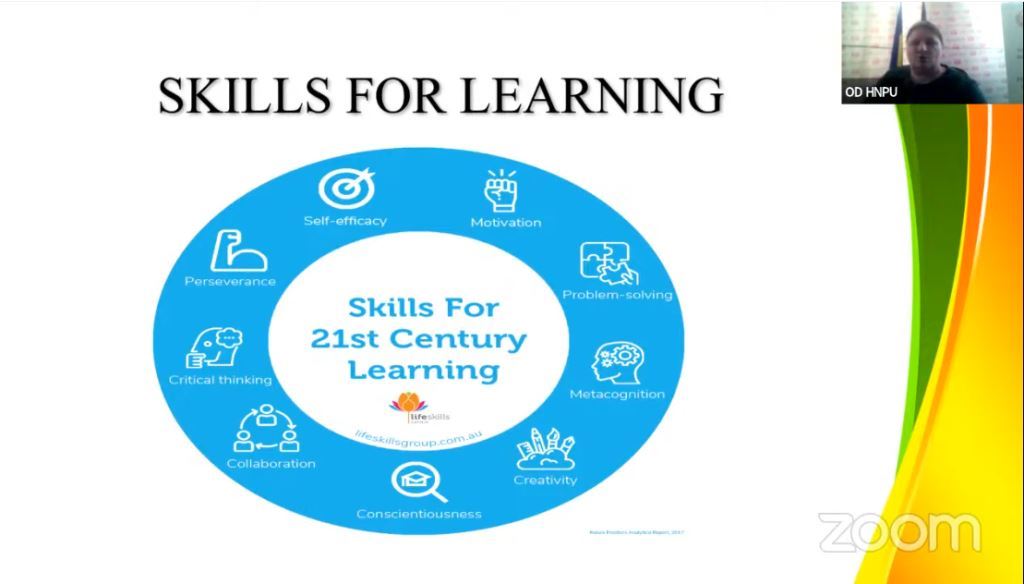
International Webinar 2023 - Visiting Lecture with Lecturer from Hlukhiv National Pedagogical University (Ukraine) – Part 7
International Webinar
Kembali ke Berita
International Webinar
Selasa, 21 Februari 2023
Priyadi, S.Kom, M.Kom
0 Dilihat