
Metacognition is awareness of one's thought processes and understanding of the patterns behind them. The term comes from the root word meta, which means "beyond," or "above." Metacognition can take many forms, such as reflecting on one's way of thinking and knowing when and how to use certain strategies for problem solving. In general there are two components of metacognition: (1) knowledge about cognition and (2) regulation of cognition. Metamemory, defined as knowledge about memory and mnemonic strategies, is a very important form of metacognition. Academic research on cross-cultural metacognitive processing is in its early stages, but there are indications that further research could lead to better results in cross-cultural learning between teachers and students. Writings on metacognition come from at least two works by the Greek philosopher Aristotle (384–322 BC): On the Soul and Parva Naturalia.
These higher-order cognitions have been labeled metacognition by the American developmental psychologist John H. Flavell (1976). The term metacognition literally means 'above cognition', and is used to denote cognition about cognition, or more informally, thinking about thinking. Flavell defines metacognition as knowledge about cognition and control of cognition. For example, people engage in metacognition if they realize they have more difficulty learning A than B, or if they think they should double-check C before accepting it as fact. J.H. Flavell (1976, p. 232). Andreas Demetriou's theory (one of the neo-Piagetian theories of cognitive development) uses the term hyper-cognition to refer to the processes of self-monitoring, self-representation and self-regulation, which are considered as integral components of the human mind. Moreover, with his colleagues, he demonstrated that these processes participate in general intelligence, along with processing efficiency and reasoning, which have traditionally been thought to make up fluid intelligence.
Metacognition also involves thinking about one's own thought processes such as learning abilities, memory skills, and the ability to monitor learning. This concept needs to be taught explicitly along with content instruction. Metacognitive knowledge is about a person's cognitive processes and understanding how to regulate those processes to maximize learning and decision making.
Some types of metacognitive knowledge will include:
- Content knowledge (declarative knowledge), namely understanding one's own abilities, such as a student evaluating his own knowledge of a subject in class. It should be noted that not all metacognition is accurate. Studies have shown that students often confuse lack of effort with understanding in evaluating themselves and their overall knowledge of a concept. Also, greater confidence in doing well is associated with less accurate metacognitive judgments of that performance.
- Task knowledge (procedural knowledge), namely how a person perceives the difficulty of a task in the form of content, length, and type of assignment. The studies mentioned in Content knowledge also relate to a person's ability to evaluate the level of difficulty of a task in relation to their overall performance on the task. Again, the accuracy of this knowledge skewed as students who perceived their path as better/easier also performed worse on evaluation, while students who were evaluated consistently and strictly reported less confidence but still performed better on their initial evaluation.
- Strategic knowledge (conditional knowledge) is a person's ability to use strategies to learn information. Young children are not very good at this; it is not until students are in upper elementary school that they begin to develop an understanding of effective strategies.
The material above was delivered by a presenter from Ukraine in a visiting lecturer held by STEKOM University in collaboration with Universities from Ukraine. The title of the presentation is "Learning Skills in 21st Century Education and Work Environment".
This international webinar activity is part of the implementation of STEKOM University's commitment to increase various international activities. This was done in order to realize the vision to become an international-class university. Various international activities carried out by STEKOM University continue from year to year. There are international activities that are sustainable and there are also some international activities that are not sustainable. All types of international activities are accommodated and regulated by the International department of STEKOM University.
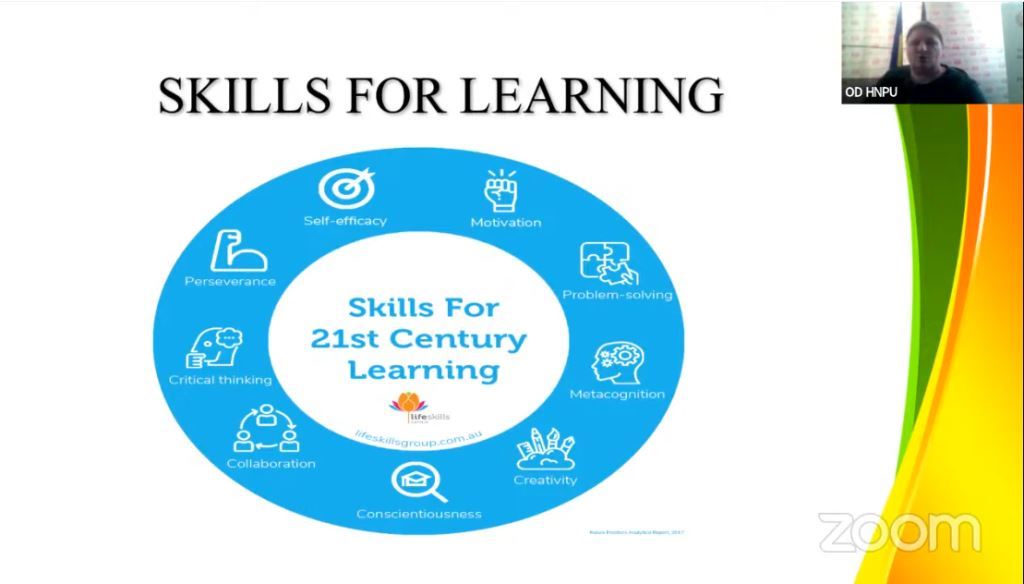
International Webinar 2023 - Visiting Lecture with Lecturer from Hlukhiv National Pedagogical University (Ukraine) – Part 8
International Webinar
Kembali ke Berita
International Webinar
Selasa, 21 Februari 2023
Priyadi, S.Kom, M.Kom
0 Dilihat