
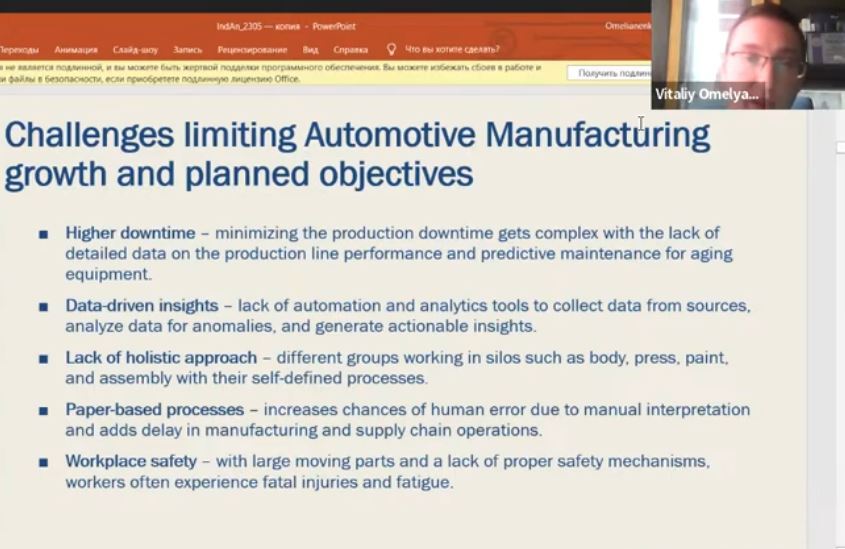
The automotive manufacturing industry has become the backbone of the global economy, but still faces a number of challenges that limit its growth. In order to achieve the planned growth goals, automakers need to overcome some of the key constraints that exist in this sector. Following are some of the main challenges and objectives planned to improve the automotive manufacturing industry.
One of the main challenges facing automotive manufacturers is higher downtime. Downtime, or production downtime, can be caused by machine breakdowns, equipment failures and inefficient maintenance. Every minute of downtime can have a significant impact on productivity and production costs. Therefore, automotive manufacturers need to focus on reducing downtime by carrying out better preventive maintenance, strengthening machine condition monitoring, and using predictive technology to detect potential breakdowns before they occur.
Furthermore, data-driven insights become an important objective in the growth of automotive manufacturing. The data generated by sensors, equipment and production systems can provide valuable insights into operational efficiency, product quality and machine performance. However, many automotive manufacturers still face challenges in managing and analyzing data effectively. Therefore, it is necessary to implement a system that is able to collect, integrate and analyze data in real-time to provide accurate and fast insights to decision makers at the operational and managerial levels.
The lack of a holistic approach is also a challenge that needs to be overcome. The automotive manufacturing industry is made up of complex and diverse supply chains, including component suppliers, car manufacturers and dealer networks. However, there is often a lack of coordination and collaboration among these stakeholders. In order to overcome this challenge, automotive manufacturers need to adopt a holistic approach that involves all related parties, from production planning, procurement, inventory management, to distribution and after-sales service. Thus, manufacturers can increase efficiency, reduce costs, and increase customer satisfaction.
In addition, paper-based processes are still widely used in the automotive industry, which causes low efficiency and high risk of errors. Documents such as purchase orders, invoices and reports are still often processed manually, which takes time and increases the likelihood of errors. To overcome this challenge, automotive manufacturers need to move to digital-based processes by implementing software solutions that enable automation and electronic integration of data. With the adoption of digital-based processes, manufacturers can increase operational speed, accuracy and transparency.
Occupational safety is also a significant challenge in the automotive manufacturing industry. Work environments involving heavy equipment, automated machines and hazardous materials pose a risk of accidents and injuries to workers. Therefore, automotive manufacturers need to pay serious attention to work safety by involving workers in safety training programs, improving equipment monitoring and maintenance, and implementing strict policies and procedures in order to create a safe and healthy work environment.
Overall, to achieve sustainable growth in the automotive manufacturing industry, manufacturers need to focus on addressing challenges such as higher downtime, applying data-driven insights, adopting a holistic approach, replacing paper-based processes with digital solutions, and improving work safety. By overcoming these challenges and executing the planned objective plans, the automotive manufacturing industry will be able to face the future with confidence and achieve higher levels of efficiency and productivity.
The above material was delivered by a presenter from Ukraine in an international webinar held by STEKOM University in collaboration with Kuala Lumpur University from Malaysia and Ukraine. The presenter's name is Omelianenko Vitalii. He is a Doctor of Economics as well as Associate Professor and head of the center for technology projects at Summy Makarenko State University. The international webinar was held on May 23 2023 which was hosted by Ms. Novita. The media used in the international seminar is zoom and broadcast directly to Youtube. The event went very well and was quite lively, marked by the many participants who took part and the number of questions asked after the presenters finished delivering their presentations.
This international webinar activity is part of the implementation of STEKOM University's commitment to increase various international activities. This was done in order to realize the vision to become an international-class university. Various international activities carried out by STEKOM University continue from year to year. There are international activities that are sustainable and there are also some international activities that are not sustainable. All types of international activities are accommodated and regulated by the International department of STEKOM University.
international Webinar - Industrial Analytics Driving Digital Information – part 8
International Webinar
Kembali ke Berita
International Webinar
Kamis, 13 Juli 2023
Priyadi, S.Kom, M.Kom
0 Dilihat