
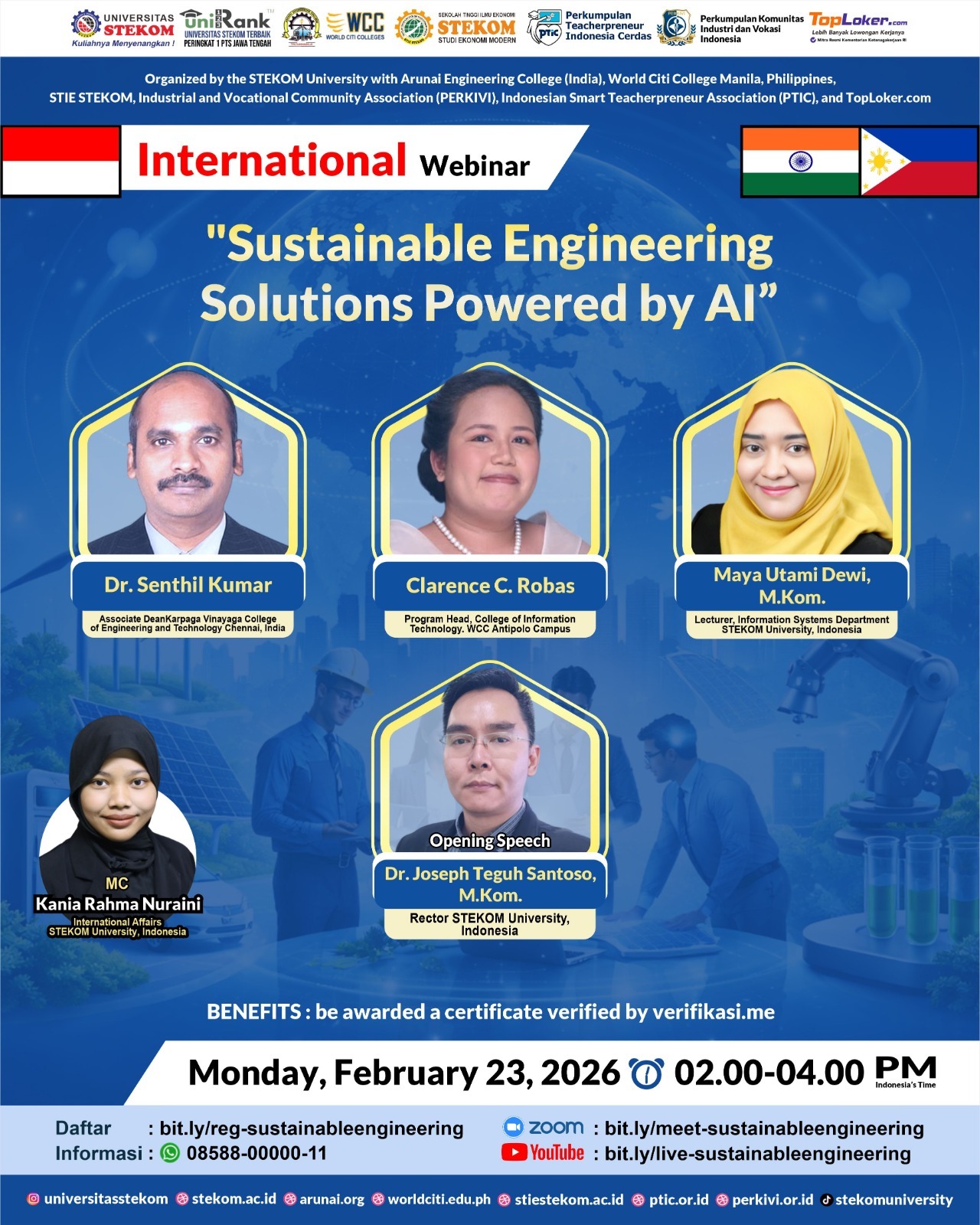
STEKOM University, Indonesia – International Webinar entitled “Sustainable Engineering Solutions Powered by Artificial Intelligence” brings together a number of International speakers to discuss in more depth the integration of artificial intelligence into sustainable engineering, navigating global challenges in energy efficiency, climate action, and the development of resilient and future-ready technological solutions.
Opening Address:
Risma Nurhapsari, S.E., M.Ak., CMM (Representative of the Rector, STEKOM University) Indonesia
Webinar Speakers:
1. Dr. Senthil Kumar (Associate Dean, Karpaga Vinayaga College of Engineering and Technology) Chennai, India
2. Clarence C. Robas (Program Head, College of Information Technology) WCC Antipolo Campus, Philippines
3. Maya Utami Dewi, M.Kom. (Lecturer, Information Systems Department) STEKOM University, Indonesia
MC:
Kania Rahma Nuraini (International Affairs) STEKOM University, Indonesia
The increasingly rapid development of digital technology and artificial intelligence has had a profound impact on human life and global engineering practices. As the world faces mounting challenges — including climate change, energy inefficiency, and the growing demand for resilient infrastructure; the integration of AI into sustainable engineering solutions has emerged as a critical pathway forward. AI-driven technologies open new possibilities for creating smarter systems, optimizing resources, reducing environmental impact, and building a more sustainable future. Beyond technical innovation, responsible and secure AI design is essential to ensure that these intelligent systems remain trustworthy, ethical, and aligned with global sustainability goals. This webinar brought together international experts to explore how artificial intelligence can power sustainable engineering solutions across multiple domains, and to share practical insights and frameworks for implementation.
The webinar was formally opened by Risma Nurhapsari, S.E., M.Ak., CMM, representing the Rector of STEKOM University, Dr. Joseph Teguh Santoso, M.Kom. In her opening address, she conveyed warm greetings and sincere appreciation to all distinguished speakers and participants. She emphasized that the theme of AI-driven sustainable engineering is both timely and profoundly relevant, as humanity faces pressing global challenges including climate change, energy efficiency, resource management, and sustainable development. She noted that the integration of artificial intelligence into sustainable engineering solutions has opened new pathways to create smart systems, optimize resources, reduce environmental impact, and build a more resilient future. She expressed confidence that the insights shared during the webinar would broaden participants’ understanding and inspire new ways of implementing AI-driven solutions in sustainable engineering practices. The webinar also welcomed Dr. Senthil Kumar (Associate Dean, Karpaga Vinayaga College of Engineering and Technology, Chennai, India), who participated in the discussion on sustainable engineering solutions powered by artificial intelligence.
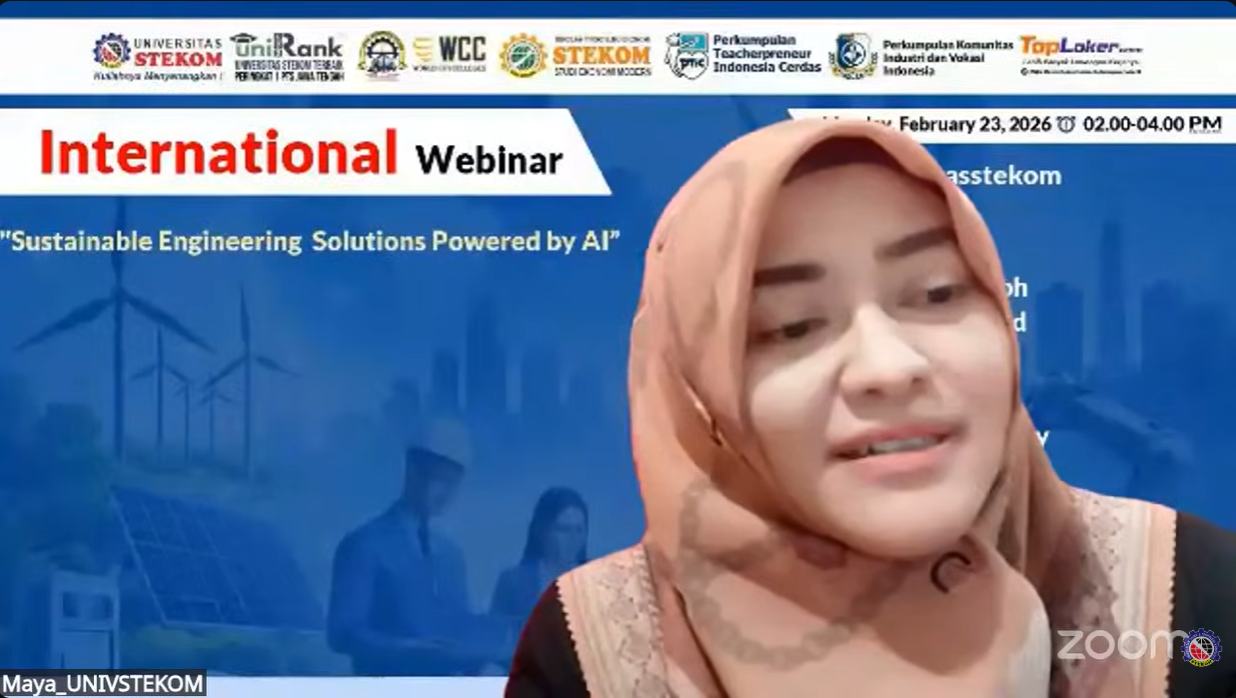
In this webinar, Maya Utami Dewi, M.Kom. (Lecturer, Information Systems Department, STEKOM University, Indonesia) delivered a presentation on Sustainable Intelligent Systems: Integrating Artificial Intelligence and Data Security for Future-Ready Engineering Solutions. In her presentation it was stated that sustainable intelligent systems are smart, data-driven systems that use artificial intelligence to optimize resources, reduce environmental impact, and support long-term economic and social sustainability. She explained that these systems are designed not only to be efficient and adaptive, but also to minimize energy consumption, support the Sustainable Development Goals (SDGs), and operate responsibly within complex engineering environments.
Maya Utami Dewi explained that modern engineering systems are highly complex and generate massive amounts of data, making AI indispensable for analyzing this data, predicting system behavior, optimizing energy use, and automating decision-making processes. Through AI, engineers can design solutions that improve efficiency, reduce waste and emissions, and enable predictive maintenance. She highlighted that AI plays a key role in achieving sustainability goals by enabling predictive analytics, intelligent automation, and system optimization across engineering sectors. Notably, AI-driven smart building systems have demonstrated the ability to reduce overall energy consumption by 25 to 30 percent through intelligent optimization of HVAC and lighting, while AI-driven grid management has achieved up to a 20 percent reduction in energy waste and a 15 percent improvement in operational efficiency.
On the importance of data security, Maya Utami Dewi emphasized that "without strong data security, AI systems are vulnerable to cyber attacks, data manipulation, and privacy violations.” She argued that responsible AI must ensure transparency, fairness, accountability, and alignment with human and environmental values, making sustainable engineering solutions safe, reliable, and socially acceptable. She also cited recent research published in Nature (2025) showing how machine learning was used to design an advanced cooling panel with high solar reflectivity and thermal emission, a material with the potential to reduce building surface temperatures by 5 to 20 degrees Celsius, significantly lowering air conditioning needs and cutting energy consumption for cooling.
Maya Utami Dewi further discussed the challenges of sustainable AI, noting that “sustainable AI faces several challenges including high energy consumption of AI models, limited data quality and availability, integration complexity, and ethical and security concerns.” She emphasized that engineers must balance performance, environmental impact, transparency, and data protection to ensure that AI-driven engineering solutions are truly sustainable and socially responsible. She concluded by presenting a practical implementation roadmap, from defining sustainability objectives and establishing a data security blueprint, to deploying AI models aligned with the SDGs and continuously monitoring performance and impact. In her closing words, she stated that:
“By uniting AI innovation with sustainability values and the Sustainable Development Goals, we can collectively shape a future where technology not only advances industry but also protects our planet and society.”
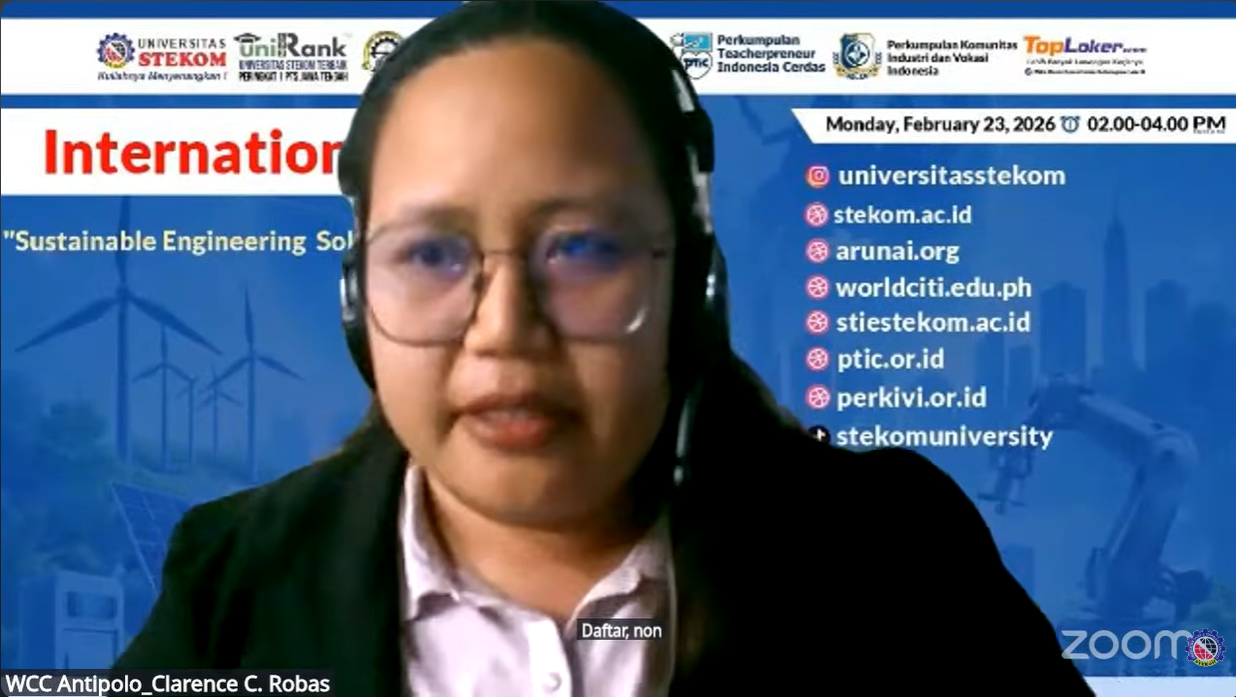
Furthermore, Clarence C. Robas (Program Head, College of Information Technology, WCC Antipolo Campus, Philippines) discussed the future of sustainable technology. In her presentation it was stated that as of early 2026, global progress toward the United Nations’ Sustainable Development Goals is progressing but slower than expected, with only approximately 18 percent of targets on track. According to his presentation, sustainable technology, defined as the use of technology to create products and solutions that meet current needs without hindering the future environment, is moving toward a pragmatic, operationally driven imperative, fueled by financial realism, energy security, and AI-driven efficiency. Clarence C. Robas explained that sustainable development involves the balancing of three key dimensions: social progress, environmental protection and enhancement, and economic development.
Clarence C. Robas presented sustainable technology applications across six key sectors. In construction and real estate, she cited One Central Park in Sydney, Australia; a 64,000 square meter complex celebrated for its vertical garden, as a landmark example of green building design, noting that it serves as “a lush and tranquil gathering space” while also cooling air ventilation around the building through its living green facade. He added that smart HVAC and lighting systems, using electrochromic glass and motion-sensor LEDs, are now widely deployed in business districts to reduce energy consumption. In agriculture and food, she highlighted IoT and AI-based smart irrigation systems that enhance agricultural productivity, as well as the Philippines’ ‘Drones for Rice’ initiative launched in April 2024, which uses drones to plant seeds, apply fertilizer, and spray pesticides, a development she described as more efficient especially for those farmers who are still using manual methods to manage their land.
In IT and data centers, Clarence C. Robas pointed to cloud computing as being capable of improving energy efficiency by up to 93 percent compared to local servers. She highlighted Sweden’s Echo Data Center, described as “climate positive data center”, a global first in emission reduction, aiming to make a fossil-free welfare country by 2045 and projected to expand to 2.13 billion pounds in value by 2029. She also discussed Microsoft’s Project Natick, an exploration of the feasibility of underwater data centers. In manufacturing, she showcased BMW’s digital twin factory in Regensburg, which provides a virtual real-time replica of the entire production site and has reduced planning time by nearly a third, leading to up to 30 percent reductions in energy and inventory. In retail and consumer goods, she highlighted Unilever’s AI-equipped IoT smart freezers that track inventory levels, temperature, and maintenance to reduce energy waste, a practical example of AI-driven supply chain sustainability.
Clarence C. Robas also shared real-world examples from her own institution in the Philippines, where students in the College of Information Technology are required to develop capstone projects aligned with the SDGs. She noted that one student developed a medical terminology application for nursing and medical students (aligned with SDG 4 – Quality Education), while another developed an AI-powered image recognition application for the National Museum of Anthropology in Manila, allowing tourists to point their phone camera at artifacts to instantly receive detailed information. She summarized that “There are a lot of applications of AI when it comes to tourism promotion,” and that image recognition is among the most compelling, bringing both educational and tourism promotion value. She also stated that:
On the question of IoT energy management system reliability in developing regions, a concern raised by participants during the Q&A session, Clarence C. Robas acknowledged that while IoT energy management systems can monitor electricity, detect power outages quickly, and support smart grids, “IoT energy management systems are promising and effective, but their reliability improves only when supported by a stable power supply, reliable internet networks, a backup system such as battery or edge computing, and proper infrastructure investment.” She concluded by affirming that the future of sustainable technology is promising, provided that innovation continues to be embedded within core business strategies, supply chains, and infrastructure.
"The future of sustainable technology is promising — it is becoming embedded into core business strategies, supply chains, and infrastructure, driven by financial realism, energy security, and AI-driven efficiency."

The webinar is closed with warm expressions of gratitude from the host to all speakers, participants, and the organizing committee whose dedication made the event possible. Participants were encouraged to carry forward the insights and connections gained, and to continue pursuing international collaboration beyond the boundaries of this virtual platform. The event exemplified STEKOM University’s commitment to advancing academic discourse, fostering global partnerships, and contributing meaningfully to sustainable development on the world stage.