
The development of information technology today is very helpful in the company's business. However, if we don't understand the type of technology needed, we might make the wrong choice of technology. Especially in the field of decision making for companies, there is one information technology product that is very helpful, namely a decision support system.
STEKOM university's efforts to have a global reach include holding webinars on an international scale. On this occasion we will discuss an international webinar held by STEKOM University in which one of the speakers is a professor from the United States. The resource person is Kaushik Dutta who is a Professor and School Director at the University of South Florida. Professor Dutta in his presentation delivered material on decision support systems which are IT products that are very useful in corporate business.
The material presented by Professor Dutta includes Framework, Applications for Business, Techniques, and Infrastructure. Because the material presented is quite long, the news article that discusses Professor Dutta's presentation is divided into several parts. We are currently entering part 6.2. If the reader wants to know the previous presentation, please see some of the previous chapters in the title of the same article.
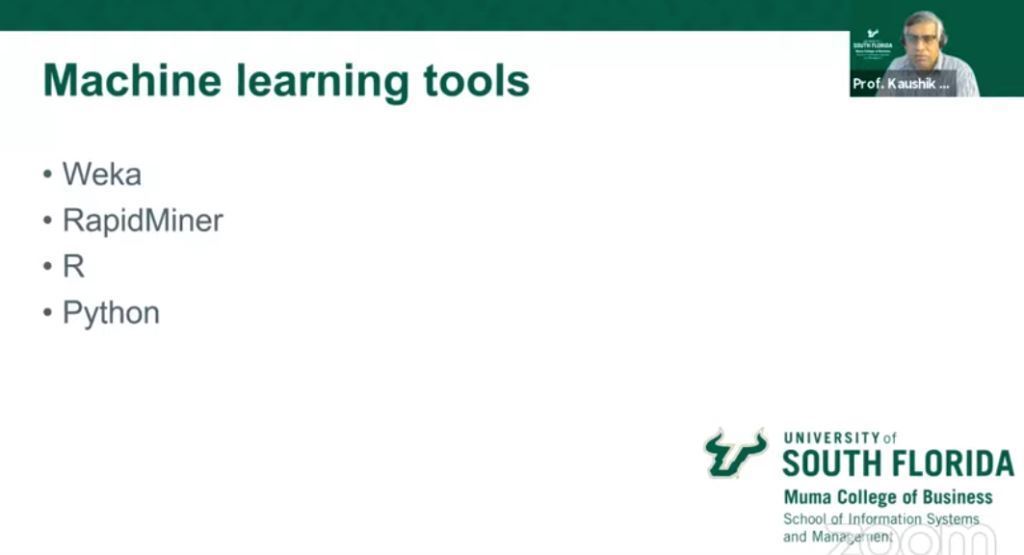
Continuing from the previous part, then Professor Dutta explained about various machine learning tools. Among them are Weka, Rapidminer, R, and Python. This time we will discuss about Rapidminer.
RapidMiner is a software that is open (open source). RapidMiner is
a solution for analyzing data mining, text mining and predictive analysis. RapidMiner uses a variety of descriptive and predictive techniques to provide users with insights so they can make the best decisions. RapidMiner has approximately 500 data mining operators, including operators for input, output, data preprocessing and visualization. RapidMiner is a stand-alone software for data analysis and as a data mining engine that can be integrated into its own product. RapidMiner is written using the Java language so that it can work on all operating systems.
RapidMiner was previously named YALE (Yet Another Learning Environment), where the initial version was developed in 2001 by RalfKlinkenberg, Ingo Mierswa, and Simon Fischer at the Artificial Intelligence Unit of the University of Dortmund. RapidMiner is distributed under the AGPL (GNU Affero General Public License) version 3. To date, thousands of applications have been developed using RapidMiner in more than 40 countries. RapidMiner as
open source software for data mining there is no need to doubt because this software is already leading in the world. RapidMiner was ranked first as a data mining software in a poll by KDnuggets, a data-mining portal in 2010-2011.
RapidMiner provides a GUI (Graphic User
Interface) to design an analytical pipeline. This GUI will generate an XML file (Extensible Markup Language) that defines the analytical process the user wants to apply to the data. This file is then read by RapidMiner to run the analyst automatically.
Written in the Java programming language so that it can run on various operating systems.
- The knowledge discovery process is modeled as operator trees
- Internal XML representation to ensure the standard format of data exchange.
- The scripting language allows for large-scale experiments and automation of experiments.
- Multi-layer concept to ensure efficient data display and ensure data handling.
- Has a GUI, command line mode, and Java API that can be called from other programs.
Some Features of RapidMiner, among others:
- Many data mining algorithms, such as decision trees and self-organization maps.
- Sophisticated graphical forms, such as overlapping histogram diagrams, tree charts and 3D Scatter plots.
- A large variety of plugins, such as a text plugin to perform text analysis.
- Provides data mining and machine learning procedures including: ETL (extraction, transformation, loading), data preprocessing, visualization, modeling and evaluation
- The data mining process is composed of nestable operators, described in XML, and created with a GUI
- Integrating Weka data mining projects and R statistics.
Continued....
Learning Data-Driven Decisions for Managers in New Style Companies with Professor Dutta from USA Part 6.2
International Webinar
Kembali ke Berita
International Webinar
Rabu, 2 November 2022
Priyadi, S.Kom, M.Kom
0 Dilihat