
The discussion on ICT Human Resource Development from Shuhei is very comprehensive and clear. However, the time required will also be longer. Therefore, we divide the news articles about these activities into several parts. This time you are reading part 2. If you want to know the previous explanation, please read part 1.
After explaining the IT-based business model with the example of the Amazon Go company, Shuhei then went into the next explanation with the example of the seven-eleven Japanese business model. In this business model, there is a Tanpin Kanri, which is a Stock Storage Unit. The stages of the business model start from sales data management. Sales data of each item is collected and analyzed, and orders are placed based on sales trends. Only the best-selling merchandise lines are stocked, while the required quantities and the poorly selling merchandise lines are not stocked. So that way sales can increase while reducing inventory at seven-eleven stores.
According to Shuhei, the POS system that supports the implementation of tanpin kanri must be implemented in stores and at the central unit. Sales data of seven-eleven data (goods, payment amount, date and time, and customer attributes) is collected and transmitted to seven-eleven headquarters with a POS list. Meanwhile at headquarters, sales data is analyzed and the results are sent to seven-eleven stores, distribution centers, and manufacturers.
The Information Analysis System at Headquarters also needs to be done well, according to Shuhei's explanation. The things that need to be concerned are about the utilization of large-scale databases and large-scale data analysis. The role of a large-scale database will later be to record POS data, assessment of various merchandise, business operating status, weather information, store location, etc. Meanwhile, large-scale data analysis will play a role for causality analysis, correlation analysis, and market basket analysis.
Shuhei then provided a comparison with systems analysis in the 1980s. Among the lessons learned from SIS in the 1980s was that ICT was the infrastructure of a new business model that increased the value of products and services. At that time the advantages of ICT-based business models were also not sustainable in the long term. Meanwhile, today's companies must continue to consider and achieve an effective ICT infrastructure that supports/enables new business models. So it becomes very important for business leaders to maintain and enhance the ability to create new CT-based business models based on business knowledge and ICT.
However, the emergence of various ICT products sometimes also presents its own problems to choose ICT products that are in accordance with the direction and needs of the company's development. So we need to know the important keys to ICT products that are currently developing. According to Shuhei, the ICT keys for the next successful business model are Artificial Intelligence (AI), Internet of Things (many), Connected Autonomous Vehicles, Robots, Blockchain, Big data, etc.
In the next explanation, Shuhei explained more about the use of robots in industry. Where many advanced industries are currently using robots. This was followed by various educational institutions to organize various programs that specifically studied various skills and development of students in the field of robotics. Then what happened in Japan, Shuhei explained further on the next presentation slide. However, because the explanation is quite long, we will present news articles about these activities in the next news article with the same title.
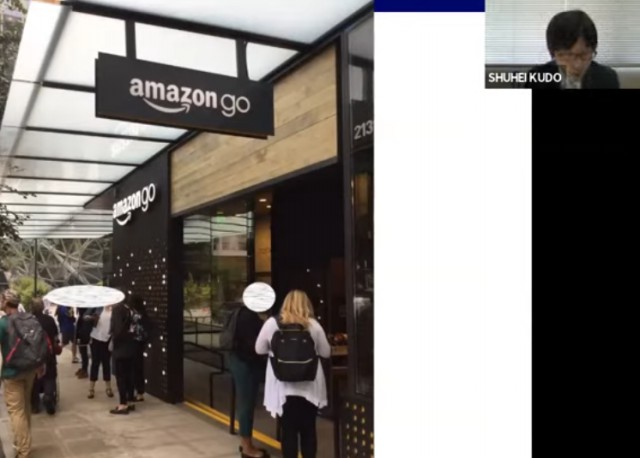
Learning ICT Human Resource Development for a new business model with Shuhei from Japan part 2
International Webinar
Kembali ke Berita
International Webinar
Minggu, 30 Oktober 2022
Priyadi, S.Kom, M.Kom
0 Dilihat