
The discussion on ICT Human Resource Development from Shuhei is very comprehensive and clear. However, the time required also becomes longer. Therefore, news articles about these activities for us are divided into several sections. This time you are reading part 3. If you want to know the previous explanation, please read part 1 and part 2.
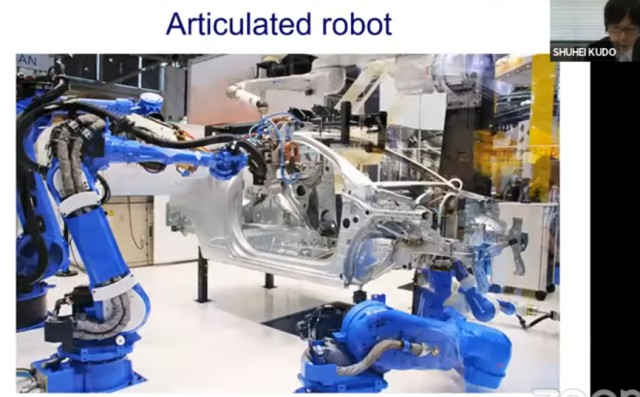
The initial explanation of robots by Shuhei in his presentation begins with various types of robots. In general, the explanation of the robot can be divided into two. The first type of robot is an industrial robot. In the industrial robot category, there are Articulated Robots and Robots that work on the installation of electronic component equipment. The second type of robot is a service robot. The types of service robots include logistics robots, medical treatment robots, social robots, home electrical equipment robots, and security robots.
Awareness of the importance of technology in supporting the industry makes various technology companies compete to meet the needs of the industry. The result is now emerging various industrial robot companies in various parts of the world. However, according to Shuhei, the four largest industrial robot companies are ABB (Switzerland), KUKA (Germany), FANUC (Japan) which works for Articulated robots for automobiles, and Yaskawa Electric (Japan) which works for Articulated and two-arm robots.
Users of industrial robots also spread in various industrial fields. However, according to the volume of domestic shipments in Japan (JARA Member Companies) described by Shuhei are the fields of cars, electrical machines, metal machines, and others.
The development of a good robot system must involve the industrial world which requires professionals in the field of Robotic system integrators. The robot system integrator conducts interviews about problems at the robot user's production work site, and then, designs and assembles the robot system according to the site to be developed.
Shuhei then explained the importance of robot human resources. The importance of robotic human resources includes the awareness that developing robotic human resources will become increasingly important for new business models in the near future. Educational robots for business use will also be increasingly needed by the community.
The many important things in the robotics industry inspire the world of education to study specifically the robotics industry. Many educational activities in Japan have held various classroom activities that support learning activities in the field of robotics. The implementation has been carried out in various cities and various educational institutions in Japan.
The purpose of various activities specifically studying robotics in Japan was explained by Shuhei. Among its aims were to support the reconstruction of the Great East Japan Earthquake; make students in Ishinomaki and beyond more interested in science, robotics, and manufacturing; Provide opportunities for young people including students at ISU to program and operate robots; Contribute to regional vitalization in Ishinomaki and beyond through robot programming education. Various class activities that have clear and targeted goals are expected to facilitate and motivate students and learn robotics as well as being real for the community.
The contents of the class activities were also well explained by Shuhei. For the materials, there are LEGO MINDSTORMS EV3 (hereinafter EV3), programming software and a laptop computer,
Assembly drawings and other teaching materials made by FCT. While the programs of the class include robot assembly (about 40 minutes), Programming robot (about 90 minutes), Robot Racing (about 40 minutes), Closing ceremony (about 10 minutes).
There are many more detailed explanations about robotics classes in Japan. From activities, learning materials, to simulation media, Shuhei's explanation looks very interesting. But what is very interesting is the outcome target of the robot programming class. The result of the robot programming class in Shuhei's explanation is that students can improve the following abilities:
- Basic knowledge and skills relevant to robot mechanics and programming
- Logical thinking for programming
- Cooperation, patience and identity
Students will also be able to contribute to the development of human resources capable of creating new business models based on robots or ICT in the Ishinomaki region in the future.
At the end of his presentation, Shuhei made several conclusions. The following is Shuhei's conclusion at the end of his presentation:
- ICT will continue to drive new business models and business models will continue to change the way we live
- Companies that are unable to respond to new ICT-based business models will find it increasingly difficult to survive
- It will be more important than ever to take the initiative in creating new businesses by combining business knowledge and ICT
- Universities need to provide the kind of education that will grow human resources capable of creating new business models based on new ICTs
Learning ICT Human Resource Development for a new business model with Shuhei from Japan part 3
International Webinar
Kembali ke Berita
International Webinar
Minggu, 30 Oktober 2022
Priyadi, S.Kom, M.Kom
0 Dilihat