
This news article is a continuation of previous news articles on the same event. If you want to know the event in its entirety, please save the related news sections. For part 1 news articles, click the following link https://international.stekom.ac.id/en-news-and-event/.the-first-day-of-the-cultural-exchange-of-stekom-university -Part 1. For part 2 which contains presentations from Kazakhstan, you can visit the following link: https://international.stekom.ac.id/en-news-and-event/the-first-day-of-the-stekom -university-cultural -change-part-2-culinary-and-traditions-kazakhstan. Part 3 of Uganda, can be seen via the following link: https://international.stekom.ac.id/en-news-and-event/.the-first-day-of-the-stekom-university-cultural-exchange -part-3-uganda-culinary-and-traditions. For part 4.1 of the first part of Ukraine, it can be seen via the following link: https://international.stekom.ac.id/en-news-and-event/.the-first-day-of-the-cultural-exchange-of -stekom-university-section-41-culinary-and-ukrainian-tradition. News article part 4.2 of the second part of Ukraine, can be viewed via the following link: https://international.stekom.ac.id/en-news-and-event/.the-first-day-of-the-cultural-exchange- from-stekom-university-section-42-culinary-and-ukrainian-tradition. News article part 5 can be visited via the following link: https://international.stekom.ac.id/en-news-and-event/.the-first-day-of-the-stekom-university-cultural-exchange-part -5-culinary-and-malaysian-traditions. News article part 6 which discusses Uzbekistan culinary and traditions can be visited via the following link: https://international.stekom.ac.id/en-news-and-event/.first-day-of-stekom-university-cultural- exchange-section-61-uzbekistan-cuisine-and-traditions. The news article part 7 which discusses the culinary and traditions of Brunei Darussalam can be visited via the following link: https://international.stekom.ac.id/en-news-and-event/.the-first-day-of-the-cultural -exchange-stekom-university-section-7-culinary-and-tradition-brunei-darussalam. News article part 8 that discusses Vietnamese cuisine and traditions can be visited via the following link: ttps://international.stekom.ac.id/en-news-and-event/.the-first-day-of-the-cultural- exchange-of-stekom-university-part-8-food-and-traditions Vietnam.
This cultural and culinary presentation is from a country located in northern Africa, namely Ethiopia. The presentation from Ethiopia was delivered by Hangandifhi Sipholi Manenzhe. At the beginning of the presentation, the presenter introduced an introduction to the land of Ethiopia. The Federal Democratic Republic of Ethiopia or Habsyi is a country located in Africa. The country is with Eritrea to the north, Djibouti to the northeast, Somalia to the east, Kenya to the south, South Sudan to the west, and the Republic to the northwest.
Ethiopia has one of the most complete histories as an independent nation on the continent. Here are the oldest countries in the world, the Ethiopian region is also one of the places of the earliest civilizations in the world. The first Ethiopian government was formed around 980 BC and accepted Christianity in the 4th century AD. This country is quite unique when compared to other African countries because it was never colonized during the Scramble for Africa and remained independent until 1936 when Italian troops took control of the country. the. The British and Ethiopian armies defeated the Italian army in 1941 and Ethiopia regained its strength after signing the Anglo-Ethiopian Treaty in December 1944. Ethiopia was formerly known as Abyssinia.
Today, Ethiopia is a republic and takes an active part in international cooperative activities. Its capital city, Addis Ababa, is the administrative center of the African Union (AU).
Ethiopia still uses the Julian calendar so the country will open an event to welcome the third millennium based on the calendar calendar. This country in the Horn of Africa uses the Julian calendar which is about 7 years behind compared to the Gregorian calendar which is more commonly used worldwide.
The name "Ethiopia" is said to have come from "Ityopp'is", the name of the descendants of Ham, who formed the city of Aksum. The old name "Abbesinians" or "Habsyah" comes from the Habesha tribal group, the people who have inhabited the Ethiopian region since 3000 BC.
In his presentation, Sipholi said that of the 11 states, Oromia is one of the largest & most populous states closest to the capital (Addis Ababa). Sedankan Oromia State University is the only public university in the country (even in East Africa), which is located 160 KM away from the Capital City.
Oromia has so many traditional cultures either in the form of rituals or events, culinary/food, style of dress/clothing. Here is an explanation of some of them:
1. Irreecha (Thanksgiving), is a traditional ceremony, which is celebrated twice a year as an event of thanksgiving to Waaqaa (God), the Most High who is believed among the Oromo. the Irreecha Birraa (Malkaa) Festival, which is celebrated in September to show brightness and hope; Although sometimes, Irreecha Arfaasaa is usually celebrated in April to thank God for having passed the dry season. The Irreecha Festival is one of the most interesting tourist attraction events in Oromia.
2. Gaaa Power Transfer Ceremony. Gadaa is a traditional system of government that reflects aspects of the core culture of the Oromo people and local wisdom and wisdom. This ceremony is an innate system of government that the Oromoo have developed and used over the centuries. Gadaa is an egalitarian system of government in which power is transferred through peaceful means and this ceremony of handover of power is called Baallii Kennuu (Giving Balli). As long as Balli is transferred / given a lot of rituals that can be done. The peaceful way of transferring power and the rituals performed in this ceremony are a source of tourist attraction.
Next, Sipholi talked about traditional food. There are many traditional foods among the Oromoo. This traditional food is prepared at weddings, holidays and other ceremonial occasions for special blowing and other purposes. Of the many traditional Oromoo foods, here are some of them.
A. Buna Qalaa
Buna Qala (Slaughtered Coffee) is a coffee food made from dried coffee cherries by cooking them in butter after being properly washed and cutting off the ends of each coffee bean with teeth, this is unique to Oromo.
B. Cunboo/Chororsa
Cunboo is one of Oromoo's cultural foods. It is made with brown teff flour, cheese, chili, butter, black cardamom and salt.
C. Anchote (Coccinia Abyssinica)
Coccinia Abyssinica is a root vegetable.
And lots of other unique and interesting traditional foods from Ethiopia. Sipholi also presented a variety of traditional clothing in Ethiopia visually. The traditional clothes displayed are very unique and attractive with various eccentric colors.
Sipholi also delivered a presentation on natural resources in Ethiopia. According to him, Oromia has many natural resources that attract tourists. Among these natural resources, some of them are as follows:
A. Forest area: .vYavo forest and others
B. Rivers and Waterfalls
For example Awash River, Abay River (Blue Nile), Wabe Shebele, Gennale River, Gibe River, Dhedhessa River, Sor River, Gabba and Dawa Rivers are some of them.
C. Lakes: Lake Wenchi, Arsadi and Rift Valley (Dambal, Langano, Hawassa, Shala, Abiata and Racana).
D. Cave System: eg Sofumar Cave.
After explaining the nature of Ethiopia above, Sipholi ended his presentation. Sipholi's presentation was very good, complete and simple so that it was easy for the participants to understand.
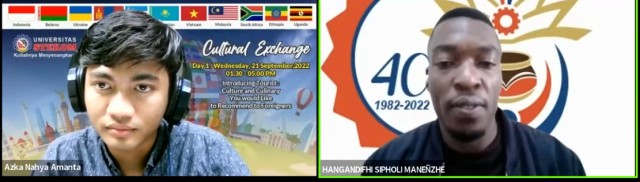
The first day of STEKOM University Cultural Exchange Part 9 (Ethiopian Culinary and Traditions)
International Webinar
Kembali ke Berita
International Webinar
Selasa, 18 Oktober 2022
Priyadi, S.Kom, M.Kom
0 Dilihat