
This paper is a continuation of the previous articles entitled “The first day of the Cultural Exchange of STEKOM University part 1” and “The first day of the STEKOM University Cultural Exchange Part 2 (Culinary and traditions of Kazakhstan)”. If you first read part 1 of the same webinar, please click the following link https://international.stekom.ac.id/en-news-and-event/.the-first-day-of-the-cultural- exchange-of-stekom-university-part-1. For part 2 which contains presentations from Kazakhstan, you can visit the following link: https://international.stekom.ac.id/en-news-and-event/the-first-day-of-the-stekom-university-cultural -exchange-part-2-culinary-and-traditions-of-kazakhstan. As for part 3 from Uganda, it can be seen via the following link: https://international.stekom.ac.id/en-news-and-event/.the-first-day-of-the-stekom-university-cultural- exchange-part-3-uganda-culinary-and-traditions.
The presenter from Ukraine was Yuliia Lishchik, from Ternopil Volodymyr Hnatiuk National Pedagogical University (TNPU), Ukraine. Before listening to the material presented by Yuliia, it is better for us to know about TNPU. TNPU is a university located in Ternopil, Ukraine. TNPU provides science and humanities courses with a focus on education and teaching. It offers postgraduate degrees mainly in teaching and the theory behind it.
Ternopil National Pedagogical University named after Volodymyr Hnatyuk is the oldest university in Ternopil. On October 1, 1805, a gymnasium was opened in Krzemieniec, which in 1818 was converted into a secondary school. In 1831 it was closed, and the secondary school material base became the main base for founding the University of St. Vladimir in Kiev (currently Taras Shevchenko National University Kiev). Then in 1920 he returned to work.
Subsequently on April 15, 1940, the Krzemieniec Institute of Teachers was opened, which on August 4, 1950 was transformed into a pedagogical institution. In 1969, the institution was transferred to Tarnopol. In 1989, a secondary school with a physical and mathematical profile was opened, and in 1991, postgraduate studies. In 1997, the Pedagogical Institute in Ternopil was reorganized into a university and named after Volodymyr Hnatyuk. In 2004, it obtained the status of a state university.
A little information for readers who do not understand about pedagogy. Pedagogy is the science or art of being a teacher. This term refers to learning strategies or learning styles.
Pedagogy also sometimes refers to the proper use of teaching strategies. In connection with the teaching strategy, teaching philosophy is applied and influenced by background knowledge and experience, personal situation, environment, and learning objectives formulated by students and teachers. One example is the Socratic school of thought.
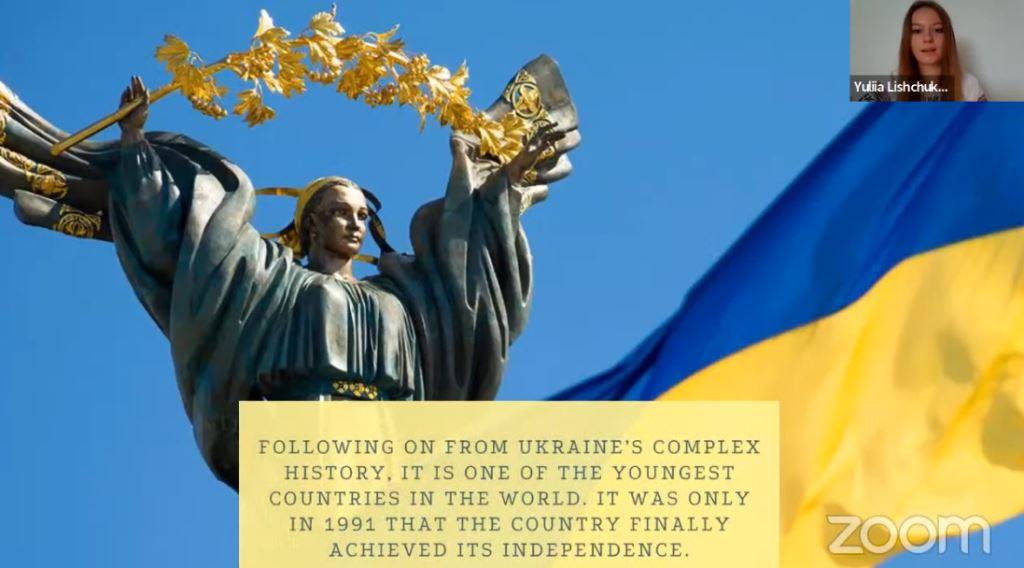
Back to the presentation topic, we will discuss Yuliia's presentation about tourism and culinary in Ukraine. In her presentation, Yuliia said “Ukraine is a country known for its beautiful and diverse landscapes, well-preserved culture and traditions, beautiful women and the invincible spirit of our strong men, whose courage knows no bounds.” It seems, for beautiful women, in this case the author agrees.
Furthermore, Yuliia explained that Ukraine is the largest country in Europe. In her explanation, Yuliia said that this country covers an area of 603,628 square kilometers. The state administration is divided into 24 oblasts. The country is not only a very large country, but also a very unique and interesting country. From the picturesque Carpathian Mountains offering scenic views of forests, rivers and valleys, to the beaches found near the city of Odesa and vibrant cultural cities like Kyiv and Lviv.
Regarding the language in Ukraine, Yuliia explained that the Ukrainian language has the following interesting things:
1. Is the 3rd most beautiful language, behind French and Persian;
2. It is the second most melodious language, behind Italian.
3. It is one of the most widely spoken languages in the world (26th in the world).
4. The oldest mention of the Ukrainian language dates back to 858.
5. The first Ukrainian ABC book was printed in 1574 in Lviv 7.
Regarding the song, Yuliia explained that many people don't know about the worldwide fame, i.e. the Christmas carol "Carol of the Bells" was actually written by Ukrainian composer Mykolai Leontovych (known in Ukraine as "Shchedryk"). The bandura, kobza and lira are the national instruments of Ukraine, which are commonly used for this purpose.
Next, Yuliia gave a presentation about folk dances in Ukraine. In her presentation, Yuliia said that traditional Ukrainian dances (hopak, polka, cossachok) and music mostly dates back to the Cossack era. Hopak describes a kind of dialogue in which men show their character, strength and courage, and women show their grace and beauty. The beauty of Ukrainian dance grows with colorful folk costumes and melodic musical accompaniment.
Yulia also explained interesting and unique things about Christmas in Ukraine. Christmas in Ukraine is a family holiday when all relatives gather together. Unique and interesting things that are there are a festive table with 12 Lenten dishes to represent each apostle (Svyata vecherya), sin songs, remembering all the good things that happened in the past year, and wishing every Admumnmloaiiaa and happiness. They also sing Kolyadnyky (singer) Christmas carols while going to neighboring yards and houses, singing Christmas carols, and wishing prosperity and health to all family members. Among Ukrainians, the belief is that the more Kolyadnyky that comes to your residence, the better and fruitful the year will be.
The next unique tradition that Yuliia told which is still related to the Christian tradition is coloring Easter eggs. The tradition of painting eggs for Easter there is called pysanka which is Ukrainian Easter eggs, namely eggs decorated with different colors using the wax-resist method. The verb pysaty (iimcatu) means "to write", as designs are written on eggs with beeswax, not painted.
The exciting story about Ukraine from Yuliia is not over. Next, Yuliia tells the story of a spring day. Spring is also a period of awakening human feelings according to Ukrainian society. The ceremony was directed at the entertainment of young people: fortune-telling, guarding, ritual singing of vesnyanky, hayivky (Slavic ritual songs to call spring), and playing circle dances. This event is very lively when we visit directly there.
The next story about Ukraine that Yuliaa told seemed more attractive, namely the tradition of jumping over the bonfire. Kupala Night is a holiday associated with the period
the summer solstice in the beliefs of some Ukrainians. The event is celebrated on the evening of July 7th. During this time, according to legend, many magical plants grew. Girls throw garlands in water. Another important ritual is burning a bonfire. A very exotic tradition that exists in Ukraine.
The many interesting and unique things that were told about Ukraine by Yuliia made the participants not get bored immediately following the international webinar. Next, Yuliia talked about the wedding culture in Ukraine. This topic is very interesting for students, especially those who are approaching wedding plans. In her presentation, Yulia shared that Ukrainians tend to wear a wedding ring on their right hand. The reason is that the left hand is considered "unclean". It is not suitable to wear a symbol of eternal love on a married couple. The right hand, on the other hand, is a symbol of power, positive change and knowledge, and was highly respected by the ancestors. This tradition is more similar to most cultures in Asia, especially those which are predominantly Muslim, than to the European tradition in general.
Yulia keeps telling me amazing things about Ukraine. Next, Yuliia tells about the world's largest sunflower seed garden located in Ukraine.
Ukraine is the world's largest producer of sunflower seeds. It is estimated that the total size of the Ukrainian sunflower farm could cover the whole of Slovenia.
Next, Yuliia told about the heaviest airplane in the world in Ukraine. The An-225 "Mriya" ("Mriya" translated as "dream") is the heaviest aircraft ever built, with a maximum take-off weight of 710 tonnes. It holds the record for total air payload weighing 559,580 pounds. It was built in Kyiv, Ukraine. It also has the largest wingspan of any functional aircraft in existence.
Yuliaa's follow-up presentation is something that makes me hungry, which is about Ukrainian food. Traditional Ukrainian foods include chicken, pork, meat, eggs, fish and mushrooms. Ukrainians also tend to eat lots of potatoes, oats, and fresh and pickled vegetables. Ukrainian cuisine is very varied and enjoyable. The diversity of ethnic minorities and rich multicultural history also influences the variety of different foods on the Ukrainian table. Here is an explanation of some traditional Ukrainian foods:
1. Borsch
The most famous Ukrainian dish is borscht. It consists of a soup made from beets, cabbage, and potatoes; true borscht also contains meat, most commonly, pork.
2. kutia
Kutia is the main dish on the Christmas table. This dish is made with oats or barley (wheat substitute) and poppy seeds, walnuts eaten with honey sauce. A series of related rituals with kutia is to prove the relationship with family and ancestors who take care of the harvest.
3. Palianitsia
Palyanytsya is a type of Ukrainian toast, mostly made from wheat flour in a home oven. Hearth yeast bread has a semicircle cut in the top third of the loaf. The word palyanytsya is used as an important shibboleth test in Ukrainian, to identify people whose Ukrainian language is not native and who are not phonetically familiar.
The first day of the Cultural Exchange of STEKOM University part 4.1 (Culinary and Ukrainian traditions)
International Webinar
Kembali ke Berita
International Webinar
Senin, 17 Oktober 2022
Priyadi, S.Kom, M.Kom
0 Dilihat